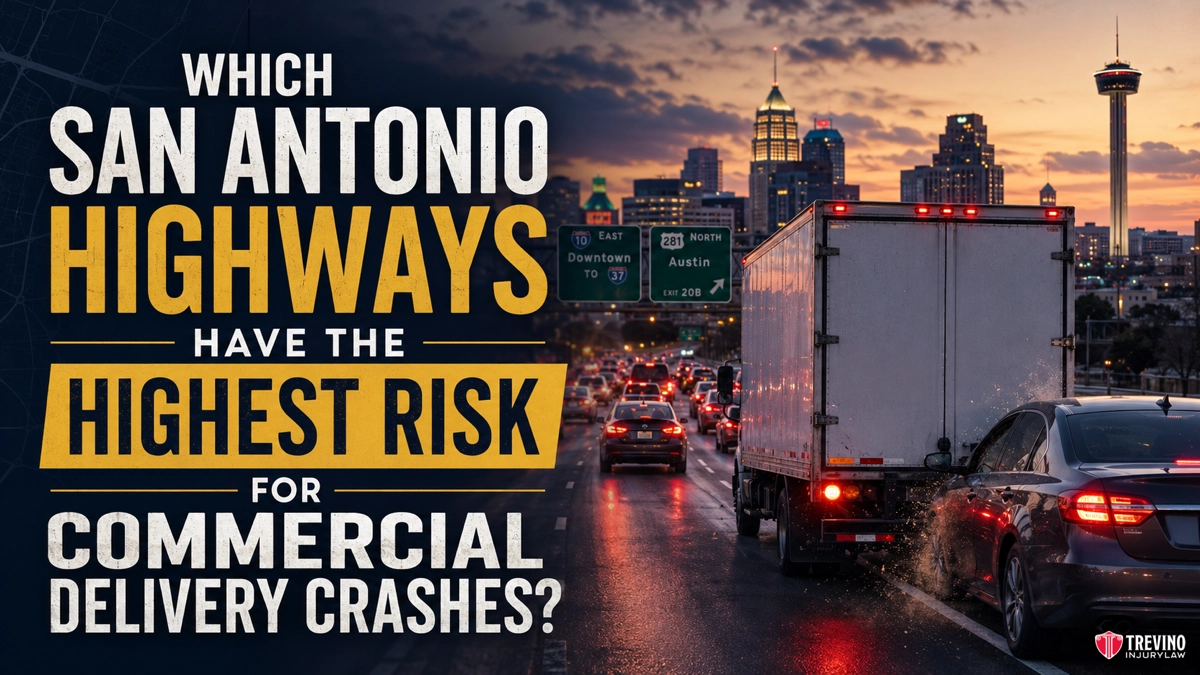
Dense highway interchanges and major commuter loops carry the highest risk of commercial delivery crashes in San Antonio. Rapid local lane merges force standard passenger vehicles to collide with heavy international freight lines moving through the city core.
The commercial insurance adjuster assigned to your case is already blaming local traffic patterns and sudden stops rather than admitting their driver was tailgating to meet a strict e-commerce routing schedule.
According to the Texas Department of Transportation, Bexar County recorded 2,684 commercial motor vehicle crashes in 2024. Behind these wrecks is a corporate fleet prioritizing aggressive delivery quotas over basic public safety.
What Could Your Commercial Delivery Accident Case Be Worth?
Answer a few quick questions about your accident. Takes about 60 seconds.
See What My Case Might Be WorthThe insurance company offered less than $20,000. I ended up with over $1 million. — Jackie Galindo
Physical evidence vanishes within days once the roadway is cleared and the damaged fleet vehicle undergoes repair. A Spoliation Letter, a legal demand that prevents the corporate carrier from destroying evidence, must be sent immediately to lock down electronic black box records and digital dispatch logs. Texas gives you two years to file the lawsuit.
Trevino Injury Law, truck accident lawyers map the collision route and work to secure relevant telemetry before it disappears.. Call 210-TREVINO now for a free case review. You pay nothing unless we win. Se Habla Español.
Which Freeway Has the Most Deaths in San Antonio?
Interstate 35 has the highest number of commercial vehicle fatalities within San Antonio city limits, serving as a dangerous transportation corridor where rapid local lane merges often collide with heavy international freight moving from South Texas toward northern distribution hubs.
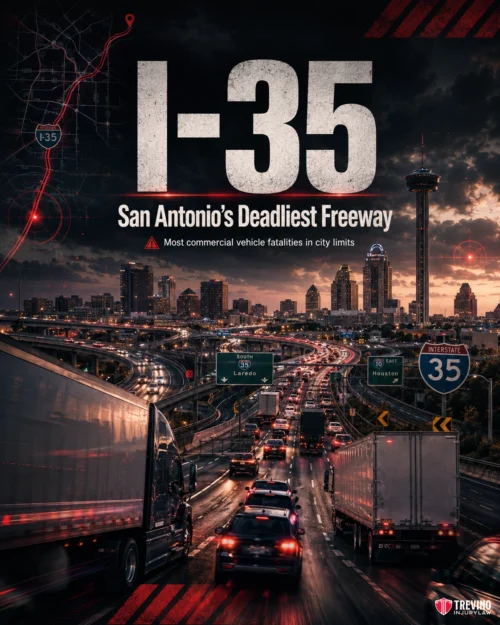
This detailed geographic analysis expands upon general local transit hazards by isolating the exact infrastructural designs that make Interstate 35 through downtown San Antonio so lethal. When massive 18-wheelers mix with fast-moving local delivery fleets near the lower-level splits, the resulting weight disparities and restricted visibility consistently lead to catastrophic outcomes for local commuters.
Navigating San Antonio’s busiest corridor becomes particularly dangerous when high traffic volume and sudden heavy traffic force drivers into split-second maneuvers. The sheer density of commercial traffic combined with unpredictable highway speeds makes this roadway one of the most hazardous in the region. In fact, one leading cause of severe vehicle accidents here is rapid lane changes near outdated entrance and exit ramps, leaving standard passenger vehicles highly vulnerable.
Aggressive driving and exhaustion among commercial truck drivers on long routes also significantly increase the risk of a major collision. When these crashes occur, they almost always result in serious injuries or fatalities due to the massive weight disparity. Navigating the aftermath of an incident on a San Antonio roadway can be overwhelming. As a result, many victims consult a specialized injury lawyer to evaluate their legal options, protect their legal rights, and pursue fair compensation in complex truck accident cases.
Where Do Most Crashes Occur in San Antonio?
Most high-impact commercial delivery crashes occur at primary highway interchanges where local commuter traffic intersects major interstate shipping corridors, creating volatile bottleneck zones that exhausted corporate fleet drivers often fail to navigate safely during peak rush hours.
Specific high-injury collision zones include:
- The Mixing Bowl interchange where Interstate 35, Interstate 10, and US-90 converge near the central core.
- The northern arc of Loop 1604 at the heavy retail intersections near Alamo Ranch and La Cantera.
- The high-volume merge points on Loop 410 near the San Antonio International Airport.
Understanding the specific intersections where these severe fatalities cluster naturally leads to questions about how suburban commuter congestion affects collision rates in commercial fleets.
What Part of San Antonio Has the Worst Traffic?
The North Side and Northwest Side of San Antonio experience the worst traffic congestion, especially along the rapidly expanding commercial corridors of Loop 1604 and Interstate 10 West, where intense commuter gridlock regularly traps aggressive delivery drivers operating under strict corporate quotas.
Rapid suburban growth around affluent residential areas like Stone Oak and sprawling developments like Alamo Ranch forces massive delivery vans, Amazon step-vans, and FedEx box trucks to share narrow, hyper-congested spaces with local families. This intense street-level density significantly increases your risk of suffering a catastrophic rear-end collision during peak e-commerce fulfillment windows.
Infrastructural Bottlenecks: Driver Fatigue and Following Distance on Loop 410
Sudden traffic standoffs along Loop 410 routinely cause catastrophic rear-end collisions because heavy commercial delivery trucks require twice the stopping distance of a standard passenger vehicle. In Texas, the duty to maintain an ‘assured clear distance’ to avoid a rear-end collision is a fundamental rule of the road.
When a fatigued trucker fails to stop, we use these established legal standards to prove they breached their basic duty of care. During aggressive settlement negotiations, standard insurance adjusters routinely try to blame local commuter traffic patterns rather than admitting their drivers were tailgating. To combat this defensive tactic, we must ask: what does the 3-second rule tell you?
This foundational technical driving standard dictates the minimum safe following distance between vehicles, which delivery dispatchers systematically compel their commercial drivers to violate to meet demanding e-commerce routing schedules on our congested inner loops.
Recognizing how extreme local traffic density leads to catastrophic following-distance violations lays the foundation for examining how broader statewide trade volumes amplify these neighborhood dangers.
What Highway in Texas Has the Most Accidents?
Interstate 35 holds the record as the most accident-prone highway corridor in Texas, serving as the primary, highly volatile statewide artery for international land-based shipping, where massive commercial trucks constantly endanger local motorists amid extreme congestion and frequent lane shifts. Heavy freight volumes continuously move northward from the border in Laredo straight through the heart of San Antonio, creating unprecedented strain on local infrastructure.
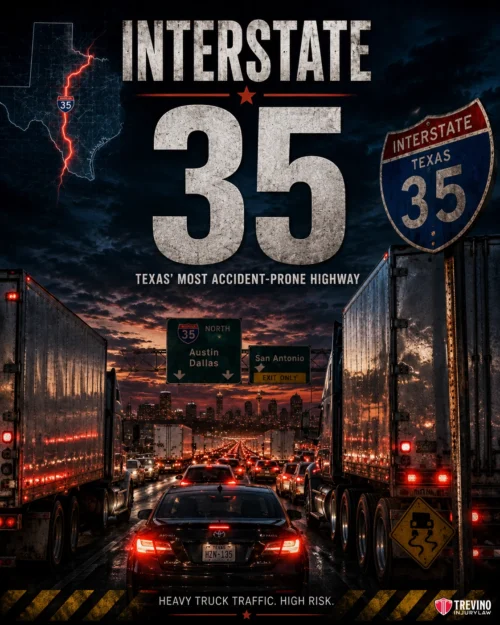
When massive, long-haul commercial trucks mix with rapid-stop local delivery fleets on outdated interstate crossing designs, the environment becomes a hotspot for severe injuries and complex jurisdictional liability battles.
What Is the Safest Highway in San Antonio?
No local highway corridor can be considered completely safe from commercial delivery vehicle hazards, though newer, multi-lane stretches of State Highway 151 offer slightly lower overall crash frequencies when compared directly to the heavily restricted, older interstate loops found near the central downtown core.
Modern highway designs with wide safety margins temporarily protect commuters, but delivery vehicles that rapidly enter and exit nearby local shipping centers quickly erase these structural advantages. To effectively hold these negligent corporations accountable for exploiting higher-risk shortcuts across our city, victims must seek immediate guidance by hiring a specialized San Antonio delivery truck accident lawyer who understands commercial vehicle litigation and deep geographic liability mapping.
While evaluating the varying safety levels of our local structural corridors is critical, identifying the specific human behaviors that turn these highways deadly determines how we build your case for maximum compensation.
What Is the Number One Killer to Avoid in San Antonio Corridors?
Excessive speed combined with severe commercial driver distraction represents the number one lethal hazard on San Antonio highways. The sheer volume of these wrecks is staggering; according to the Texas Department of Transportation (TxDOT), Bexar County recorded 2,684 commercial motor vehicle crashes in 2024, making it the third most dangerous county in Texas for large-truck collisions. This harsh reality forces local families to pay the ultimate price for corporate delivery companies that prioritize aggressive delivery quotas over basic public safety.
When these multi-billion-dollar carrier fleets impose unrealistic delivery windows, their drivers routinely speed through high-risk corridors such as Loop 410 and Interstate 35 while constantly checking handheld dispatch devices and navigation apps. When a multi-ton commercial truck impacts a local motorist at high speed under these conditions, the physical trauma is frequently catastrophic and life-altering.
Proving this pattern requires immediate action after a delivery truck crash to preserve available digital evidence such as dispatch logs and black-box records. Knowing how these corporate drivers behave on our roads is only half the battle, as understanding how local authorities record these actions provides the legal foundation for proving your personal injury claim.
How Does Local Law Enforcement Document Commercial Highway Collisions?
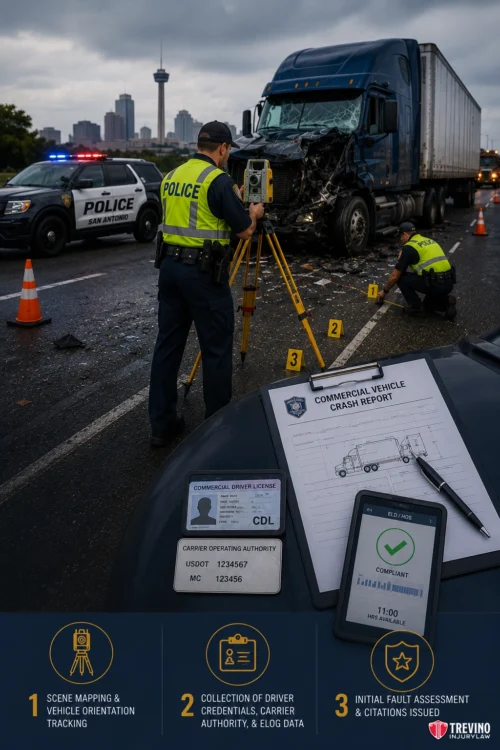
Law enforcement officers use specialized commercial vehicle crash reports to document scene metrics, mechanical compliance, and driver log violations after a highway collision, creating an objective data baseline that helps establish corporate fault. When responding officers arrive at a severe wreck site, they follow structured investigative protocols to ensure all vital tracking data is securely preserved for insurance and civil court review.
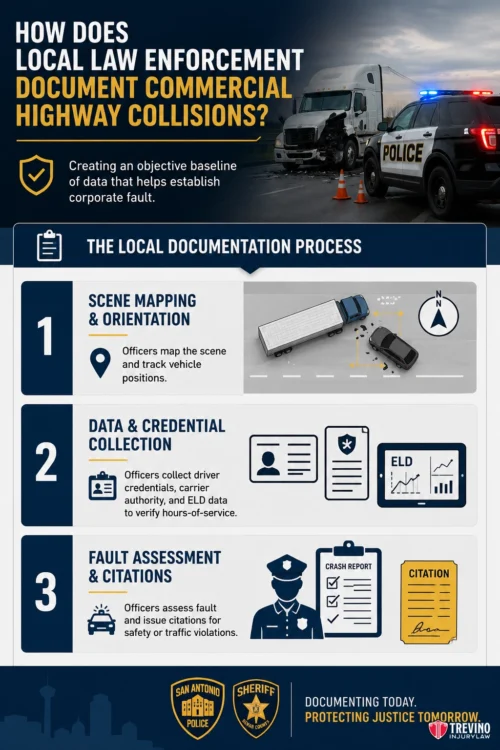
Local documentation procedures follow this strict, sequential process:
- Responding San Antonio Police officers or Bexar County Sheriff’s Office personnel conduct immediate scene mapping and vehicle orientation tracking.
- Officers must collect commercial driver credentials, carrier operating authority numbers, and electronic logging data to track hours-of-service compliance.
- Responding units complete an initial fault assessment and issue formal citations for commercial safety infractions or local traffic violations.
Do I Need a Police Report to Prove Fault for a Highway Delivery Crash?
Yes, obtaining an official police report is vital because it establishes an authoritative, third-party record of the collision scene and contains essential commercial insurance identification data.
Can a Delivery Company Escape Liability if the Crash Happened on a State-Maintained Loop?
No, a delivery carrier remains fully liable under Texas law for its driver’s negligence, regardless of whether the crash occurred on a municipal street, a state loop, or a federal interstate highway. This corporate accountability is rooted in the doctrine of respondeat superior. The Texas Supreme Court firmly reinforced this standard in Painter v. Amerimex Drilling I, Ltd., 561 S.W.3d 125 (Tex. 2018), which definitively holds that employers are vicariously liable for the negligent acts of their employees committed within the course and scope of their employment. We aggressively leverage this precedent in court so that commercial carriers cannot dodge financial responsibility for the destruction their drivers cause on Bexar County roads.
Commuter Loops vs. Intrastate Freight Lines: Comparing Delivery Truck Crash Risks
Comparing local commuter loops with primary interstate freight routes reveals distinct operational patterns, vehicle profiles, and collision risks for commercial delivery claims. These differences directly influence how a personal injury firm gathers evidence and targets liability.
| Route Type | Primary Vehicle Profile | Core Crash Drivers | Legal & Operational Focus |
| Commuter Loops (e.g., Loop 410, Loop 1604) | Delivery vans, box trucks, parcel step-vans | Unrealistic quotas, sudden stops, driver distraction | Local fleet employment records, routing software data, cell phone records |
| Intrastate Freight Lines (e.g., I-35, I-10) | Long-haul 18-wheelers, tractor-trailers, heavy cargo rigs | Driver fatigue, hours-of-service violations, brake lag | Federal black box telemetry, shipping manifests, border maintenance logs |
Understanding these contrasting operational profiles helps a trial attorney outline how regional delivery companies structure their routes and where they cut corners on safety.
What Happens if You Do Not Map the Delivery Truck’s Precise Highway Route?
Failing to reconstruct the commercial vehicle’s exact highway route lets the delivery company conceal critical hours-of-service and speed-limit violations that directly caused the collision.
Without precise GPS tracking data and highway camera verification, commercial insurance adjusters can easily downplay the driver’s fatigue and blame the crash entirely on local traffic conditions or weather anomalies. This lack of geographic evidence allows multi-billion dollar carrier fleets to escape accountability for forcing exhausted drivers onto local highways.
When Is It Too Late to Collect Highway Crash Scene Evidence in San Antonio?
It is effectively too late to capture critical evidence at a highway crash scene once the Texas Department of Transportation has cleared the debris and the delivery fleet has repaired the damaged commercial vehicle. While the formal Texas personal injury statute of limitations allows up to 2 years to file a lawsuit, physical evidence can vanish within days.
Tire marks fade from high-speed corridors like Loop 1604, highway incident logs are archived, and corporate delivery carriers quickly wipe digital engine control modules. Launching an immediate legal investigation is the only way to preserve this evidence before the corporate target destroys the proof needed to demand maximum financial recovery.
Why Hire a San Antonio 18-Wheeler Accident Lawyer?
You hire an 18-wheeler accident lawyer at Trevino Injury Law to secure electronic black box records before they are systematically overwritten, track hours-of-service compliance through electronic logging data, and force negligent trucking companies into court. We preserve engine control modules in the first week. We depose corporate dispatchers to expose aggressive delivery quotas. Settlement mills fold under corporate pressure and accept lowball offers. We do not.
Want to Protect the Full Value of Your Claim?
You’ve seen how this affects your case—but it is only one piece of the puzzle. Our Delivery Accident Lawyer page breaks down what a trial-ready firm does differently.
The $17 million settlement in an 18-wheeler wrongful death case and the $7.9 million jury verdict prove what happens when Trevino Injury Law, a personal injury law firm, forces negligent delivery companies to settle high or takes commercial drivers in front of a Bexar County jury.
Call 210-TREVINO for a free case review. Se Habla Español. No Win, No Fee.