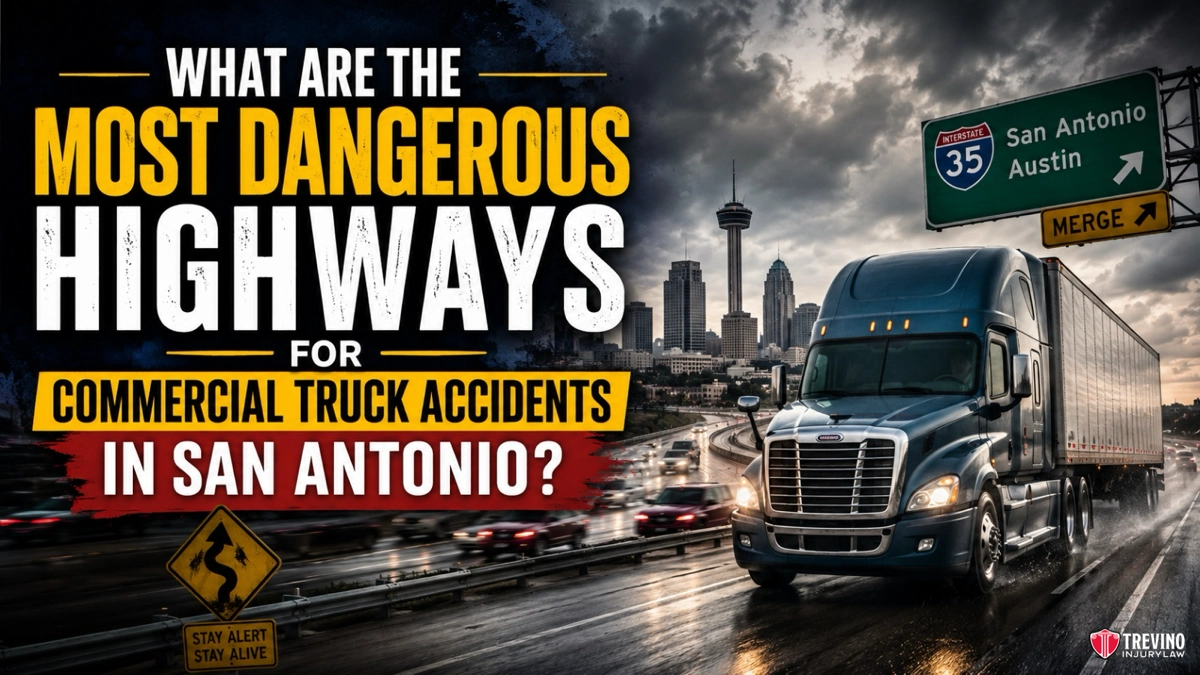
Major San Antonio interstates and the mixing bowl interchange are the most dangerous corridors for commercial truck crashes. Extreme traffic density, heavy freight movement, and tight merging zones pose unique threats to everyday passenger vehicles, with catastrophic consequences along these high-speed routes.
The negligent trucking company’s rapid-response defense team is already altering the crash narrative. They deploy industry experts to blame sudden bottlenecks, weather conditions, or your own merge timing rather than their driver’s direct negligence. A spatial analysis of local crash zones reveals that nearly 40% of all catastrophic commercial crashes in Bexar County occur precisely at these complex highway intersections and narrow exit ramps.
What Could Your Commercial Truck Accident Case Be Worth?
Answer a few quick questions about your accident. Takes about 60 seconds.
See What My Case Might Be WorthThe insurance company offered less than $20,000. I ended up with over $1 million. — Jackie Galindo
Critical highway camera footage and commercial dash-cam video are permanently overwritten within 14 to 30 days. You must immediately issue a Spoliation Letter, a legal demand that stops the corporate fleet managers from destroying logbooks and black box data.
Trevino Injury Law, our truck crash attorneys, lock down this evidence and force negligent fleets to pay full value for your injuries. Call 210-TREVINO now for a free case review. You pay nothing unless we win. Se Habla Español.
What Highway Has the Most Deaths in Texas and Bexar County?
The highway with the most deaths in Texas is Interstate 35, which runs directly through the heart of San Antonio and generates an exceptionally high number of fatal commercial truck collisions annually due to its status as a primary North American freight corridor.
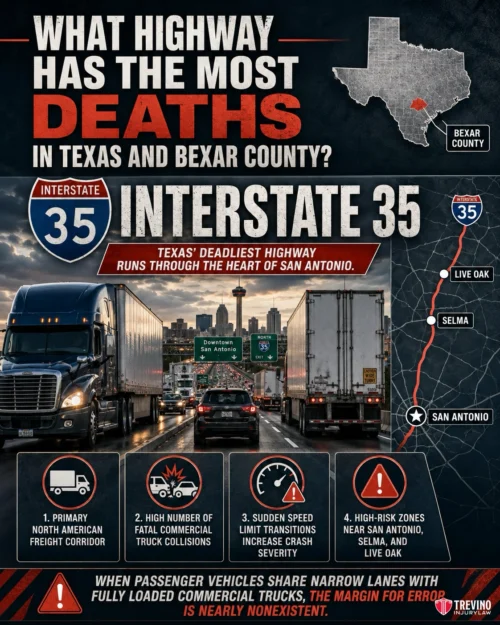
While the main hub identifies various high-risk routes across the city, the granular crash statistics and historical traffic fatality data map a much more severe threat along this specific interstate. As a vital artery for international shipping trucks navigating through the Northeast Military Corridor and communities like Selma and Live Oak, the constant flow of heavy freight creates unparalleled hazards.
The Texas Department of Transportation fatality maps frequently highlight specific high-risk mile markers within the San Antonio city limits where sudden speed limit transitions exacerbate the severity of these crashes. When a passenger vehicle shares these narrow lanes with fully loaded commercial transport trucks, the margin for error is nonexistent.
Why Is the I-35 and Loop 410 Mixing Bowl Highly Hazardous for Truckers?
The mixing bowl interchange is inherently hazardous for everyday drivers because it combines massive 80,000-pound 18-wheelers with sudden, high-speed lane changes and incredibly short merging distances, creating unavoidable blind-spot conflicts that routinely result in devastating jackknife and underride accidents.
This specific interchange represents a massive engineering failure when accommodating modern commercial traffic. The physical laws governing stopping distances dictate that heavy trucks cannot safely navigate these tight transition ramps at highway speeds. When a truck driver loses control in this zone, the resulting collision often blocks multiple lanes and causes secondary pileups.
Which Highway Has the Most Accidents Overall in the Region?
While Interstate 35 often sees the most fatalities statewide, Loop 410 experiences a high volume of commercial-vehicle accidents locally due to extreme commuter congestion intersecting with heavy local deliveries of box trucks and transit flatbeds, which navigate tightly curved, outdated on-ramps.
The heavy traffic flow near affluent neighborhoods like Alamo Heights and Terrell Hills forces commercial drivers into constant stop-and-go patterns. This continuous requirement for rapid deceleration increases the likelihood of rear-end collisions, sideswipes, and catastrophic brake failures as overworked systems overheat during peak commuter hours.
Understanding the sheer volume of fatal wrecks on these major interstates naturally leads to examining the specific physical locations where these catastrophic collisions actually occur.
Where Does 40% of All Catastrophic Commercial Crashes Occur Locally?
Nearly 40% of all catastrophic commercial crashes in San Antonio occur at complex highway intersections, narrow exit ramps, and major frontage road crossings where rapid deceleration is immediately required but frequently fails due to massive, overloaded 18-wheelers carrying heavy freight through Bexar County.
Expanding on the types of commercial truck accidents handled by a proven trial attorney, a spatial analysis of local crash zones reveals that straightaways are rarely the most dangerous segments. Instead, the mechanics of intersection-related trucking failures dominate the landscape, particularly along the Northwest Side near Leon Valley and the highly congested intersections along Bandera Road.
The physics of halting an 80,000-pound vehicle dictate that sudden stops are physically impossible without adequate warning and perfectly functioning equipment. When brakes fail on steep exits or delivery trucks run red lights at major highway underpasses, the results are devastating.
The top three deadliest intersection types for commercial crashes include:
- High-speed frontage road turnarounds with limited visibility.
- Curved highway off-ramps with sudden traffic light stops.
- Multi-lane underpasses where crossing traffic moves at high velocities.
What Is the Number One Killer of Truck Drivers on These Routes?
Rollovers and severe jackknife incidents caused by taking highway exit ramps at excessive speeds are the leading cause of fatal accidents for truck drivers themselves, highlighting widespread systemic issues with inadequate commercial training and unrealistic delivery schedules mandated by corporate dispatchers.
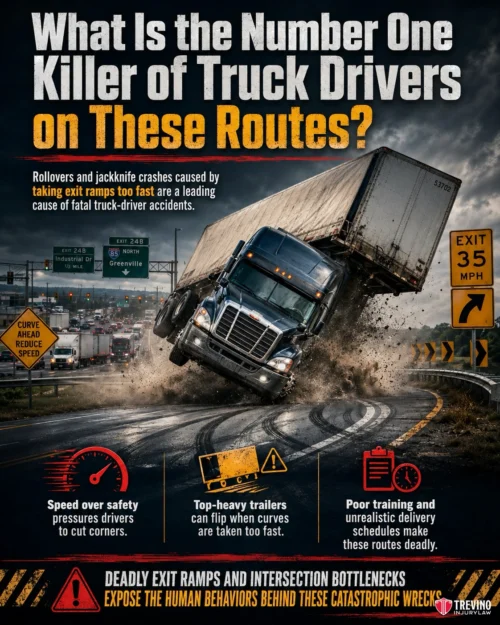
When a trucking company prioritizes speed over safety, drivers are forced to cut corners. Taking a curve too fast in a top-heavy trailer shifts the center of gravity, causing the vehicle to flip and crush anything in its path.
Recognizing that intersection bottlenecks and exit ramps trigger these specific types of wrecks reveals the underlying human behaviors that make these corridors so deadly.
What Are 90% of Highway Truck Accidents Caused By?
Up to 90% of all highway commercial truck accidents are caused by critical human error—but the liability often extends far beyond the driver. When Negligent Trucking Companies prioritize unrealistic deadlines over public safety, they can be held directly liable for negligent hiring, supervision, and retention.
This framework is grounded in landmark Texas Supreme Court precedents such as TXI Transportation Co. v. Hughes, 306 S.W.3d 230 (Tex. 2010), which emphasizes that a commercial fleet’s failure to properly vet driver qualifications or monitor safety compliance exposes the corporation to direct liability when its driver’s extreme fatigue results in a catastrophic crash.
To fully understand these catastrophic failures, you must first understand what a CDL means: a Commercial Driver’s License, which is the specialized certification required to operate these massive vehicles. Refining our knowledge of the deceptive tactics used by negligent trucking companies, an analysis of federal violation data shows that human error is rarely accidental. It is often a direct result of corporate pressure.
Fleet managers routinely force drivers past their legal limits on high-speed corridors like I-10, particularly when transporting goods toward the East Side and St. Hedwig areas. This extreme fatigue severely delays reaction times, making it impossible for a driver to avoid a collision when traffic suddenly stops.
What Is the 14-Hour Rule in CDL Driving?
The 14-hour rule is a strict Federal Motor Carrier Safety Administration regulation that prohibits a commercial truck driver from driving past the fourteenth consecutive hour after coming on duty, a law routinely broken by negligent companies attempting to accelerate freight delivery through Texas.
This federal mandate exists specifically to prevent fatigued drivers from operating heavy machinery on public roads. When a plaintiff trial lawyer investigates a crash, uncovering logbook falsifications and hours-of-service violations is a primary means of proving gross negligence and maximizing the injured family’s financial recovery.
Uncovering these widespread regulatory violations and dangerous driving practices provides critical context for how our local roadways compare to national risk levels.
What Are the Top 10 Deadliest Highways in the US, and How Does Texas Compare?
Texas routinely dominates the list of the 10 deadliest highways in the United States, with Interstate 35 and Interstate 10 serving as massive, dangerous arteries that funnel unprecedented volumes of national and international commercial freight directly through Bexar County, significantly elevating the local risk of fatal collisions.
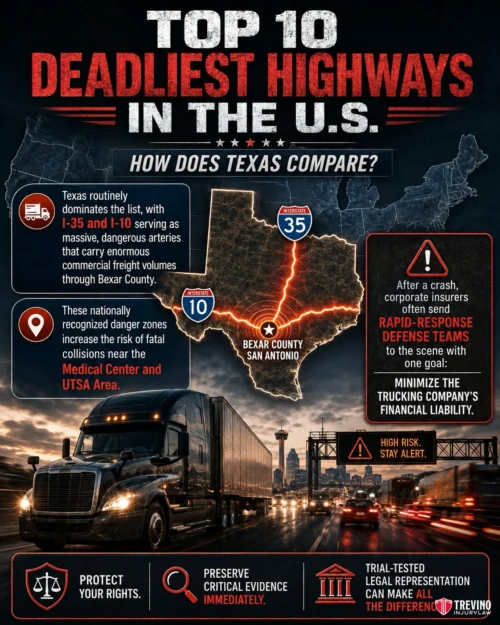
Transitioning from local traffic data to national statistics reveals the true scale of the threat facing everyday drivers near the Medical Center and the UTSA Area. Because these specific routes are nationally recognized as extreme danger zones for commercial transport, corporate insurers deploy rapid-response defense teams to the scene of a crash immediately.
These investigators arrive with one goal: to minimize the trucking company’s financial liability. Commercial insurers are highly aggressive in defending claims arising on these high-volume corridors, necessitating elite, trial-tested legal representation to combat their deceptive tactics and secure maximum compensation.
Recognizing how aggressively these corporate defense teams operate on these nationally ranked danger zones makes it absolutely crucial to understand the exact steps you must take to protect your rights and preserve critical evidence immediately after a collision.
The most dangerous road conditions for commercial truckers involve sudden, poorly marked highway construction zones along Loop 1604, which force massive vehicles to navigate narrow concrete barriers and uneven pavement at high speeds, often resulting in devastating sideswipe or rollover collisions.
When navigating these restricted corridors near military installations like Fort Sam Houston, heavy commuter traffic creates unpredictable stop-and-go patterns that make it extremely difficult for an 18-wheeler to maneuver safely.
Because a fully loaded tractor-trailer requires a significant distance to brake, sudden bottlenecks in these confined spaces lead to unavoidable impacts.
When a commercial driver loses control in a narrow construction zone, the rigid concrete barriers prevent evasive maneuvers, effectively trapping passenger vehicles in the immediate crush zone.
Are You Legally Required to Call the Police for a Highway Truck Crash in Texas?
Yes, Texas law requires you to immediately call 911 and obtain a formal police report if a commercial truck crash on a highway results in injury, death, or property damage exceeding $1,000.
This official document provides objective evidence of the scene, establishes the exact time and location, and includes the responding officer’s initial determination of fault. Insurance adjusters rely heavily on this documentation, and lacking a formal report gives corporate defense teams leverage to dispute the facts of the collision and deny your rightful compensation.
Is It Illegal to Drive 60 in a 70 mph Zone on Texas Highways?
No, driving 60 in a 70-mph zone is not strictly illegal on its own, but impeding the reasonable flow of dense highway traffic or driving at speeds that create a hazard can result in a citation and complicate liability.
Driving unusually slowly on a major commercial corridor forces large transport trucks to brake suddenly or attempt unsafe lane changes. This unpredictable behavior disrupts the natural traffic pattern and can significantly complicate fault disputes if you are rear-ended by a speeding commercial vehicle in a high-density area.
What Happens If You Don’t Document Highway Conditions Immediately after a Crash?
If you fail to document the specific highway conditions, lane markings, and debris at the crash scene, the trucking company’s rapid-response defense team will alter the narrative, potentially claiming that weather, third-party drivers, or unavoidable roadway hazards caused the wreck.
The absence of your own photographic evidence leaves a critical void that corporate insurers will eagerly fill with their own fabricated version of events. They will hire industry experts to argue that a missing road sign, a sudden downpour, or slick pavement near Southtown caused the collision, rather than their driver’s direct negligence.
To protect your claim from these deceptive tactics, you must capture the scene exactly as it was when the catastrophic injury occurred, ensuring the objective truth cannot be erased or manipulated by the defense.
Highway-condition photos are only one part of the post-crash record. Follow the immediate steps for preserving evidence after a San Antonio truck accident for scene documentation, driver and carrier information, and the broader investigation sequence. Then review why Texas truck accident evidence must be preserved before adjuster contact for the commercial records and digital data that can disappear after the wreck.
I-35 Vs. I-10: Which Highway Presents Higher Fatal Accident Risks for Passenger Vehicles?
Both corridors are exceptionally hazardous; however, I-35 poses a substantially higher risk of fatal accidents for passenger vehicles due to tighter urban congestion, constant merging traffic, and its direct route, which funnels NAFTA-related international commercial trucking fleets.
While both interstates facilitate immense volumes of commercial freight, their localized risk profiles differ significantly based on the surrounding infrastructure and traffic density. The long stretches of Interstate 10 moving toward the Texas Hill Country near Fair Oaks Ranch often see wrecks triggered by driver fatigue and high speeds.
In contrast, Interstate 35 forces heavy trucks through dense, older infrastructure right through the urban core, creating a high-stress environment where blind spots and rapid lane shifts are constant.
| Highway Feature | Interstate 35 | Interstate 10 |
| Primary Risk Factor | Dense urban congestion and constant merging | High speeds and long straightaways |
| Commercial Traffic | Heavy international freight and NAFTA fleets | Cross-state shipping and regional transport |
| Common Collision Type | Blind spot merging and rear-end pileups | High-speed rollovers and driver fatigue |
| Local Threat Zone | The “Mixing Bowl” downtown interchange | Wide expanses transitioning to rural areas |
When Is It Too Late to Secure Traffic Camera Footage from a Highway Collision?
It is often too late to secure critical TxDOT traffic camera footage and commercial dash-cam video if you wait more than fourteen to thirty days, as these digital systems are routinely overwritten, permanently erasing the objective visual proof needed to secure maximum financial compensation.
Once this critical digital evidence expires and is overwritten, proving absolute liability becomes significantly more difficult, leaving your case highly vulnerable to the trucking company’s delay-and-denial tactics.
A trial-ready law firm must immediately intervene and issue a formal spoliation letter to legally force the preservation of all black box data, logbooks, and video recordings. Missing this narrow time window can irreparably sabotage your ability to hold the negligent corporate parties fully accountable in court.
Why Hire a San Antonio Commercial Truck Accident Lawyer?
Catastrophic wrecks on I-35 demand immediate action to secure your financial recovery. While Negligent Trucking Companies deploy teams to rewrite the crash narrative, we step in. We expose high-volume settlement mills that fold under pressure. At Trevino Injury Law, we litigate to a verdict and force them to pay.
Want to Protect the Full Value of Your Claim?
You’ve seen how this affects your case — but this is only one piece of the puzzle. Our Truck Accident Lawyer page breaks down what a trial-ready firm does differently.
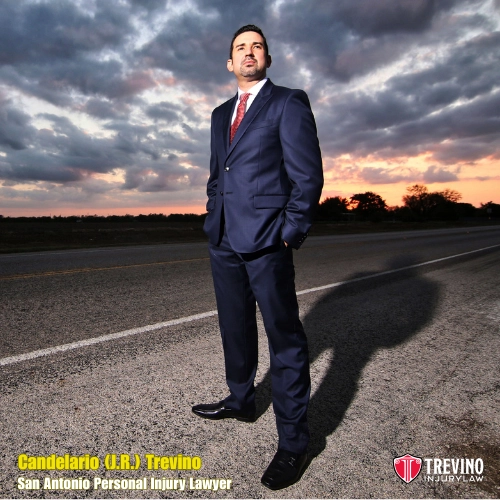
We back our fight with a $17 million settlement in an 18-wheeler wrongful death case. Our San Antonio accident attorneys immediately issue a Spoliation Letter to secure black box data for Bexar County trials.
Call 210-TREVINO for a free case review. We operate strictly on a No Win, No Fee basis. Se Habla Español.