You were severely injured on a commercial property in Bexar County, but the corporate defense team is already rewriting the facts of your visit. They are actively erasing your legal status as a protected customer to protect their bottom line.
Insurance adjusters are aggressively disputing why you were on the property, trying to downgrade you to a licensee so a judge can dismiss your claim as a strict question of law before a jury ever sees it. Trevino Injury Law’s verdict history includes a $536,007 jury verdict, even after the last offer was $5,000.
What Could Your Premises Liability Accident Case Be Worth?
Answer a few quick questions about your accident. Takes about 60 seconds.
See What My Case Might Be WorthThe insurance company offered less than $20,000. I ended up with over $1 million. — Jackie Galindo
Evidence proving your commercial purpose disappears in the first week. Surveillance footage is overwritten, maintenance logs are lost, and witness memories fade. A Spoliation Letter, a legal demand that stops the property owner from destroying proof, must go out immediately to prevent them from destroying your case. Once they successfully downgrade your visitor status, your path to compensation is gone.
Trevino Injury Law premises liability attorneys will subpoena this critical evidence and hold negligent property owners to be held accountable. Call 210-TREVINO for a free case review. You pay nothing unless we win. Se Habla Español.
Texas Invitee vs. Licensee: Key Takeaways
- As your legal team handling invitee vs licensee Texas claims, we defeat Insurance Adjusters who intentionally manipulate your visitor status.
- In cases involving injuries in corridors like Loop 1604 in Bexar County, our firm proves that commercial owners had constructive notice of hidden hazards.
- Trevino Injury Law litigates premises liability claims and has taken 80+ cases to trial, holding negligent property owners accountable.
- Our trial attorneys immediately issue Spoliation Letters to secure vanishing surveillance footage and protect your rightful financial recovery.
The Legal Distinction Between Invitees and Licensees in Texas
The primary legal difference lies in mutual benefit: an invitee enters a property with express or implied permission for a commercial purpose that benefits the owner, while a licensee enters for their own convenience or social purposes with the owner’s permission. The Supreme Court of Texas has clarified that this “mutual benefit” generally requires a shared business or economic interest, meaning that social goodwill alone is not sufficient to secure invitee status (Supreme Court of Texas, 2021).
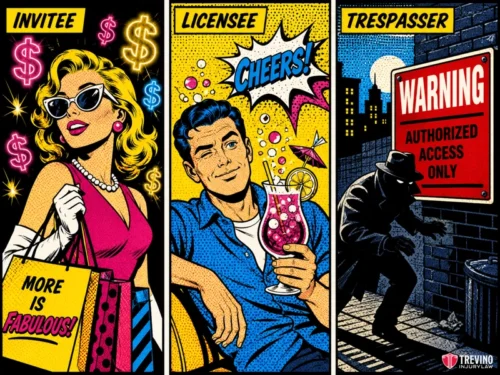
When a major commercial retailer in San Antonio opens its doors to the public, they implicitly invite you in for financial gain. This mutual economic benefit grants you the highest level of legal protection as an invitee. Conversely, if you attend a private dinner party at a residential home in Alamo Heights, you are classified as a licensee because the visit is primarily social.
We must also recognize a trespasser as someone who enters property unlawfully without any legal right or permission, thereby establishing the full legal spectrum. Insurance Adjusters at Companies like State Farm or USAA often try to blur these lines to reduce their financial exposure.
Texas courts strictly classify retail shoppers at locations like The Shops at La Cantera as invitees, whereas social guests at private residences are firmly classified as licensees. Common invitees include retail shoppers.
The distinction hinges on the primary purpose of the visit. If you are buying groceries at a store owner’s location, like H-E-B, the corporation profits from your presence, which establishes you as an invitee. If you are visiting a friend at an apartment complex off Loop 1604 for a barbecue, you are a licensee. We secure lease agreements and transaction receipts to conclusively establish your status in court.
Understanding exactly how courts define your visitor status is essential, but knowing what specific legal obligations those commercial owners owe you is what ultimately wins your personal injury claim.
The Elevated Duty of Care Owed to Commercial Invitees
Under Texas law, business owners owe a duty to protect invitees, which requires them to proactively inspect for hazardous conditions, promptly remedy them, and provide adequate warnings in the interim. This affirmative legal obligation was solidified in Corbin v. Safeway Stores, Inc., 648 S.W.2d 292 (Tex. 1983), where the Texas Supreme Court ruled that a commercial property owner is liable for injuries if they fail to use reasonable care to protect customers from dangerous conditions they knew about or should have known about through routine inspection.
Recent rulings reinforce that an injured invitee must conclusively prove that the owner had actual or constructive knowledge of the hazard to hold the owner liable (Supreme Court of Texas, 2024).
Commercial landlords and major retailers cannot simply react to hazards. They have an affirmative legal obligation to hunt for them. If a negligent management company at a Northwest Side shopping center near Leon Valley fails to identify a rotting staircase, they are liable for your injuries. As plaintiff trial lawyers who have taken more than 80 cases to trial, we litigate to verdict by proving the corporation violated this supreme duty. We know their playbook.

Even if a property owner does not know about the exact hazard, for an invitee, “should have known” through routine inspection is enough to trigger liability and force them to pay.
Evidence Required to Prove a Breach of Duty
To successfully hold a negligent commercial owner accountable, we aggressively secure specific evidence demonstrating they failed their property owner’s responsibility to take reasonable steps to inspect and repair the premises. Under the constructive notice standard, the evidence must specifically show the hazard likely existed long enough for the owner to have a reasonable opportunity to discover it (Supreme Court of Texas, 2026).
We utilize Spoliation Letters to preserve critical data, including:
- Internal sweeping logs and maintenance schedules.
- Surveillance footage from the exact time of the incident.
- Prior safety complaints filed with Bexar County Code Enforcement.
- Incident reports generated by the property management team.
Gathering this aggressive proof secures your legal protections, but those protections can instantly vanish if the insurance company finds a way to alter how the court views your presence.
Can an Invitee’s Status Downgrade to a Licensee or Trespasser?
Yes, your legal status can instantly downgrade from an invitee to a licensee or even a trespasser under Texas premises-liability law when you enter the property and exceed the scope of your initial invitation by entering restricted areas. Texas case law dictates that a person can be an invitee for some parts of a premises but not others, as your legal status depends strictly on your relationship to the owner at the exact time and place of the injury (Supreme Court of Texas, 2021).

Your status as an invitee is not a blanket shield that covers the entire property. Corporate defense teams will aggressively investigate exactly where you suffered a trip-and-fall to strip you of your invitee protections. If you are an invitee dining at a restaurant near the San Antonio River Walk, but you wander through an “Employees Only” door into the kitchen and slip, your status legally shifts.
Because you exceeded the geographical scope of your invitation, the court may reclassify you as a trespasser, drastically lowering the owner’s liability in Texas.
If you enter an unauthorized area, the trespasser’s protection drops, and the property owner’s duty drops from proactively ensuring your safety to merely refraining from intentionally injuring you or causing harm through gross negligence.
The moment you cross into a restricted zone without permission, the legal burden of proof skyrockets. We combat this defense by investigating whether the restricted area was clearly marked, if the locked doors were functioning, and if employees routinely allowed customers into that specific space.
Navigating the complexities of unauthorized zones is difficult, but understanding how defense teams exploit these boundary rules reveals their broader strategy to deny your rightful compensation.
How Insurance Adjusters Weaponize Visitor Status to Deny Claims
Aggressive insurance adjusters will intentionally misclassify your visitor status early in the injury case process, actively attempting to label you with a licensee’s status rather than a protected invitee to legally justify denying your financial recovery, minimize their corporate exposure, and pressure you into accepting a severely devalued settlement.
When you are catastrophically injured at a commercial property in Bexar County, the corporate defense team immediately searches for ways to diminish its responsibility. If they can convince a judge that you were merely a licensee, they no longer have to prove they routinely inspected the property. They only have to claim they were unaware of the specific danger.
This is why you must never give a recorded statement to an insurance adjuster without a trial-tested injury attorney present. They will use your own words to downgrade your legal status. Our law firm shuts down these tactics, securing the evidence needed to lock in your invitee status and maximize your compensation.

While stopping these aggressive insurance tactics is crucial for commercial claims, understanding how these same legal classifications apply to private residences and other unique scenarios provides a complete picture of your legal rights.
The Homeowner’s Duty of Care to a Licensee
A residential homeowner only owes a licensee the duty to adequately warn them of known, hidden property dangers that the visitor cannot reasonably discover themselves, but they have no affirmative legal obligation to proactively inspect the home for potential hazards. Instead, the legal requirement is that the owner must use ordinary care to warn of, or make safe, dangerous conditions that are actually known to the owner but not known to the licensee (Supreme Court of Texas, 2021).
If a homeowner in Stone Oak knows their wooden deck is structurally compromised but fails to warn you before you step onto it, they can be held liable. However, if the deck collapses due to a hidden termite infestation the homeowner genuinely did not know about, they are typically protected from liability under Texas law. We meticulously investigate these residential claims to uncover text messages, prior contractor estimates, or HOA complaints that prove the homeowner had actual knowledge of the danger before you arrived.
Can a Social Guest Sue a Homeowner for Hidden Property Dangers in Texas?
Yes, a social guest can sue a Texas homeowner if the injured person proves the owner knew about a hidden danger and failed to warn them.
Are Contractors Classified as Invitees or Licensees?
Yes, independent contractors are legally classified as invitees, not licensees, because their work provides a direct mutual economic benefit to the property owner.
However, under Chapter 95 of the Texas Civil Practice and Remedies Code, a property owner is generally not liable for contractor injuries unless they exercised or retained control over the work and had actual knowledge of the danger but failed to adequately warn (Texas Legislature, Current statute).
Invitee, Licensee, and Trespasser Duty Classifications
Texas law categorizes every visitor into one of three distinct classes, each carrying a drastically different level of legal protection and requiring a specific, elevated duty of care from the commercial or residential property owner to prevent severe, life-altering injuries.
- Invitees: Afforded the highest protection; owners must inspect, repair, and warn (e.g., grocery store shoppers, hotel guests).
- Licensees: Afforded moderate protection; owners must only warn of known, hidden dangers (e.g., social guests, off-duty employees).
- Trespassers: Afforded minimal protection; owners must simply not cause intentional injury or act with gross negligence.
The “Unforeseeable Hazard” Limitation for Commercial Invitees
The elevated duty of care owed to a protected invitee does not make a commercial property owner automatically liable for damages if a dangerous hazard was entirely unforeseeable or occurred so suddenly that the management had no reasonable opportunity to discover it.
While commercial landlords must proactively inspect their premises, Texas courts do not hold them strictly liable for every injury that occurs on site. If a hazard materializes instantaneously, such as another customer suddenly dropping a glass bottle in a grocery store aisle just seconds before you are injured, the owner may be shielded from liability because they lacked a reasonable window of time to discover it.
Furthermore, the court requires that any prior knowledge must directly relate to the dangerous condition at the exact time and place of the injury, not merely an earlier situation that produced it (Supreme Court of Texas, 2026). Insurance companies use this limitation to claim the accident was unavoidable. We defeat this defense by subpoenaing sweeping schedules and security footage to prove the danger actually existed long enough that a responsible owner should have found and fixed it.
The Consequences of Failing to Prove Invitee Status
If you cannot legally prove you had explicit permission or a clear commercial purpose for being on the property at the time of the crash, the court will automatically default your status to a trespasser, effectively destroying your injury claim and financial recovery.
Without hard evidence of your legal right to be on the premises, commercial insurance giants will immediately move to dismiss your lawsuit. This is why early evidence preservation is mandatory. We actively secure digital receipts, appointment confirmations, CCTV footage, and witness testimony in the first week of your case to irrefutably establish your legal right to be on the property, protecting your path to financial recovery.
Why Hire a Premises Liability Lawyer?
Insurance adjusters will immediately try to downgrade your visitor status to deny your claim. You need a trial-ready premises liability lawyer who understands premises liability in Texas to secure vanishing evidence, lock in your rights as a protected invitee, and force negligent property owners to be held responsible.
Want to Protect the Full Value of Your Claim?
You’ve seen how this affects your case — but this is only one piece of the puzzle. Our Premises Liability Lawyer page breaks down what a trial-ready firm does differently.
When defense teams challenge your visitor status, a relentless personal injury law firm immediately sends a spoliation letter to preserve critical CCTV footage. We back our trial-first mindset with undeniable results inside the Bexar County Courthouse, including a massive 107x verdict against lowball offers.
Do not give them a recorded statement. Contact Trevino Injury Law for a free consultation. Call 210-TREVINO. Se Habla Español.