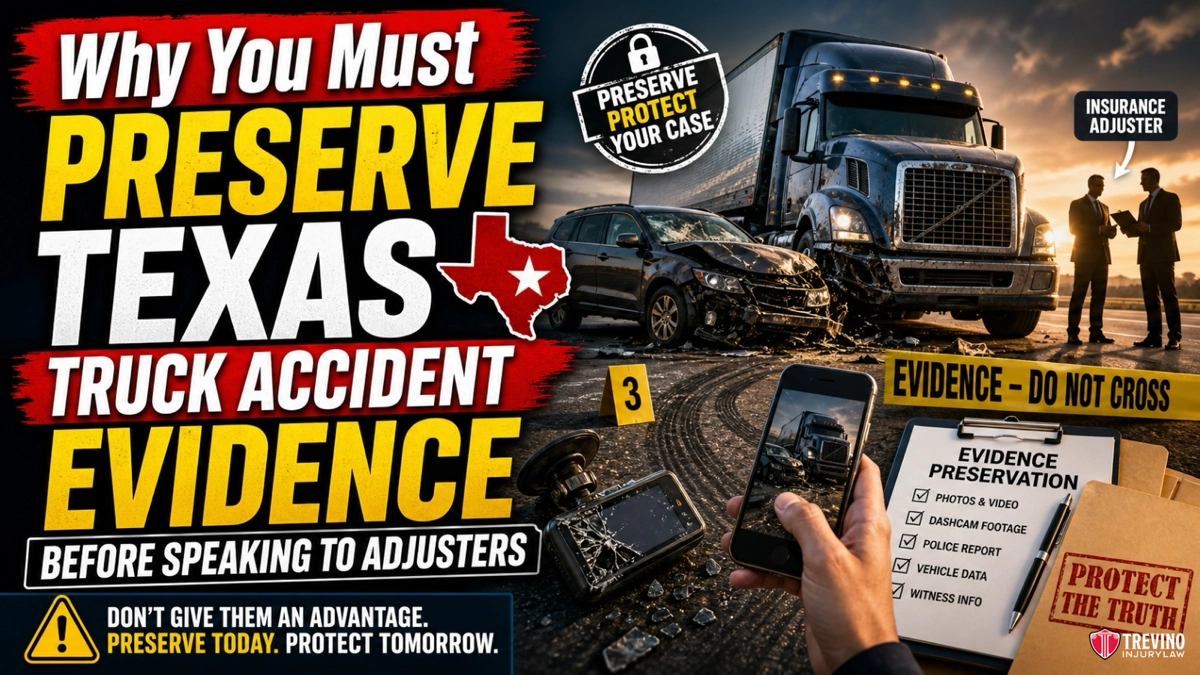
Texas truck accident evidence vanishes quickly because commercial carriers legally overwrite their onboard engine telemetry within days. The defense apparatus is already erasing the crash scene.
The insurance adjuster calling your phone is not trying to help you secure medical care; they are intentionally stalling your legal counsel while a rapid-response corporate defense team deletes the commercial dashcam loops. According to the National Safety Council, passenger vehicle occupants accounted for 70% of fatalities in large-truck crashes in 2024. That staggering mortality rate makes you a severe financial threat to their fleet, so they weaponize federal document-retention rules to hide their liability and shift the blame.
What Could Your Truck Accident Case Be Worth?
Answer a few quick questions about your accident. Takes about 60 seconds.
See What My Case Might Be WorthThe insurance company offered less than $20,000. I ended up with over $1 million. — Jackie Galindo
A Spoliation Letter, a legal demand that stops the property owner from destroying evidence, must go out immediately. If you wait even a single week to freeze the electronic control module, that digital footprint vanishes. Once those files disappear, corporate adjusters blame the impact entirely on you.
At Trevino Injury Law, our truck accident lawyers demand immediate compliance and lock down crash data before it vanishes. Call 210-TREVINO now for a free case review. You pay nothing unless we win. Se Habla Español.
How Quickly Can Trucking Companies Legally Destroy Crash Evidence?
Trucking companies can legally destroy driver logbooks after just six months, and electronic control module data can be overwritten within weeks if not immediately secured. While the main considerations for gathering evidence apply to any motor vehicle accident, commercial truck crashes require deeper analysis. Beyond standard police reports, victims must navigate FMCSA-specific retention limits, data-overwriting mechanisms, and Department of Transportation logbook expiration dates.
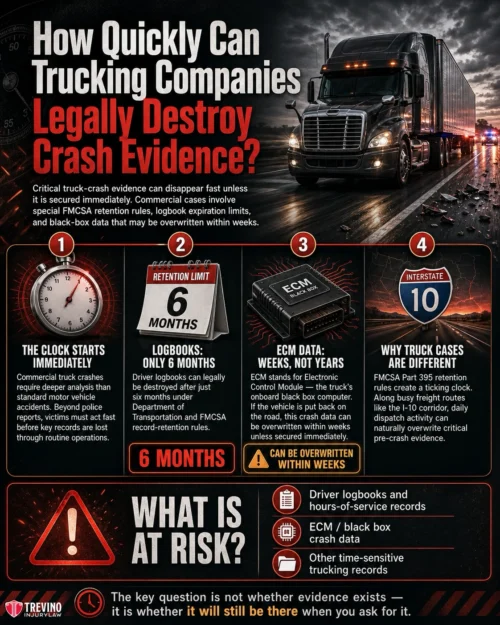
The Federal Motor Carrier Safety Administration outlines strict document retention rules in Part 395. These regulations create a ticking clock for victims in Bexar County. The fast-paced nature of freight dispatching along the I-10 corridor means that routine truck operations naturally overwrite critical pre-crash data every single day.
Preservation starts with what happens at the scene. Use the immediate steps after a San Antonio truck accident to document the crash, collect commercial-driver information, and protect the records needed for a later investigation. If the wreck occurred on I-35, I-10, Loop 410, or another major corridor, also review San Antonio’s most dangerous highways for commercial truck crashes for route-specific conditions and potential camera evidence.
When discussing this digital evidence, victims often ask what ECM stands for. ECM stands for Electronic Control Module, which is the technical term for the commercial vehicle’s onboard black box computer. If a trial attorney does not secure this module quickly, the negligent trucking company will put the vehicle back on the road and erase the digital footprint of the crash. This naturally leads to understanding exactly what is at risk of being destroyed.
What Electronic Data Does a Truck’s Black Box (ECM) Record?
A commercial truck’s ECM records vital pre-crash telemetry, including exact vehicle speed, hard braking events, steering angles, and whether cruise control was active at the moment of impact. This objective data frequently contradicts the truck driver’s initial statements to law enforcement. The module captures several key metrics:
- Vehicle speed before and during the collision
- Brake application and pressure data
- Engine RPM and throttle position
- Steering wheel angle and sudden maneuvers
How Long Are Driver Logbooks Preserved under FMCSA Regulations?
Under Federal Motor Carrier Safety Administration (FMCSA) rules, motor carriers are required to retain truck drivers’ records of duty status and supporting documents for only 6 months. To ensure your case is protected from the start, here is how we handle this critical deadline:
- The Critical Window: Unlike typical car accidents, truck accidents often involve multiple liable parties. The driver and the trucking company use this short six-month window to their advantage to hide liability.
- The Risk of Delay: Trucking companies and their insurers intentionally stall your truck accident claim, specifically to let this timeline expire safely. If they delay, critical electronic evidence will disappear, and once it is destroyed, they will argue that poor road conditions or your own actions contributed to the accident.
- Why Logbooks Matter: Following an accident, these documents serve as important evidence of Hours-of-Service violations and severe driver fatigue.
- Immediate Action Required: If you are injured in a truck accident, knowing the immediate steps to take is vital for securing fair compensation. Following a truck accident, you must preserve the logbooks and all evidence related to the crash before the corporate defense teams make it vanish.
- How We Protect You: Truck accident victims need an experienced truck accident lawyer who operates with a trial-first mindset. At Trevino Injury Law, we immediately issue a Spoliation Letter to lock down this evidence in its original state.
- Building a Bulletproof Case: We work with accident reconstruction experts to analyze every piece of evidence. They rely on this powerful evidence, physical evidence, and statements from anyone who witnessed the accident to prove exactly how it occurred.
- Securing the Win: By acting urgently, we lock down the relevant evidence, evidence related to the accident, and all accident-related evidence needed to expose insurance tactics. We secure the exact evidence needed to litigate to a verdict and force maximum payouts.
How Does a Spoliation Letter Prevent the Destruction of Commercial Vehicle Evidence?
A spoliation letter is a formal legal directive sent to the trucking carrier that imposes a mandatory duty to preserve all crash-related evidence, overriding the standard FMCSA destruction timelines. Building a strong truck accident case requires more than just gathering police reports. It requires the use of this specific legal instrument to halt the rapid deletion of data and impose severe legal consequences on the negligent trucking company if evidence is lost.
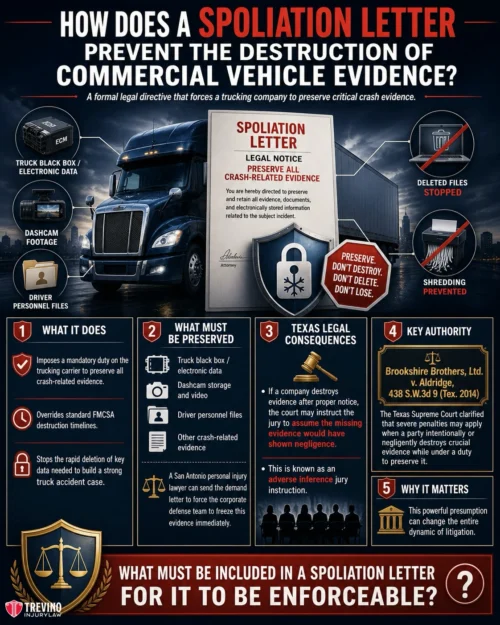
Sending this legal demand letter via a San Antonio personal injury lawyer forces the corporate defense team to immediately freeze the truck’s black box and dashcam storage, as well as all driver personnel files.
Under Texas law, if a company destroys evidence after receiving a proper spoliation notice, the court may instruct the jury to assume that the destroyed evidence would have proved the company’s negligence. This framework for spoliation of evidence was firmly clarified by the Texas Supreme Court in Brookshire Brothers, Ltd. v. Aldridge, 438 S.W.3d 9 (Tex. 2014), which establishes that severe penalties, such as an adverse inference jury instruction, can be levied when a party intentionally or negligently destroys crucial evidence while owing a legal duty to preserve it. This powerful presumption changes the entire dynamic of the litigation.
This immense legal power naturally raises the question of what must be included in this directive for it to be enforceable.
Why Is Independent Accident Reconstruction Essential Alongside Police Reports?
Independent accident reconstruction is essential because San Antonio police reports provide only a preliminary assessment of the crash scene, whereas our reconstruction experts use preserved black box data to scientifically prove the commercial trucking company’s negligence before a jury.
While immediately preserving the evidence stops the destruction clock, translating that raw data into a compelling legal argument requires specialized engineering. When a severe collision occurs on Loop 1604, the San Antonio Police Department and Texas Highway Patrol focus heavily on securing the area, clearing the roadway, and tending to traumatic injuries.
These responding officers rarely have the time, specialized equipment, or advanced training to download complex Electronic Control Module (ECM) data at the scene. They write a preliminary report, but they do not conduct a forensic engineering analysis.
This is where a trial-tested San Antonio personal injury lawyer makes the decisive difference. We take the black box telemetry, dashcam video, and logbooks you helped preserve and hand them directly to independent accident reconstruction engineers.
These experts counter the trucking company’s own rapid-response defense team by mathematically mapping the exact speed, braking pressure, and impact force. Understanding how this engineering analysis works requires a closer look at the specific steps involved in actually extracting this specialized digital data from the wrecked commercial vehicle.
What Steps Are Involved in Extracting Black Box Data after a Crash?
Extracting black box data requires securing the damaged vehicle in a controlled lot, issuing a court subpoena if the company refuses access, and utilizing a certified crash data retrieval technician to physically download the ECM without corrupting the highly sensitive files.
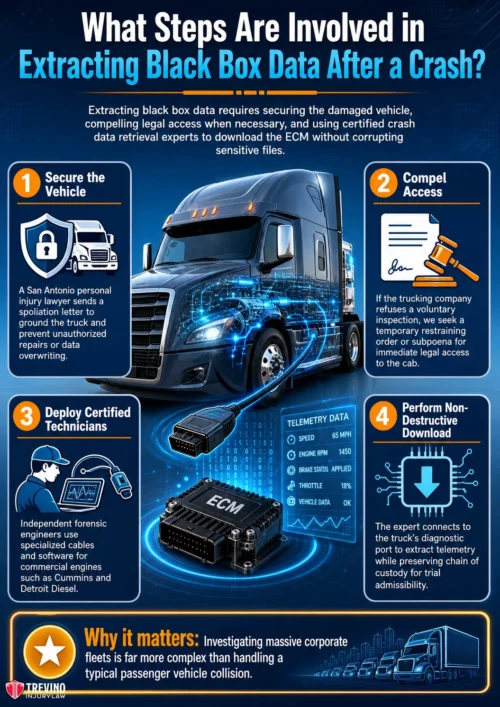
Victims simply cannot execute these procedures while recovering from catastrophic injuries in a hospital bed. To properly secure this evidence, a trial-ready attorney must execute the following protocol:
- Secure the Vehicle: A San Antonio personal injury lawyer sends a spoliation letter to ground the truck and prevent any unauthorized repairs or data overwriting.
- Compel Access: If the negligent trucking company refuses a voluntary inspection, we file for a temporary restraining order or a subpoena to obtain immediate legal access to the cab.
- Deploy Certified Technicians: We dispatch independent forensic engineers equipped with specialized cables and software designed for commercial engines, including Cummins and Detroit Diesel.
- Perform Non-Destructive Download: The expert physically connects to the truck’s diagnostic port to extract the telemetry, ensuring the chain of custody remains unbroken for trial admissibility.
While understanding how we extract this digital telemetry is crucial, it also highlights why investigating these massive corporate fleets is far more complex than handling a typical passenger-vehicle collision.
What Happens If You Speak to Trucking Adjusters Before Securing Evidence?
Speaking to a trucking adjuster before securing the vehicle’s data allows them to extract out-of-context statements that shift liability while intentionally running down the clock on evidence preservation deadlines. While dealing with any insurance adjuster requires caution, commercial trucking defense teams deploy highly specialized, rapid-response tactics. They use these initial communications to delay the issuance of spoliation letters and shift blame before objective, black-box data is pulled.
The “friendly adjuster” tactic is common in trucking defense. These representatives sound helpful on the phone. However, their actual goal is to establish a narrative of comparative fault under Texas law before the telemetry data can prove otherwise. They want you to accept a small percentage of the blame. This strategy directly impacts the total compensation you can recover. This tactic naturally raises questions about the legality of these manipulative communications.
How Do Adjusters Use Recorded Statements to Shift Liability?
Adjusters use carefully phrased questions in recorded statements to make you inadvertently admit to speeding, failing to avoid the collision, or feeling “fine,” which they later use to deny your claim.
For example, they might ask if you saw the 18-wheeler before the crash. If you say no, they will argue that you were distracted. If you say yes, they will argue that you failed to take evasive action. These deceptive traps are designed specifically to protect the corporate defendant’s bottom line.
Am I Legally Required to Give a Recorded Statement to the Trucking Company’s Insurance?
No, you are not legally required under Texas law to provide a recorded statement to the at-fault trucking company’s insurance adjuster, and doing so will only harm your case. Protecting your rights during these phone calls is vital, but preventing the physical destruction of the crash data requires specific, forceful legal intervention.
What Happens If You Don’t Send a Spoliation Letter Immediately?
If you fail to send a spoliation letter immediately, the trucking company is legally permitted to repair the damaged 18-wheeler, overwrite the digital engine data, and eventually shred the driver’s logbooks as part of their normal, everyday course of business. Without this critical legal intervention from a trial-ready attorney, you lose the strongest leverage in your case.
If the data disappears through routine maintenance because you did not act, Texas courts will not automatically assume the trucking company was hiding something. The legal doctrine known as “spoliation of evidence” only protects you if the corporate defendant destroys evidence after being formally placed on notice.
By attempting to handle the claim alone and lacking proper legal protection, you give the insurance adjusters a massive advantage. This absence of legal protection is devastating, but even if you do eventually hire a lawyer, waiting too long means certain volatile files will inevitably expire and vanish forever.
What Specific Items Must a Commercial Vehicle Spoliation Letter Demand?
Comprehensive spoliation letter must explicitly demand the preservation of the tractor’s ECM data, driver qualification files, dispatch records, hours-of-service logs, and all onboard video footage. Vague letters routinely fail in court. To enforce preservation effectively, the demand must list specific commercial evidence categories:
– Complete Electronic Control Module and telematics downloads
– Driver logs, including all supporting fuel and toll receipts
– Pre-trip and post-trip inspection reports
– Internal corporate communications and dispatch messages
All inward and outward-facing dashcam video loops
Securing this comprehensive list of data successfully halts the destruction process, but translating that raw data into courtroom proof requires a highly specialized approach.
How Does Commercial Truck Evidence Differ from Standard Car Crash Evidence?
Unlike passenger car crashes, which rely heavily on subjective witness statements and basic police reports, commercial truck crashes generate a massive footprint of highly regulated corporate data, including mandatory post-crash drug testing results, specialized engine telematics, and exhaustive corporate hiring files.
A collision involving a fully loaded 18-wheeler is not just a larger car crash; it is a statistically devastating event for passenger vehicles and a complex corporate liability event governed by federal law. In fact, according to 2024 data from the National Safety Council, 70% of deaths in large-truck crashes are the occupants of other vehicles, highlighting exactly why injured victims bear the brunt of the trauma and need a trial-tested attorney to fight back against aggressive corporate defense teams.
| Evidence Category | Standard Car Crash | Commercial Truck Crash |
| Vehicle Data | Minimal onboard diagnostics, standard airbags | Comprehensive ECM telemetry, hard-braking logs |
| Driver History | Basic driving record and license status | FMCSA qualification files, background checks |
| Substance Testing | Only if police suspect intoxication at the scene | Mandatory federal post-accident drug and alcohol screening |
| Video Surveillance | Rare personal dashcams or nearby businesses | Integrated inward and outward corporate video loops |
| Maintenance Records | Basic oil changes, subjective upkeep | Federally mandated pre-trip and post-trip inspection logs |
Because this specialized commercial data is so comprehensive, the consequences of failing to protect it early in your case can completely destroy your ability to secure maximum compensation.
When Is It Too Late to Recover Dashcam Footage from a Commercial Carrier?
It is permanently too late to recover commercial dashcam footage once the system’s continuous storage loop overwrites the critical crash data, which often happens within just twenty-four to forty-eight hours unless the truck is grounded by an immediate legal preservation order. Modern commercial trucking fleets use outward- and inward-facing cameras that record in a continuous loop to save digital storage space.
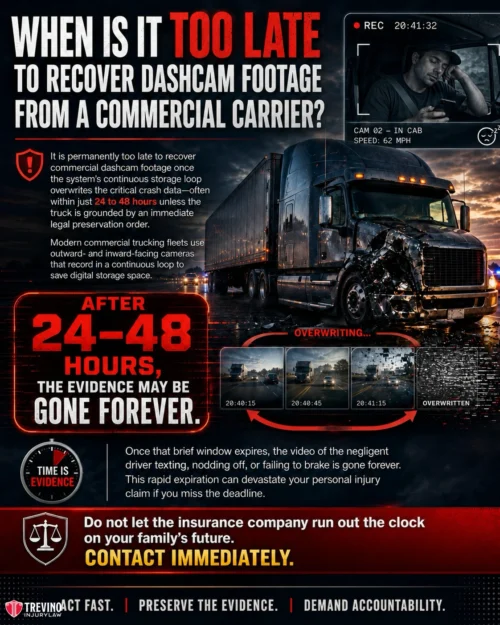
Once that brief window expires, the video of the negligent driver texting, nodding off, or failing to brake is gone forever. This rapid expiration represents a catastrophic failure for your personal injury claim if you miss the deadline.
Do not let the insurance company run out the clock on your family’s future. You must contact Trevino Injury Law immediately so we can litigate your case, stop this destruction, and force the responsible parties to pay the maximum compensation you deserve.
Why Hire a San Antonio Truck Accident Lawyer?
When a crash on I-35 threatens your future, corporate defense teams immediately overwrite critical data. To secure maximum compensation, you must fight negligent trucking companies and adjusters. Unlike settlement mills that avoid court, Trevino Injury Law is a plaintiff trial firm. We litigate to a verdict, and we force them to pay.
Want to Protect the Full Value of Your Claim?
You’ve seen how this affects your case — but this is only one piece of the puzzle. Our Truck Accident Lawyer page breaks down what a trial-ready firm does differently.
With 80+ jury trials and a $17 Million 18-wheeler wrongful death settlement, we prepare every case for the Bexar County Courthouse. A San Antonio injury law firm will issue an immediate spoliation letter to secure black box data.
Call 210-TREVINO for a free case review. Se Habla Español. No win, no fee.