Proving liability in a San Antonio crane accident requires determining exactly what failed before the general contractor clears the site. It is a forensic battle between identifying a poorly trained operator or a hidden mechanical defect in the rigging. The answer lies in the maintenance logs and black box data, not in the excuses provided by the site manager.
Insurance adjusters are already reclassifying your crush injury: your equipment failure becomes your own carelessness, and their maintenance skip becomes an unavoidable accident. Crane failures like this are among the common construction accidents in San Antonio, especially when contractors ignore inspections, rigging limits, or operator training. They use your silence to build a defense that protects their bottom line. According to the Bureau of Labor Statistics, Texas recorded 50 crane-related fatal and nonfatal occupational injuries between 2011 and 2017.
What Could Your Construction Accident Case Be Worth?
Answer a few quick questions about your accident. Takes about 60 seconds.
See What My Case Might Be WorthThe insurance company offered less than $20,000. I ended up with over $1 million. — Jackie Galindo
Proof disappears in the first week. A Spoliation Letter, a legal demand that stops the property owner from destroying evidence, must be sent immediately to preserve the machine’s electronic records. Texas law gives you two years, but without that digital data, the clock runs out on your ability to prove negligence.
Trevino Injury Law construction accident lawyers will lock the evidence down on day one and force negligent corporations to pay. Call 210-TREVINO now for a free case review because you pay nothing unless we win. Se Habla Español.
Investigating Operator Negligence in San Antonio Heavy Equipment Crashes
To prove a heavy equipment operator was negligent, your injury lawyer must acquire and analyze the operator’s training records, drug testing results, and the machinery’s telematics data. We must demonstrate that their actions violated established protocols and directly caused serious injuries. Proving operator error requires demonstrating that the individual controlling the machinery failed to meet the standard of care expected on a Bexar County worksite.
Heavy-equipment crashes are part of the broader pattern of construction accident hazards in San Antonio. The risks on these worksites are severe; recent reports confirm there were 3,684 work-zone crashes in Bexar County in just one year (TxDOT, 2024). On dense commercial sites, such as those near the South Texas Medical Center or the I-35 mixing bowl, blind spots and poor communication frequently cause operators to strike or crush pedestrian workers.
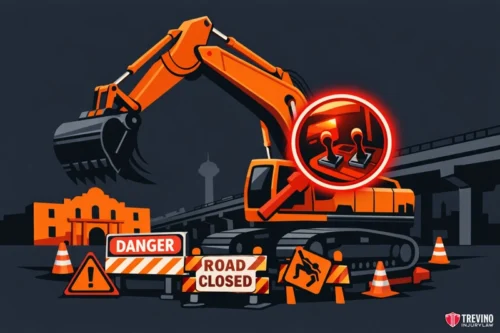
Operators of excavators, bulldozers, and forklifts often bypass safety mechanisms, fail to use spotters, or operate while fatigued. When working in unpredictable environmental hazards like high winds, the risk multiplies. Trevino Injury Law forensically evaluates the incident by obtaining the operator’s logbooks, electronic control module data, and site surveillance footage.
By cross-referencing the operator’s actions against the site’s specific safety manual, we expose deviations that led to the catastrophic failure. If an operator swings an excavator bucket without clearing the swing radius, pinning a worker against a concrete wall, this constitutes actionable negligence.
OSHA Certification Standards and Employer Liability
OSHA (Occupational Safety and Health Administration) mandates that all crane operators on commercial construction sites possess a valid, accredited certification specific to the type and capacity of the crane they operate, ensuring safe lifting of heavy loads. Contractors routinely violate these occupational safety and health mandates to accelerate project timelines on rapid developments in areas like Westover Hills.
- Accredited Testing: Operators must pass written and practical exams from an accredited organization.
- Equipment-Specific Qualification: A certification for a small mobile crane does not legally qualify an operator to run a tower crane.
- Employer Evaluation: General contractors must ensure they formally evaluate and document the operator’s actual competency on the specific job site.
When an uncertified or improperly trained operator causes a collision, the general contractor may be held legally responsible for negligent hiring and supervision. This duty of care is firmly anchored in Texas law by the landmark Supreme Court decision Redinger v. Living, Inc., 689 S.W.2d 415 (Tex. 1985), which holds that general contractors who retain control over worksite operations or safety owe a strict legal duty to ensure proper safety protocols are actually followed to protect workers.
While untrained operators are a primary hazard, perfectly trained workers cannot compensate for failing machinery, forcing an investigation into the equipment’s mechanical integrity.
Proving Mechanical Failure and Defective Equipment
To prove a crane collapse or machinery crash was caused by defective equipment, your legal team must secure the physical components, analyze maintenance logs, and deploy engineering experts. We look to identify metallurgical failures, faulty hydraulics, or a faulty design in the rigging hardware.
When a heavy equipment failure is not the result of human error, the investigation shifts to mechanical integrity. Equipment defects often involve compromised load-bearing components, such as snapped cables, failed hydraulic outriggers, or equipment sold without adequate safety instructions.
On major infrastructure projects across South Texas, the immense stress placed on heavy machinery exposes any manufacturing flaws or maintenance failures. The human cost of these failures is immense, with 27 fatal occupational injuries recorded in Texas heavy and civil engineering construction in a single year (TDI-DWC, 2023). Trevino Injury Law acts immediately to preserve the failed components before the general contractor repairs them.
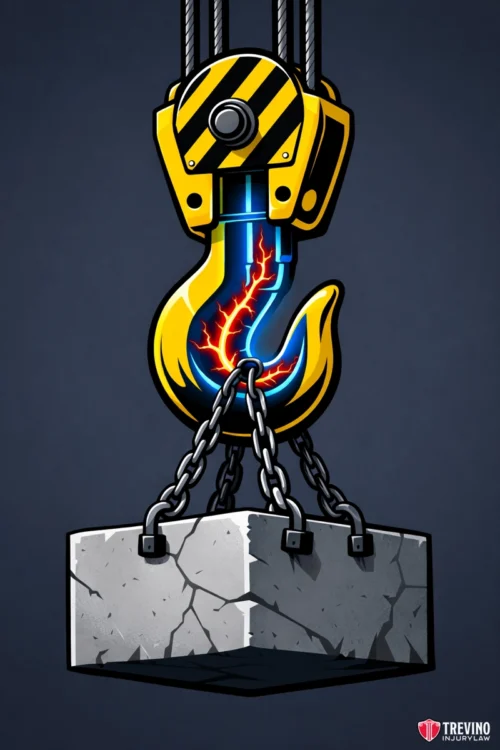
We use spoliation letters to secure the physical evidence and the machinery’s event data recorder. A load capacity chart defines the maximum safe lifting limits, and if a crane fails below this capacity, it strongly indicates a mechanical defect. We then retain structural engineers to conduct metallurgical testing, proving that the equipment failed under normal operational loads due to a pre-existing defect.
The Role of Falsified Maintenance Logs in Proving Negligence
Maintenance logs reveal general contractor negligence by documenting deferred repairs, ignored warning lights, and skipped mandatory safety inspections prior to the equipment failure. Because machinery often requires regular maintenance, general contractors and equipment leasing companies frequently falsify logs to keep poorly maintained machinery operating and avoid downtime on lucrative Bexar County projects.
Through aggressive discovery, we compel the production of these maintenance records. If the logs show that a forklift’s hydraulic fluid leak was reported but never repaired before it dropped a load on a worker, liability shifts entirely to the party responsible for maintenance. This documentation transforms an unavoidable event into a case of gross negligence. In catastrophic incidents, fault rarely rests solely on one party, requiring an analysis of how liability is apportioned when human and mechanical failures combine.
Apportioning Liability: When Operator Error and Mechanical Defects Intersect
When both operator error and defective equipment contribute to an accident, liability is legally divided among multiple parties, such as the general contractor, the subcontractor employing the operator, and the equipment manufacturer, based on their respective degrees of fault. Construction site accidents rarely stem from a single variable.
These complex variables contribute to a highly dangerous environment, evidenced by the 124 fatal occupational injuries reported across the Texas construction industry in 2023 (TDI-DWC, 2023). Accidents occur when a marginally defective piece of equipment is pushed to the point of catastrophic failure by an aggressive or untrained operator.
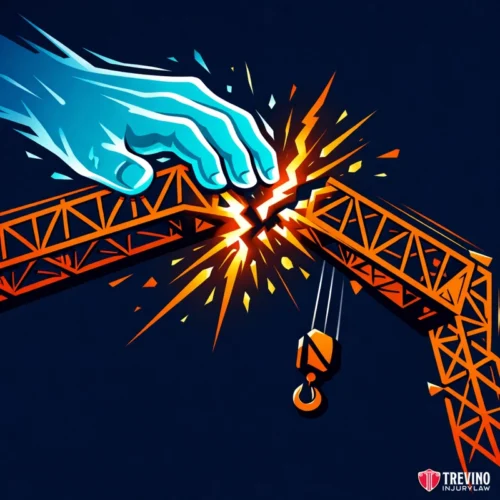
Under Texas law, responsibility rarely falls on a single party at a multi-employer worksite. If a defective crane boom snaps because an uncertified operator overloaded it while working on a commercial build near the La Cantera district, both the equipment manufacturer and the operator’s employer can be held liable. Trevino Injury Law systematically dismantles the defense’s attempt to shift blame, and we pursue third-party injury claims against all negligent entities.
By thoroughly mapping the percentage of fault assigned to each defendant, we ensure that the injured worker receives full economic justice for life-altering trauma, rather than relying solely on workers’ compensation claims or being shortchanged by an insurance company’s finger-pointing tactics.
Maximizing Recovery Through Third-Party Lawsuits
A third-party accident lawsuit or injury lawsuit allows you to sue negligent entities other than your direct employer. This helps recover full earning capacity if the crash impacts your ability to work, as well as compensation for pain, suffering, and the long-term effects of the trauma. Workers’ compensation only covers basic medical care and a fraction of lost wages. Third-party claims enable securing the maximum compensation for catastrophic harm.
Trevino Injury Law secured a $7.9 Million Verdict for a worker who suffered a crushed foot and amputated toe due to a corporate defendant’s failure to safely operate site equipment. We litigate to verdict against these third parties, forcing commercial insurers to pay for future medical treatment, life care plans, and permanent physical impairment. Securing these massive verdicts relies entirely on the physical evidence gathered at the scene, which requires specific, immediate legal action.
Immediate Evidence Preservation for Heavy Machinery Claims
To preserve evidence following a catastrophic crush incident, you must secure immediate medical attention, aggressively document the machinery and surrounding hazards with photographs if physically able, and hire a trial lawyer to immediately send a Spoliation Letter to all involved contractors. Proving a third party’s negligence requires immediate action before the scene changes. Once the general contractor removes the faulty excavator, repairs the defective crane rigging, or completes that phase of the build, critical physical evidence vanishes. Excavation collapses create a parallel preservation problem because crews may alter or refill the trench; our guide to trench collapse accidents in San Antonio explains the excavation-specific evidence and liability issues.
Delaying an investigation makes proof exponentially harder. From day one, an attorney at Trevino Injury Law reviews the case, identifies potential dash cam or site surveillance footage, and executes public records requests for official OSHA citations and police reports.
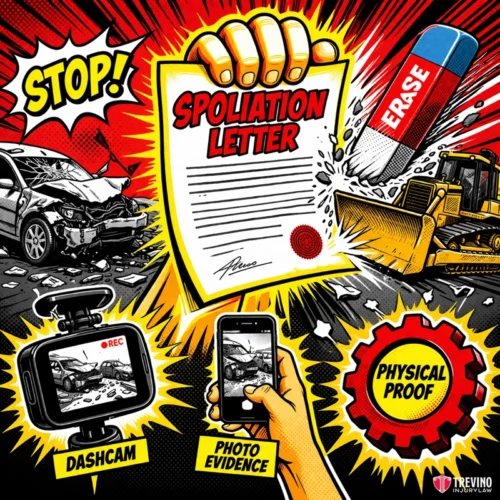
We legally demand that defendants preserve black box data, maintenance logs, and the physical machinery itself. This trial-first mindset ensures we capture critical evidence, utilizing the strict spoliation framework established by the Texas Supreme Court in Brookshire Brothers, Ltd. v. Aldridge, 438 S.W.3d 9 (Tex. 2014), which allows courts to severely penalize corporate defendants who intentionally destroy, alter, or hide crucial proof before a jury can see it.
Understanding these immediate steps applies directly to specific types of heavy machinery incidents, such as navigating the complexities of localized equipment crashes.
Investigating Forklift and Excavator Crush Accidents
Investigating a forklift or excavator accident requires a systematic forensic approach to immediately secure the machine’s electronic data, isolate the physical load-bearing components, and thoroughly analyze the Bexar County worksite layout for severe safety violations before the general contractor alters the scene.
Forklifts and excavators are involved in a massive percentage of struck-by and caught-between accidents in densely packed zones, such as highway construction on Loop 410. The danger in these areas is significant, as Bexar County alone saw 12 work-zone traffic fatalities in a recent reporting year (TxDOT, 2024).
When something goes wrong and these machines crush a worker, our investigation follows a rigorous forensic protocol.
This comprehensive process prevents employers and general contractors from hiding the accident or altering the scene to protect their liability:
- Secure Electronic Data: We extract the telematics and event data recorder information from the excavator to determine speed, braking, and control inputs at the exact moment of impact.
- Analyze Worksite Layout: We evaluate the site for OSHA violations, such as a lack of designated pedestrian walkways, absent spotters, or poorly managed blind spots without adequate warnings.
- Inspect the Machinery: We retain experts to examine the forklift’s hydraulics, backup alarms, and mast mechanisms for defects or signs of poor maintenance.
- Interview Witnesses: We immediately secure statements from co-workers before they are intimidated by the general contractor.
This investigative depth often answers the most pressing legal questions construction workers and other workers at risk have regarding their specific rights to sue.
Can I sue my employer for a heavy equipment accident in Texas?
Yes, you can sue your employer for a heavy equipment accident in Texas if they are a non-subscriber who opted out of workers’ compensation.
Do maintenance logs definitively prove a crane was defective?
No, while maintenance logs prove a history of neglect by the contractor, definitive proof of a mechanical defect requires expert metallurgical analysis of the components.
Operator Negligence vs. Manufacturer Liability in Heavy Machinery Crashes
Operator negligence focuses on the human failure to safely control the machine, whereas manufacturer liability focuses on an inherent flaw in the machine’s design or assembly that made it unreasonably dangerous regardless of how perfectly the trained operator acted on the construction site.
Distinguishing between these two concepts dictates which corporate entity is targeted in your lawsuit. Operator negligence claims target the subcontractor or general contractor for failing to train, supervise, or properly operate the equipment, such as a forklift driver speeding through a blind corner.
Manufacturer liability, or product liability, targets the corporation that built the crane or excavator. If a crane’s outrigger fails because the steel used in manufacturing was brittle and substandard, the manufacturer is strictly liable for the resulting injuries, regardless of how perfectly the operator acted.
We hold both negligent drivers and massive corporate manufacturers accountable in court. Proving manufacturer liability relies entirely on access to specific technological data, which can be lost if not immediately secured.
The Impact of Missing Black Box Data in a Crane Accident
Without black box data in a crane accident, your attorney loses the precise digital record of the machine’s load weight, operating angles, and critical warning signals at the exact moment of failure, making it exponentially harder to definitively prove third-party liability. The absence of this electronic control module data creates a negative space where the defense can easily construct alternate narratives.
General contractors will claim the worker stepped into the swing radius, or manufacturers will argue the operator ignored safety alarms. Without the objective data to prove exactly what the machine was doing, proving liability relies heavily on less reliable eyewitness testimony and post-accident physical analysis.
This is why aggressive early intervention and spoliation letters are vital to prevent the destruction of this digital proof. Even when all data is preserved, and a defect is found, there are specific legal boundaries within which the manufacturer may escape liability.
Exceptions to Manufacturer Liability for Defective Equipment
Manufacturer liability does not apply if the general contractor substantially altered the heavy equipment after purchase, or if the machinery was used in a manner explicitly prohibited by the safety manual, shifting the legal responsibility entirely back to the reckless equipment owner. Product liability has distinct legal boundaries. If a construction company removes the safety guards from an excavator, bypasses the load-moment indicator on a crane, or installs unauthorized aftermarket rigging hardware, the original manufacturer is generally shielded from liability.
In these edge cases, the legal responsibility shifts entirely back to the general contractor or equipment owner who made the dangerous modifications. Understanding these limitations is crucial; it ensures your legal team targets the correct at-fault party rather than wasting time suing a manufacturer who has a valid defense based on the contractor’s reckless alterations.
Why Hire a Construction Accident Lawyer?
Hiring a construction accident lawyer is critical because general contractors and insurance adjusters will immediately attempt to blame you for the crush injury and destroy evidence. However, a trial-tested attorney will preserve the black-box data and litigate to a verdict to secure the maximum compensation.
Want to Protect the Full Value of Your Claim?
You’ve seen how this affects your case — but this is only one piece of the puzzle. Our Construction Accident Lawyer page breaks down what a trial-ready firm does differently.
A dedicated personal injury accident attorney near me issues spoliation letters to preserve critical black box data immediately. We fight at the Bexar County Courthouse, backed by our $7.9 million verdict for a catastrophic work injury.
Do not give a recorded statement to the insurance company. We know their playbook, and we shut it down. Contact the San Antonio plaintiff trial lawyers at Trevino Injury Law for a free consultation. Call 210-TREVINO. Se Habla Español.