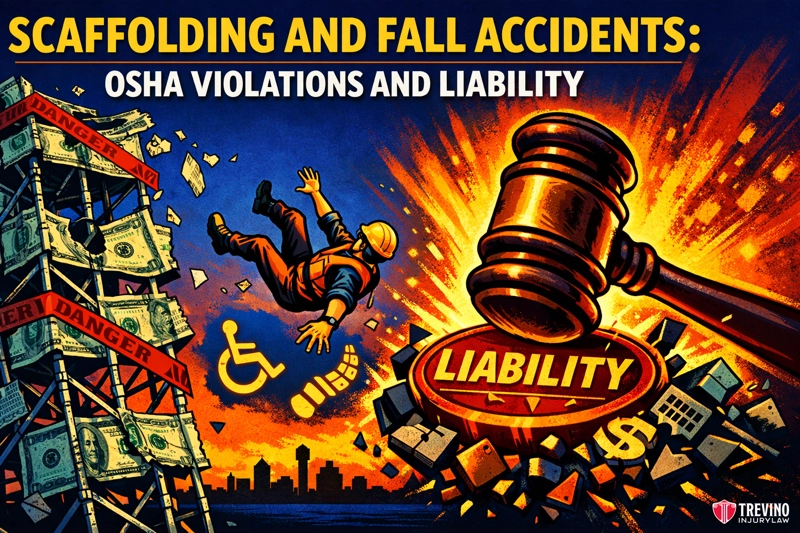
Your scaffold collapsed because a third-party subcontractor removed the cross-braces to speed up their work. The resulting drop shattered your vertebrae, leaving you with lifetime medical costs that basic workers’ compensation ignores.
The third-party contractor’s insurance adjuster is already shifting blame back to your direct employer to trap your claim in the workers’ compensation system. Scaffold collapses like this are among the common construction accidents in San Antonio, especially when contractors ignore load limits and basic bracing requirements.
According to the Texas Department of Insurance, the state recorded 85 fatal occupational falls to a lower level in 2023. Behind most of these drops is a general contractor or equipment supplier who ignored mandatory load capacities and cut safety protocols.
What Could Your Construction Accident Case Be Worth?
Answer a few quick questions about your accident. Takes about 60 seconds.
See What My Case Might Be WorthThe insurance company offered less than $20,000. I ended up with over $1 million. — Jackie Galindo
Evidence of third-party negligence disappears in the first week as site supervisors replace defective locking pins and rewrite daily safety logs. A Spoliation Letter, a legal demand that prevents the property owner from destroying evidence, must be issued immediately to lock down the exact structural failures. Texas gives you two years. After that, the claim is gone.
Trevino Injury Law construction accident lawyers will subpoena competent-person inspection reports and force negligent companies to pay. Call 210-TREVINO now for a free case review. You pay nothing unless we win. Se Habla Español.
How Do Specific OSHA Scaffolding Violations Prove Negligence in San Antonio?
Specific OSHA scaffolding violations prove negligence by showing the controlling employer ignored mandatory federal safety requirements for load capacities, cross-bracing, and daily inspections before allowing any construction worker on the platform.
General contractors owe a strict duty to maintain a safe work environment, particularly on multi-story projects in rapidly developing areas like The Pearl or Stone Oak. This duty was codified in the landmark Texas Supreme Court case Redinger v. Living, Inc., 689 S.W.2d 415 (Tex. 1985), which dictates that when a general contractor retains supervisory control over safety on a job site, they bear the legal liability for injuries caused by their failure to exercise that control with reasonable care.

When a worker suffers a catastrophic fall, it is rarely a freak accident; it is almost always the result of a specific safety shortcut that creates an unsafe workspace. Employers must follow regulations, and proving negligence requires mapping the exact cause of the fall directly to an OSHA standard that explicitly forbids that condition.
Our trial attorneys act immediately to cross-reference the physical state of the collapsed scaffold with the mandatory regulations the contractor violated to cut costs. According to OSHA guidelines, OSHA’s scaffolding standards restrict unsecured scaffolding height to a 4:1 ratio of height to base width, a standard often ignored on rushed Bexar County job sites.
This disregard for safety protocols is part of a broader pattern of common construction accidents in San Antonio. In fact, scaffolding violations are so prevalent that the scaffolding standard ranked 8th among the most frequently cited federal OSHA standards in Fiscal Year 2024 (Occupational Safety and Health Administration, 2024).
Rather than relying on a settlement-mill approach, our team uses over 20 years of litigation experience to aggressively preserve this evidence. We build a trial-ready case from day one, forcing the negligent parties to answer for their safety failures in court.
Critical Load Capacity and Base Plate Failures
Critical load capacity and base plate failures occur when contractors place scaffolding on unstable ground without proper mudsills or overload the platform with heavy masonry materials. Under 29 CFR 1926.451, scaffolds and their components must support, without failure, their own weight and at least 4 times the maximum intended load.
When contractors ignore the requirement that the structure hold at least 4 times the maximum limit, structural integrity vanishes. A scaffold is only as stable as its foundation. In South Texas, where soil conditions can shift rapidly, the failure to use adequate base plates can cause the entire structure to tilt, resulting in catastrophic multi-worker falls and injuries.
The data reflects the lethal reality of these mid-elevation collapses; nationally, falls from heights of 6 to 30 feet accounted for 260 fatal falls to a lower level within the construction sector in 2023 (U.S. Bureau of Labor Statistics, 2023). The most common foundation failures include:
- Missing base plates on uneven ground.
- Lack of adequate mudsills to distribute weight.
- Overloading platforms with excess masonry materials, exceeding 4 times the maximum intended capacity limit.
What Are the OSHA Requirements for Personal Fall Arrest Systems on Scaffolding?
1926 Subpart L of OSHA regulations requires personal fall arrest systems, including fully inspected harnesses and independent lifelines, for any worker operating on a scaffold more than 10 feet above a lower level. In fast-growing residential developments like Alamo Ranch, subcontractors routinely fail in providing safe fall-arrest systems.
Supplying a harness is not enough; the general contractor must ensure there are proper, structurally sound tie-off points completely independent of the scaffolding structure itself. In the landmark case Lee Lewis Constr., Inc. v. Harrison, 70 S.W.3d 778 (Tex. 2001), the Texas Supreme Court affirmed a multi-million-dollar judgment against a general contractor precisely because it retained control over fall-protection systems but negligently allowed workers to operate without independent lifelines.
Understanding how structural failures occur is critical, but knowing how to secure the physical proof of these safety shortcuts determines whether you can hold the negligent parties fully accountable.
What Physical Evidence Proves a Scaffold Was Improperly Erected?
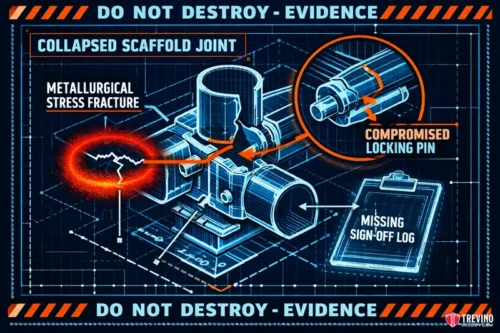
Physical evidence proving a scaffold was improperly erected includes compromised locking pins, missing cross-braces, metallurgical stress fractures, and the absence of a designated competent person sign-off log. You cannot rely on the general contractor’s incident report to prove a scaffold was improperly erected.
After a worker falls, the site supervisor often quickly replaces the missing toe boards before official investigators arrive. Securing victory in Bexar County courts requires immediate, aggressive evidence preservation.
We use a Spoliation Letter, a legal demand that stops them from destroying evidence, tailored to scaffolding components, to require that the exact rusted pins, bent frames, and frayed lifelines be quarantined and preserved.
With more than 80 personal injury law cases taken to trial, we force negligent corporate defendants to hand over the physical proof of their shortcuts.
Securing “Competent Person” Inspection Logs
Securing competent person inspection logs is vital because federal law requires a highly trained supervisor to inspect scaffolding for visible defects before every work shift. If the daily safety log is missing, blank, or signed by someone without proper safety credentials, it constitutes willful negligence.
We subpoena these daily safety briefs to show the general contractor knowingly allowed workers onto an uninspected, lethal structure. Essential steps to secure this proof include:
- Filing immediate demands to preserve all site safety documentation.
- Cross-examining the designated competent person on their actual qualifications.
- Comparing shift logs against the physical state of the scaffolding.
Can You Sue the Equipment Rental Company for Defective Scaffolding?
Yes, you can sue the equipment rental company or manufacturer if the scaffolding collapse resulted from inherent design flaws, pre-existing metal fatigue, or defective manufacturing rather than improper assembly. This applies to standard frames and suspension scaffolds, such as two-point adjustable suspension systems.
If a scaffold frame buckles under normal weight limits due to rusted internal components that the rental supplier failed to maintain, the rental supplier can be held strictly liable. Insurance adjusters will immediately attempt to minimize these claims by shifting the blame. Furthermore, suspension scaffolds require rigorous rope inspections, as failure can be catastrophic.
We aggressively litigate against corporate suppliers by investigating specific equipment failures, such as defective shoring props, bent outriggers, or malfunctioning hoists, ensuring all responsible parties pay for the harm caused.
Why Do High-Elevation Fall Damages Require Extensive Life Care Planning?
High-elevation fall damages require extensive life care planning because the extreme gravitational impact inherently causes permanent, serious injuries like spinal cord severing and traumatic brain injuries that demand decades of specialized medical intervention.
A 20-foot fall from a commercial scaffold does not result in a minor sprain; it results in life-altering trauma. To illustrate the severe risk of these specific elevations, Texas reported 52 fatal occupational injuries resulting from falls to a lower level between 6 to 30 feet in 2023 alone (Texas Department of Insurance, 2023).

Victims frequently require immediate airlift or trauma transport to facilities like the South Texas Medical Center or University Health System. Because the damage is permanent, you can’t base a fair settlement on only the first few months of hospital bills.
We prepare a Life Care Plan, a detailed roadmap of your future medical needs and lifetime costs. This meticulous calculation prevents insurance adjusters from lowballing families who will face decades of wheelchair accessibility costs, ongoing neurological care, and a complete loss of earning capacity.
How Do Medical Experts Calculate the Cost of a Scaffolding Spinal Injury?
Medical experts calculate the cost of a scaffolding spinal injury by analyzing the permanent loss of motor function and combining it with the projected inflation of surgical revisions, daily in-home nursing care, and specialized medical equipment over the victim’s natural life expectancy.
Trevino Injury Law leverages established relationships with medical experts to present undeniable proof of future damages. We do not just submit current medical bills; we litigate to a verdict using forensic economists and spinal specialists who can explain to a Bexar County jury exactly how a shattered vertebra will economically devastate a family without a maximum financial recovery.
Why Do Scaffolding Fall Injuries Frequently Exceed Workers’ Compensation Limits?
Scaffold accidents frequently exceed workers’ comp limits because standard workers’ comp only pays for basic medical care and a fraction of lost wages, completely ignoring the massive pain, suffering, and total loss of future earning capacity caused by paralysis or brain damage. When a worker suffers a spinal injury from a commercial scaffold collapse, the true lifetime cost easily ranges into the millions of dollars.
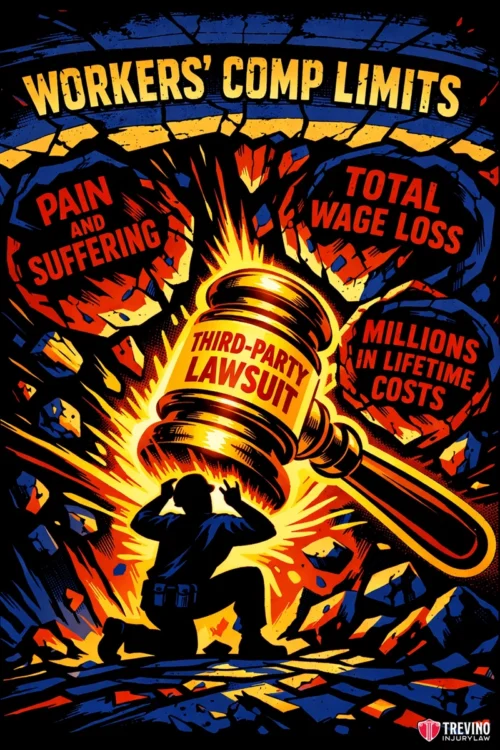
Filing a third-party personal injury lawsuit allows your family to pursue maximum compensation. For example, if you are an electrician whose scaffold was improperly built by a separate masonry subcontractor, you can sue that negligent subcontractor directly. We secured a $1.8 Million Settlement for a spinal injury, proving that aggressive third-party litigation is absolutely necessary to secure long-term financial stability.
How Does OSHA Investigate Fatal Scaffolding Drops?
OSHA investigates fatal scaffolding drops by securing the scene, conducting immediate interviews with the competent person, and issuing citations for specific code violations that your accident attorney will later use as evidence of negligence per se. A recent OSHA inspection following a 2025 scaffold incident in Port Arthur, Texas, resulted in four violations carrying a current penalty of over $61,000 (Occupational Safety and Health Administration, 2025). Following a severe fall, federal investigators will scrutinize several critical components, including:
- The structural grade of the scaffolding planking.
- The exact height and placement of guardrails.
- The availability and use of proper tie-off procedures.
We monitor this federal investigation closely. By utilizing the official findings and securing the citations, we build a bulletproof case against the commercial insurance companies and negligent corporate defendants. We use their own safety failures and code violations to force maximum financial recovery.
Can an independent subcontractor be liable for altering scaffolding?
Yes, an independent subcontractor can be held highly liable if they unauthorizedly removed cross-braces or guardrails from a scaffold to make their own work easier, thereby creating a fatal hazard for the next crew.
Other hazards include overhead power lines, where failing to take precaution is the third most common cause of death in the construction industry, frequently resulting in electrocution.
Do OSHA scaffold tagging rules affect worker liability?
No, the failure of a site supervisor to properly use red, yellow, or green scaffold safety tags falls entirely on the controlling employer’s negligence, not the injured worker.
How Do South Texas Weather Conditions Impact Scaffolding Safety?
South Texas weather conditions, such as sudden high-wind gusts and extreme heat, impact scaffolding safety by requiring contractors to utilize advanced tie-downs and strict work-stoppage protocols during severe weather events.
During unpredictable storm fronts near the Hill Country gateway, high winds can turn scaffolding planks into deadly projectiles or cause the entire structure to sway. A sudden weather shift in Leon Valley or Helotes demands immediate action from site supervisors.
If a contractor forces a crew to work on a high elevation during a wind advisory, they are strictly liable for the resulting falls. Refusing to halt work to save time directly causes catastrophic injuries.
What Happens If the Scaffold Lacked Required Guardrails and Toe Boards?
If a scaffold lacked required guardrails and toeboards, the contractor committed a serious OSHA violation, establishing clear liability not only for workers who fell but also for workers struck by falling tools or debris. The complete absence of standard edge protection demonstrates the site manager’s conscious decision to prioritize speed over human life. This active negligence directly inflates the value of the injury claim.
When Is a General Contractor Not Liable for a Scaffolding Collapse?
A general contractor is not liable for a scaffolding collapse unless they can definitively prove that a rogue employee or a trespassing third party intentionally vandalized or drastically altered a fully inspected, legally compliant scaffold without the contractor’s knowledge. General contractors will often try to blame the victim for using the scaffold incorrectly.
They use this tactic to minimize your settlement. Unless the worker deliberately defeated a known and functional safety device, the controlling employer remains financially responsible for the hazardous environment. We expose these blame-shifting tactics in court to ensure you get full compensation.
Why Hire a Construction Accident Lawyer?
Hiring an injury attorney is critical because negligent contractors will immediately hide physical evidence of OSHA scaffolding violations, requiring a trial-ready attorney to secure the proof and force maximum compensation for your permanent injuries.
Want to Protect the Full Value of Your Claim?
You’ve seen how this affects your case — but this is only one piece of the puzzle. Our Construction Accident Lawyer page breaks down what a trial-ready firm does differently.
Our trial authority is proven inside the Bexar County Courthouse, including a $7.9M recovery for work injuries. Before site supervisors destroy evidence, your personal injury accident attorneys will issue a spoliation letter to preserve the facts.
Do not give a recorded statement to the insurance adjuster. Contact Trevino Injury Law for a free consultation on a contingency-fee basis. Call 210-TREVINO. Se Habla Español.