A scaffolding platform gives way. An excavator bucket swings without a spotter. A trench collapses and buries you in seconds. You survived the initial trauma, but the corporate cover-up is already underway.
The general contractor’s insurance adjuster is currently rewriting the narrative, blaming you for a safety violation to protect their bottom line. According to the Texas Department of Insurance, Texas construction sites recorded 47 fatal occupational falls in 2023. Behind these casualties is a corporate defendant cutting corners on mandatory OSHA protocols to speed up a Bexar County build. That is not an unavoidable tragedy. That is negligence.
What Could Your Construction Accident Case Be Worth?
Answer a few quick questions about your accident. Takes about 60 seconds.
See What My Case Might Be WorthThe insurance company offered less than $20,000. I ended up with over $1 million. — Jackie Galindo
Physical evidence disappears rapidly on an active job site. Maintenance logs vanish, and skid marks fade before the official investigation concludes. A Spoliation Letter, a legal demand that prevents negligent contractors from destroying critical evidence, must be issued immediately. Texas gives you two years to file, but the corporate defendant deletes the equipment data in days.
Trevino Injury Law construction accident lawyers subpoena the site logs on day one and lock down the facts. Call 210-TREVINO now for a free case review. You pay nothing unless we win. Se Habla Español.
1. Falls from Heights (Scaffolding and Roofing)
Falls are among the leading causes of construction accidents in Texas. When a worker falls from a multi-story commercial building or a residential roof, gravity turns concrete and steel into deadly forces.
The resulting trauma is severe; victims frequently suffer traumatic brain injuries (TBI), spinal cord damage, and complex multi-bone fractures. Texas data from the Texas Department of Insurance shows that 47 fatal occupational injuries resulted specifically from a fall to a lower level in 2023.
In fast-growing San Antonio developments, contractors sometimes rush safety protocols to meet tight deadlines. They may skip mandatory OSHA fall-protection standards, fail to install a proper guardrail, ignore harness tie-off requirements, and build hasty elevation platforms.
Insurance adjusters will try to argue that the worker simply lost their balance. Our trial attorneys investigate the site to determine if the fall was the direct result of a corporate shortcut that compromised worker safety.
Scaffolding Collapses and Structural Failures
Scaffolding collapses occur when general contractors negligently overload platforms or use improper setups that fail to account for structural integrity checks. These compromised elevation platforms pose a constant threat to multi-story commercial projects and demand strict legal accountability when structural failures result in catastrophic injuries.
Roofing, Skylight, and Ladder Accidents
During routine construction work, roofing and ladder accidents occur when contractors fail to provide proper fall-arrest systems, such as safety harnesses. Nationally, data from the U.S. Bureau of Labor Statistics show that 96 fatal occupational injuries among roofing contractors in 2024 were caused by falls, slips, and trips.
These safety failures involve unprotected leading edges, fragile skylights, and defective ladders on high-pitch residential roofs in rapidly expanding areas like Alamo Ranch.
Understanding how elevation hazards cause trauma is just the first step, as the sheer volume of heavy machinery on these same sites creates an entirely different set of risks.
2. Struck-By, Heavy Equipment, and Work-Zone Vehicle Accidents
Struck-by accidents happen in the chaotic, loud environments of active construction zones. These incidents occur when workers are hit by moving construction equipment, swinging crane loads, or commercial vehicles operating with massive blind spots due to poor visibility. Because the impact involves thousands of pounds of force, the trauma often results in crushed extremities, internal organ damage, and amputations.
Near highway projects like the I-35 mixing bowl or Loop 410, these hazards merge OSHA’s “struck-by” category with severe transportation incidents. When an articulating dump truck backs over a worker or an excavator operator swings a bucket without a spotter, the corporate defendant’s insurance company will immediately try to blame the victim.
We aggressively subpoena equipment maintenance logs, black box data, and operator certifications to uncover equipment malfunctions or negligence to hold corporations accountable.
Crane, Forklift, and Heavy Equipment Accidents
Forklifts, excavators, and cranes cause devastating equipment injuries when rigging fails or operators lack necessary safety training. Our firm holds a proven track record against negligent corporations, including securing a $7.9 Million verdict for a crushed foot and amputated toe caused by a corporate defendant’s failure to safely operate site equipment.
Work-Zone Vehicles and Commercial Truck Deliveries
Highway and street construction workers face severe daily risks from passing traffic, commercial delivery trucks, and articulating dump trucks entering active work zones off the main road. In Bexar County, Texas Department of Transportation data shows there were 3,684 work-zone crashes in 2024, resulting in 12 fatalities and 49 suspected serious injuries. If a vehicle-related incident affects a worker, we aggressively fight commercial insurers to secure full compensation.
While moving equipment causes severe blunt-force trauma, the stationary hazards hidden below the ground present an equally lethal danger to excavation crews.
3. Caught-In/Between, Trench Collapses, and Crush Hazards
Caught-in/between hazards involve a worker being pinned, squeezed, or buried. Utilizing the precise OSHA classification, events occur when a worker’s body is crushed between heavy moving machinery and a fixed structure, or when the earth swallows them entirely during deep excavation.
Infrastructure projects across South Texas, including extensive pipeline installations in the Eagle Ford Shale, expose crews to these severe crush risks. The physical toll of a mechanical crush injury often involves compartment syndrome, shattered pelvises, and permanent loss of limb function.
To secure compensation, our firm investigates the site to determine exactly which subcontractor or general contractor failed to establish exclusion zones around moving machinery or properly shore up unstable soil.
In the landmark trench collapse case Enserch Corp. v. Parker, 794 S.W.2d 2 (Tex. 1990), the Texas Supreme Court affirmed that a corporate entity can be held liable for fatal excavation cave-ins if it retains control over the safety protocols or the specific work process that caused the hazard. We systematically uncover this chain of command to hold negligent companies accountable in court.
Why Trenching Cave-Ins Are Frequently Fatal
A trench collapse can bury workers in seconds, leading to mechanical asphyxiation. These fatalities occur because negligent contractors fail to properly slope, shore, or use trench boxes to stabilize the surrounding earth.
Texas data from the Texas Department of Insurance recorded 6 fatal occupational injuries in the construction sector resulting from collapses or engulfments in 2023.
Caught Between Machinery and Fixed Objects
Workers suffer massive blunt-force trauma when they get pinned between heavy moving machinery and a concrete wall or fixed structure. Nationally, U.S. Bureau of Labor Statistics data shows 35 construction workers suffered fatal occupational injuries from being struck, caught, or compressed by running powered equipment in 2024.
Whether pinned by a swinging excavator bucket or trapped against scaffolding, these crushing incidents require swift evidence preservation.
4. Electrocution and Utility-Contact Accidents
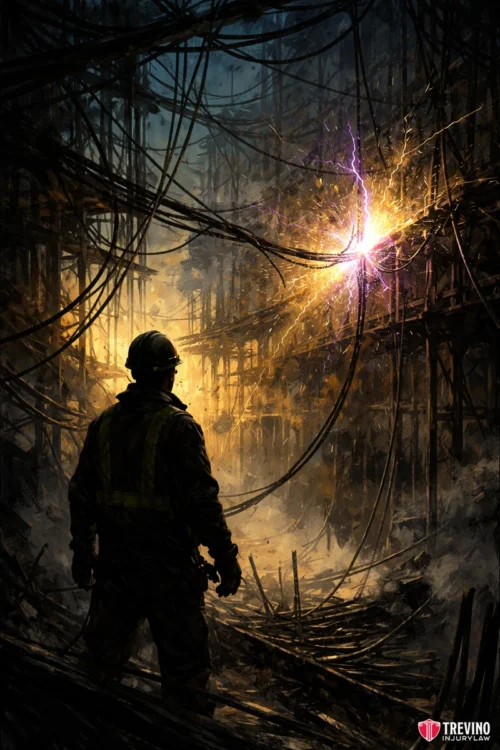
Electrical hazards are a severe danger on a multi-employer worksite. Electricity strikes in a fraction of a second when utility companies fail to de-energize lines or subcontractors negligently leave live wires exposed.
A failure in mandatory lockout/tagout protocols can send thousands of volts through a worker’s body upon contact with live circuits, causing severe electrical burns, cardiac arrest, and permanent nerve destruction.
Texas data from the Texas Department of Insurance shows that 8 fatal occupational injuries stemmed directly from exposure to electricity in the construction sector in 2023.
Because the energy frequently travels internally, surviving an electrocution requires specialized burn unit care, painful skin grafting, and years of physical therapy. We narrow our investigation strictly to electrical exposure, bringing in forensic experts to determine exactly who bypassed the critical safety checks.
By proving liability, we force the at-fault party to fund comprehensive life care plans that cover the massive, lifelong medical costs associated with these catastrophic burns.
Overhead Power Lines and Exposed Site Wiring
Site wiring hazards and line-contact accidents trigger deadly arc flashes and ground-fault circuit interrupter (GFCI) failures when general contractors skip mandatory safety checks. Surviving these severe electrical burns requires comprehensive life care planning. We utilize these detailed roadmaps of future medical needs and costs to calculate total damages and force insurers to pay.
Recognizing the specific mechanism of your severe injury provides the factual foundation of your case, but establishing exactly who holds the legal responsibility for these failures determines your family’s financial future.
Who Is Liable for Construction Accidents in Texas?
Multiple parties on a multi-employer worksite can be held liable for your Texas construction accident. However, when pursuing property owners for known dangers, your claim must navigate the strict limitations of Texas Civil Practice & Remedies Code Chapter 95.
As defined in the landmark case Abutahoun v. Dow Chemical Co., 463 S.W.3d 42 (Tex. 2015), injured independent contractors must prove the property owner retained control over the work and had actual knowledge of the hazard. We systematically prove these elements to hold general contractors, subcontractors, property owners, and non-subscriber employers fully accountable, leveling the playing field between injured families and powerful corporations.
Responsibility rarely falls on just one party when you are catastrophically injured on a complex commercial or residential development. Finding every responsible entity is how our trial attorneys force insurance companies to pay maximum compensation. Before we ever set foot in the Bexar County Courthouse, we thoroughly investigate the worksite to identify and hold accountable all negligent parties:
- General Contractors: For overall site safety failures and ignoring mandatory OSHA regulations.
- Subcontractors: For creating specific, localized hazards that injure other crews.
- Property Owners: Under premises liability laws, for hiding known, dangerous conditions from workers.
- Non-subscriber Employers: Texas doesn’t require private employers to carry traditional workers’ compensation coverage, meaning those who opt out can be sued directly for negligence.

Knowing exactly who to hold responsible sets the stage, but understanding the immediate legal steps to protect that claim is what ultimately secures your financial recovery.
How to Preserve Evidence After a Severe Site Accident
You must preserve evidence immediately after a severe site accident by securing medical attention, safely photographing the hazardous condition, hiring legal counsel to send a spoliation letter that prevents contractors from destroying logs, and executing public records requests for official OSHA citations before the general contractor alters the scene.
Proving a third party’s negligence requires immediate action because active job sites change rapidly. We take aggressive steps in the first week to secure video, witness statements, and medical records in formats that are admissible in court. To properly secure your claim, you should follow these specific steps:
- Secure medical attention and photograph the hazard before it is fixed, removed, or covered up by the crew.
- Send a Spoliation Letter, a legal demand that legally stops contractors from deleting black box data or destroying equipment maintenance logs.
- Execute public records requests for official OSHA citations, police reports, and site inspection records to establish a timeline of negligence.
Can I Take Photos of the Job Site After My Injury?
Yes, you should safely take photos of the job site immediately after your injury to document the hazard before the general contractor alters the scene.
Do I Need to Wait for OSHA Before Contacting a Lawyer?
No, you should never wait for OSHA before contacting a lawyer because federal investigations take months while critical physical evidence on the site disappears daily.
Workers’ Comp vs. Third-Party Injury Claims
While workers’ compensation covers only basic medical care and a portion of your lost wages for workplace injuries, a third-party personal injury lawsuit allows injured workers to exercise their full legal rights to recover full earning capacity, future life care costs, and non-economic damages for pain and suffering. Understanding this distinction is vital for families facing catastrophic injuries in places like the Medical Center or fast-growing North Side developments.
Settlement mills might push for a quick, low-value workers’ compensation resolution to close the file fast. In contrast, our trial attorneys meticulously investigate the job site to look for every negligent third party, ensuring we maximize your financial recovery and hold the right corporations accountable.
| Feature | Workers’ Compensation | Third-Party Injury Claim |
| Damages Recoverable | Basic medical care and partial lost wages. | Full earning capacity, pain and suffering, and future care. |
| Fault Requirement | No-fault system (fault does not matter). | Must prove the third party’s negligence caused the injury. |
| Target Defendant | Your direct employer’s insurance policy. | General contractors, subcontractors, or equipment manufacturers. |
What Happens If Your Employer Tries to Hide the Accident?
If your employer tries to hide the accident by unlawfully failing to report the injury to OSHA or covering up the safety failure, you must immediately contact an attorney to document your injuries and secure an independent record of the crash.
This lack of official documentation poses significant risks to your case. Unscrupulous contractors on large commercial builds near Southtown or JBSA-Lackland sometimes pressure injured workers to use personal health insurance or promise cash under the table. Without an official incident report, the insurance adjuster will inevitably deny that the event ever happened.
We aggressively combat this lack of documentation by quickly gathering witness statements, securing medical records that explicitly state the workplace cause of injury, and bringing the truth to light through relentless litigation against the negligent parties.
How Delaying an Investigation Destroys Your Injury Claim
Delaying an investigation destroys your injury claim because once the general contractor repairs the defect, removes the faulty equipment, or completes that phase of the build, critical physical evidence vanishes permanently, making it exponentially harder to prove negligence.
While the Texas statute of limitations technically gives you time to file a lawsuit, waiting can significantly affect your ability to preserve evidence. In rapidly developing areas like Westover Hills, job sites evolve daily. If you wait months to take action, skid marks fade, scaffolding is completely dismantled, and crucial eyewitnesses move on to other projects.
This expiration of opportunity allows corporate defendants to falsely blame you for the accident. By hiring a trial-ready attorney within the first week, you prevent the destruction of evidence and compel the insurance company to confront undeniable facts.
Why Hire a Construction Accident Lawyer?
You should hire a San Antonio construction accident lawyer immediately because general contractors will quickly alter the scene to destroy critical evidence. Our injury lawyers will step in to preserve the facts, prove third-party negligence, and secure maximum compensation.
Want to Protect the Full Value of Your Claim?
You’ve seen how this affects your case — but this is only one piece of the puzzle. Our Construction Accident Lawyer page breaks down what a trial-ready firm does differently.
We back our trial authority with results, like our $7.9M verdict for work injuries. Before the defense alters the scene, the proven personal injury lawyer in San Antonio will execute a spoliation letter to preserve critical evidence. When we enter the Bexar County Courthouse, we demand maximum compensation.
Do not give a recorded statement to the insurance adjuster. If you need legal help, contact Trevino Injury Law at 210-TREVINO for a free consultation. Se Habla Español.