To prove a general contractor is liable for your workplace injury, you must definitively establish that they exercised actual or contractual control over your physical work and daily safety procedures.
The general contractor is already deploying rapid-response teams to alter the physical accident scene and falsely claim that your direct employer had sole authority over the hazardous area.
According to the U.S. Bureau of Labor Statistics, construction and extraction occupations suffered 1,032 fatal injuries across the country in 2024. Behind these catastrophic incidents is a master contractor who bypassed trenching protocols or ignored fall protection standards to protect their project timeline.
What Could Your Construction Accident Case Be Worth?
Answer a few quick questions about your accident. Takes about 60 seconds.
See What My Case Might Be WorthThe insurance company offered less than $20,000. I ended up with over $1 million. — Jackie Galindo
Their daily site logs and internal corporate communications prove who was actually giving orders, but that documentation vanishes under standard retention policies. A Spoliation Letter, a legal demand that prevents the property owner from destroying evidence, must be issued immediately to lock down the superintendent’s reports.
Trevino Injury Law construction accident lawyers will subpoena this evidence on day one to bypass workers’ compensation caps. Call 210-TREVINO now for a free case review. You pay nothing unless we win. Se Habla Español.
The Legal Standard for General Contractor Liability in Texas
Under Texas law, general contractors are generally shielded from liability for a subcontractor’s severe injury unless the injured worker can definitively prove that the master contractor retained and explicitly exercised specific control over the job site’s daily safety procedures and physical work methods. This control must extend to the “means, methods, or details” of the independent subcontractor’s work.
Texas law traditionally protects property owners and general contractors from the independent negligence of specialized independent contractors. However, in heavy commercial developments near the South Texas Medical Center and massive master-planned communities like Alamo Ranch, where multi-tiered contractor structures are common, establishing liability requires determining whether the master contractor compromised worker safety.
We litigate to a verdict by systematically dismantling this corporate shield to hold the right parties accountable for catastrophic injuries.
Overcoming Chapter 95 of the Texas Civil Practice and Remedies Code
If the general contractor also owns the property or acts as the premises owner, Chapter 95 of the Texas Civil Practice and Remedies Code requires us to prove they had actual knowledge of the unsafe condition and still failed to adequately warn you. The Texas Supreme Court clarified the strict application of this dual-pronged burden in Abutahoun v. Dow Chemical Co., 463 S.W.3d 42 (Tex. 2015), ruling that Chapter 95 serves as the exclusive remedy against a property owner for independent contractor negligence claims arising from the condition or use of an improvement to real property.
This specific statute creates a strict dual-pronged burden of proof for injured workers navigating the legal system. Our trial attorneys must comprehensively establish both that the master contractor exercised explicit control over the specific hazardous activity and possessed actual knowledge of the condition that caused the injury long before the catastrophic accident occurred.
Contractual Control vs. Actual Control on a Construction Site
Proving legal liability in Texas requires demonstrating either contractual control, where the master service agreement explicitly grants safety authority to the general contractor, or actual control, where site superintendents actively directed your specific physical tasks immediately before the catastrophic construction accident occurred.
The distinction between these two forms of authority is deeply rooted in the landmark case Dow Chemical Co. v. Bright, 89 S.W.3d 602 (Tex. 2002), where the Texas Supreme Court established that merely having the right to stop work or requiring general compliance with safety standards does not, on its own, constitute sufficient control to impose liability.
We use targeted discovery to establish these distinct forms of authority over the work environment:
| Type of Control | Legal Definition | Forensic Evidence Required |
| Contractual Control | Subpoenaing the master contract, safety addenda, and subcontractor agreements. | Subpoenaing the master contract, safety addendums, and subcontractor agreements. |
| Actual Control | Master service agreements explicitly grant the general contractor authority over safety procedures and work methods. | Daily site logs, witness statements, and internal corporate emails regarding site operations. |
Overcoming these strict statutory hurdles and proving exact levels of control lays the foundation for understanding the specific documentation required to build your case.
Forensic Evidence Used to Prove a General Contractor’s Duty of Care
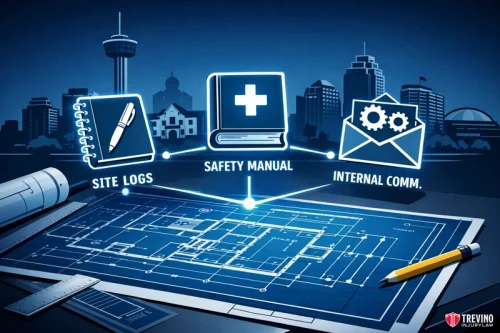
To prove a general contractor is liable for your injury, we must show they controlled your specific physical work. Your trial attorney must immediately subpoena three critical pieces of evidence:
- Daily Site Logs: These show who was on site and giving orders.
- Formal Safety Manuals: These prove that the general contractor assumed responsibility for site safety.
- Internal Corporate Communications: These reveal if onsite superintendents actively directed the specialized subcontractor’s daily operations.
Settlement mills often wait months to gather evidence. This delay allows critical proof to vanish. A trial-first firm immediately targets the general contractor’s comprehensive documentation. Our legal team ensures early preservation of evidence through aggressive legal demands. We specifically target job sites across Bexar County, from downtown high-rises to commercial projects along Loop 1604. We know their playbook and we shut it down by legally forcing the immediate disclosure of every superintendent’s daily report.
Beyond gathering corporate documents and witness testimony, preserving this evidence requires anticipating the aggressive strategies companies use to hide their negligence.
Establishing Liability Through Site Safety Manuals
Comprehensive site safety manuals legally establish a strict duty of care by providing documented proof that the master general contractor formally assumed the absolute responsibility for enforcing vital safety precautions across all contractors and subcontractors on site. The specific standards they dictate often include:
- Enforcing strict fall protective requirements.
- Mandating rigorous trenching protocols.
- Overseeing heavy equipment operational standards.
If the general contractor’s formal manual dictates exactly how a subcontractor must work safely, the general contractor has exercised contractual control. When those safety systems fail and result in severe injury, the general contractor may be responsible for the harm.
The Role of Witness Statements in Proving Actual Job Site Control
Immediate witness statements from your immediate coworkers and other specialized trades are absolutely critical because they provide objective, independent verification that the general contractor’s superintendent visually observed the hazardous site condition and directly ordered the physical work to continue anyway.
There is an urgent need to secure these recorded statements immediately after a severe workplace accident. We act fast to capture this crucial testimony before memories naturally fade, site conditions are rapidly altered by the defense, or workers with specialized skills are heavily intimidated into silence by their direct employers.
Beyond gathering corporate documents and witness testimony, preserving this evidence requires anticipating the aggressive strategies companies use to hide their negligence.
Corporate Defense Tactics and Evidence Destruction Policies
General contractors and their insurers frequently attempt to avoid financial liability immediately following a catastrophic incident. They rapidly deploy rapid response teams to minimize their financial exposure by:
- Altering the physical accident scene.
- Destroying internal digital communications under standard corporate retention policies.
- Falsely claiming your direct subcontractor employer had sole authority over the hazardous area.
Our firm has a proven history of combating these calculated delay tactics. We aggressively fight for families against powerful corporate defendants across South Texas. We do not let negligent companies hide behind complex contractor hierarchies. We refuse to let them shift the blame onto the injured worker.
Using Spoliation Letters to Preserve Subcontractor Communications
Issuing an immediate, aggressive spoliation letter is a critical early legal maneuver that legally compels the master general contractor and all involved corporate entities to permanently preserve internal emails, text messages, safety logs, and any available site surveillance footage.
A spoliation letter is a formal legal demand that stops them from willfully deleting critical evidence related to your severe injury. By issuing this aggressive demand on day one, we completely protect the plaintiff’s ability to prove control in court, showing the defense that we are checking trial boxes and fully preparing to litigate to a final verdict.
To stop the destruction of critical evidence, your attorney must immediately use aggressive legal measures, which ultimately determine the financial outcome of your case.
For the filing timeline that runs alongside these evidence-preservation steps, see Texas construction accident filing and notice deadlines.
How Does Proving General Contractor Liability Impact Your Financial Settlement?
Successfully proving a general contractor’s liability allows your trial attorney to completely bypass the severe financial caps of the state workers’ compensation system and aggressively pursue a multi-million dollar third-party lawsuit for your medical bills, total lost earning capacity, future medical care, and lifelong physical impairment.
Injured workers often falsely believe they are strictly limited to meager workers’ compensation checks that barely cover basic household bills and initial hospital visits. By establishing independent third-party liability, we completely open the door to full tort damages against the negligent master contractor or premises owner. We litigate to verdict to secure justice for families devastatingly affected by construction accidents along major South Texas growth corridors like I-10 and I-35.
For example, when a corporate defendant tried to offer an incredibly inadequate settlement, our legal team took the case to trial and secured a $7.9 Million Verdict for a crushed foot and amputated toe. This life-changing outcome clearly demonstrates the vast difference in financial compensation when third-party liability is successfully established by a San Antonio personal injury firm that flatly refuses to settle for less.
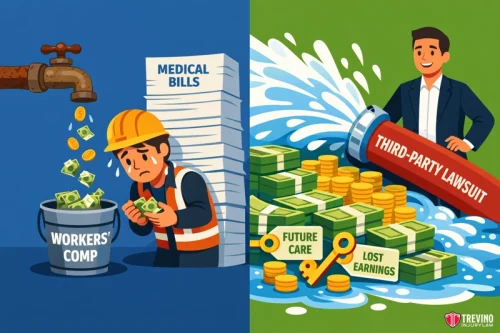
Establishing who is liable lays the foundation for understanding the specific OSHA violations, legal exceptions, and financial consequences that determine the full compensation your family is legally entitled to recover.
For the broader recovery options that become relevant when an outside contractor may be responsible, see compensation beyond workers’ comp after a Texas construction accident.
Common OSHA Violations That Implicate a General Contractor
The most frequent OSHA violations that establish a general contractor’s negligence under the Multi-Employer Citation Policy include three systemic failures:
- Failed to follow safety procedures for proper fall protection.
- Improper and unsafe scaffolding construction.
- Ignored or entirely bypassed trenching protocols.
The lethal consequences of these specific failures are undeniable; in fact, across the U.S., construction and extraction occupations suffered 1,032 fatal injuries, including 370 deaths specifically caused by fatal falls, slips, and trips (U.S. Bureau of Labor Statistics, 2024). Under OSHA’s Multi-Employer Citation Policy, a “controlling employer” is liable for safety violations even if their direct employees were not exposed to the hazard.
A general contractor breaches their legal duty of care when they actively create, control, or fail to correct severe hazards. This includes leaving exposed electrical wiring on a commercial build near SH-151. This federal standard aligns closely with the Texas legal standard of “control”. Proving these systemic failures allows a Texas construction accident lawyer to definitively establish the general contractor’s underlying negligence.
Can a general contractor be liable for an independent contractor’s negligence?
Yes, contractors are responsible and can be held liable for an independent contractor’s negligence if your trial attorney proves they retained actual or contractual control over the specific activity or condition that caused the catastrophic injury.
Do you need a signed contract to prove general contractor liability in Texas?
No, you do not need a signed contract to prove general contractor liability if your trial lawyer can demonstrate that the general contractor exercised actual, physical control over your daily tasks and safety procedures.
Texas General Contractor Liability vs. Subcontractor Employer Immunity
While your direct subcontractor employer is typically shielded from personal injury lawsuits by the Texas workers’ compensation exclusive remedy rule, the general contractor does not share this immunity and can be sued directly for their independent negligence.
General contractors vs independent subcontractor liability rules mean multiple parties can involve shared liability and be partially responsible, but workers’ compensation protects the direct employer.
In Texas, the workers’ compensation system heavily protects your direct employer from being sued, even if their gross negligence caused your severe injuries. It is worth noting that 24% of Texas private-sector employers were non-subscribers, meaning they lose statutory liability limits and may be sued directly by injured employees (Texas Department of Insurance, 2024).
However, even if your direct employer is a subscriber, a third-party general contractor operating on a massive project in areas like Leon Valley or near Joint Base San Antonio does not automatically receive this same legal protection. When a general contractor’s negligent actions cause a catastrophic injury, a dedicated trial attorney can help injured workers pursue them directly outside of the workers’ compensation system.
| Legal Factor | Direct Subcontractor Employer | Third-Party General Contractor |
| Legal Immunity | Protected by the workers’ compensation exclusive remedy rule. | No automatic legal immunity; fully exposed to direct third-party lawsuits. |
| Available Damages | Capped economic benefits for medical care and lost wages only. | Full tort damages, including physical impairment and pain and suffering. |
| Standard of Proof | No-fault system (specific negligence does not need to be explicitly proven). | Must definitively prove actual or contractual control and explicit negligence. |
The Financial Impact of Failing to Prove Contractor Control
If your legal team cannot prove that the general contractor on a construction site retained control over your work environment, your third-party lawsuit will likely be dismissed, leaving your family entirely dependent on inadequate, capped workers’ compensation payments.
The negative consequences of failing to establish this vital legal connection are financially devastating for injured workers and their families. Without definitive proof that the general contractor controlled the specific hazard and caused the damage, you are trapped within the restrictive Texas workers’ compensation system.
This severely limits your financial recovery, entirely stripping away your right to pursue non-economic damages like lifelong pain and suffering, mental anguish, or compensation for permanent physical disfigurement following a severe site accident. We fight to prevent this outcome by relentlessly pursuing the corporate documentation necessary to establish absolute liability.
Legal Exceptions to General Contractor Liability in Texas
A general contractor is legally shielded from liability if the injury resulted from a hazard entirely created by the subcontractor, and the general contractor had absolutely no knowledge, contractual authority, or actual control over that specific condition or the omissions of its employees.
The law creates clear boundaries protecting property owners and master contractors from hazards they legitimately had no part in creating or controlling. If your direct employer independently alters a safe worksite, such as bringing in defective equipment without authorization, and the general contractor truly had no opportunity to discover or correct the danger, third-party liability claims will fail.
Because these legal thresholds are incredibly complex, securing an immediate case evaluation from a San Antonio personal injury lawyer at Trevino Injury Law is the only way to accurately determine if you have a viable claim against a negligent general contractor.
Why Hire a Construction Accident Lawyer?
You must hire personal injury crash attorneys to immediately secure site logs before the general contractor destroys them, bypass the inadequate workers’ compensation system, and force negligent corporate defendants to pay maximum compensation for your injuries.
General contractors will rapidly delete critical evidence and shift the blame to avoid liability. We know their playbook, and we shut it down. We litigate to a verdict to secure full financial recovery.
Want to Protect the Full Value of Your Claim?
You’ve seen how this affects your case — but this is only one piece of the puzzle. Our Construction Accident Lawyer page breaks down what a trial-ready firm does differently.
When a defendant tried to lowball an injured worker, we fought at the Bexar County Courthouse and secured a $7.9 million verdict for a crushed foot. You need the best construction accident attorney who immediately executes spoliation letters to preserve critical superintendent logs before they vanish.
Do not give a recorded statement to any Insurance Adjuster. Call our San Antonio personal injury lawyers at 210-TREVINO for a free consultation on a contingency-fee basis. Se Habla Español. Contact us.