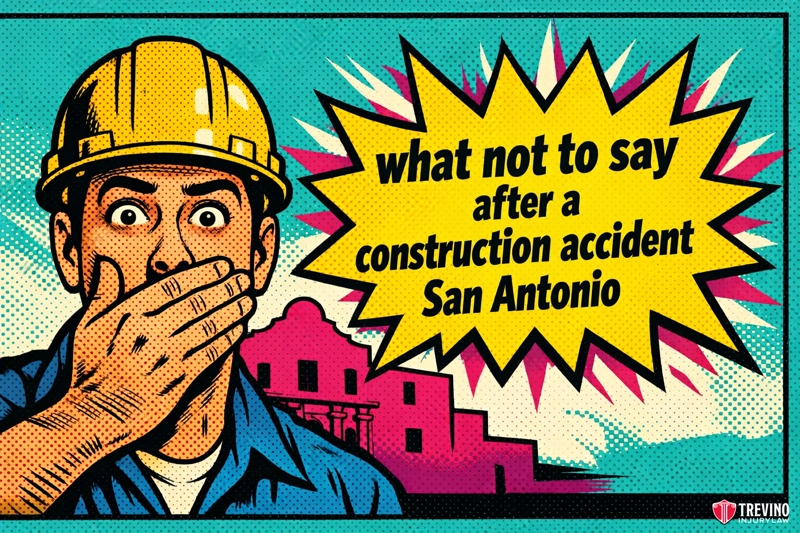
Never tell the site superintendent you are okay, and never apologize for the hazard that crushed you. Corporate safety directors at job sites near Alamo Heights or Stone Oak are already twisting your basic politeness into a formal admission of liability. They document casual remarks to shield negligent subcontractors from accountability.
Trevino Injury Law secured a $7.9 Million verdict for a crushed foot and amputated toe because our trial team knows how to block these exact verbal traps. Once a polite remark is added to the incident report, the commercial adjuster uses it to permanently lock you out of compensation.
What Could Your Construction Accident Case Be Worth?
Answer a few quick questions about your accident. Takes about 60 seconds.
See What My Case Might Be WorthThe insurance company offered less than $20,000. I ended up with over $1 million. — Jackie Galindo
Evidence disappears rapidly after a commercial site failure. A Spoliation Letter, a legal demand that prevents the property owner from destroying evidence, must be issued immediately. You have thirty days to formally report the workplace incident to your employer, but speaking to their risk managers without legal protection destroys your leverage.
Trevino Injury Law construction accident attorneys will silence the insurance adjusters and secure the site data before it vanishes. Call 210-TREVINO now for a free case review. You pay nothing unless we win. Se Habla Español.
Never Say “I’m Okay” or Apologize to Your Site Superintendent
Never tell your employer, “I’m okay” or “It was my fault.” HR representatives will immediately use these phrases against you. They will document that no third-party negligence occurred. Protect your rights and timely report your injury. Remain absolutely silent regarding fault.
The immediate aftermath of a commercial build crash is chaotic. Adrenaline often masks severe spinal or crush injuries. Because of this adrenaline rush, stating “I’m okay” is medically inaccurate before you begin medical treatment or physical therapy. It also provides the Insurance Company with early ammunition to deny your claim and force a lowball settlement during negotiation.
Corporate safety directors at job sites near Alamo Heights or Stone Oak are highly trained. They twist basic politeness into a formal admission of liability. They document casual remarks to shield negligent subcontractors from accountability. We know their playbook. A single polite remark can derail your fight for maximum compensation for your medical bills, future medical needs, lost wages, and pain and suffering.

Instead of apologizing, use this safe script to establish basic facts: “I was injured by falling debris at 2 PM at the Loop 1604 site. I need to see a doctor immediately.” This reports the injury without giving the other side ammunition.
How the Phrase “I’m Sorry” Acts as an Admission of Fault in Texas
Apologizing after a job site crash is routinely construed as an admission of fault. This reflex can shift liability from a negligent subcontractor to you. Texas follows modified comparative negligence. If a Bexar County jury finds you more than 50 percent responsible for your own injury, you recover nothing.
The Texas Supreme Court reinforced the strict application of proportionate responsibility in the landmark case Nabors Well Services, Ltd. v. Romero, 456 S.W.3d 553 (Tex. 2015). This ruling establishes that any evidence increasing your percentage of fault directly reduces your financial compensation. If an Insurance Adjuster twists your polite apology to push your fault to 51 percent, your claim is entirely barred.
You must state only objective facts. Never offer subjective apologies. Our trial-proven law firm has seen how a simple apology complicates a clear-cut case. We secured a $7.9 Million Verdict for a crushed foot, even though the last offer was only $1.3 million. We know that precision in your language prevents corporations from escaping responsibility.
Once you successfully navigate the initial employer interaction without admitting fault, you will inevitably face far more sophisticated traps deployed by corporate insurance adjusters.
Refuse All Recorded Statements Requested by Commercial Insurance Adjusters
You must actively refuse to provide recorded statements to commercial insurance adjusters. Adjusters often use rehearsed empathy and leading questions to trick you. They want you to minimize your catastrophic injuries on tape so they can later argue that your injuries are not severe.
The Insurance Adjuster has a duty to protect their corporate bottom line, not to pay you fair compensation. Their job is to protect the insurer. You are not obligated to give a recorded statement to an opposing adjuster without your Plaintiff Trial Lawyer present to object to their manipulative tactics.
A recorded statement is only one of several decisions that matter immediately after a site injury. The immediate steps after a San Antonio construction accident also cover emergency response, medical care, reporting, and preserving the scene.
Within 24 hours of an accident along the I-10 corridor, major commercial carriers deploy rapid-response teams. They try to capture statements early in the timeline. These adjusters adopt a friendly persona. They express false concern for you and your family. Their actual goal is to secure a recorded conversation that destroys third-party liability claims.
We have taken 80+ jury trials in personal injury cases. We constantly see adjusters use these recordings to claim your injuries were pre-existing. Agreeing to a seemingly harmless conversation gives the Insurance Adjuster complete control over the narrative as they transcribe your words.

They will lie to avoid paying. As our client Jesus M. experienced: “Despite clear dashcam evidence of an 18-wheeler driver’s fault, their insurance company denied responsibility until Trevino Injury Law secured maximum compensation“.
Specific Trigger Words That Automatically Ruin Your Injury Claim
An adjuster may ask for additional information using speculative phrases or asking for definitive estimates of speed or distance. This will trigger immediate claim denials. You must completely eliminate this dangerous vocabulary when determining what to say to insurance representatives.
- “I guess” or “Probably”: Creates immediate doubt about third-party liability. It establishes a lack of definitive facts.
- “I’m feeling fine today”: Actively used to terminate your ongoing medical care. Adjusters use this to argue you have reached maximum recovery.
- “It happened so fast”: Used by the defense to argue you were not paying attention. It implies a lack of situational awareness.
While you may successfully avoid these trigger words in formal statements, adjusters will aggressively search for them in your public digital footprint.
You must lock down and stop posting on all social media platforms. Defense attorneys actively scrape Facebook and Instagram. They look for photos or comments that contradict your claims of physical trauma. Complete digital silence is mandatory to protect the integrity of your Litigation.
Commercial defense firms in Texas utilize sophisticated surveillance tactics. They monitor everything you do online. Even posting an old photo of a family gathering at the San Antonio River Walk or Southtown can be weaponized against you. Defense teams will present these images to a Bexar County jury. They will argue that you are not in chronic pain from a trench collapse.

We know their playbook. They want to paint you as a fraud to avoid paying a massive settlement. Protecting your digital footprint is just as critical as seeking emergency medical attention or securing your medical records.
The Myth of “Private” Accounts and “Friends-Only” Posts in Texas Injury Claims
Setting your social media accounts to private will not protect your statements or photos. Texas judges routinely compel injured workers to hand over their entire digital history. This happens during the discovery phase of a lawsuit. Assume everything you post will be seen by opposing counsel.
Defense attorneys almost always use legal subpoenas to bypass privacy settings. They can legally force you to produce your hidden content. Furthermore, deleting old posts after the accident constitutes spoliation of evidence. This carries severe legal penalties and instantly destroys your credibility. The only safe strategy is complete digital inactivity.
Controlling your formal narrative and public digital footprint empowers you to confidently execute the procedural steps required to protect your case before taking legal action.
Only First Responders and OSHA Can Legally Demand Your Immediate Statement
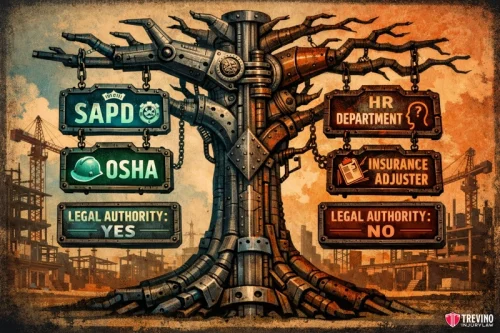
These injuries are unfortunately common; in 2024, the incidence rate for total recordable nonfatal cases in the Texas construction industry was 1.3 cases per 100 full-time workers (Texas Department of Insurance, 2024). You must formally report the workplace incident to your employer within 30 days of the accident to protect your rights. However, only official first responders like the SAPD and federal OSHA investigators have the legal authority to demand your immediate written statement. You are required to provide these neutral, official investigators with the basic facts of the crash.
This authority does not extend to your company’s HR department. It does not extend to their commercial insurance carrier. You must notify your employer that you were injured on the site. However, you do not have to provide exhaustive narratives to their internal risk managers in the absence of a Plaintiff Trial Lawyer.
While you stay silent, our legal team builds your case. In the first week, we bypass HR completely. We analyze the police report and immediately send FOIA requests for dash cam and body cam footage to preserve the real evidence.
Knowing exactly who holds legal authority leads directly to the specific methods for declining aggressive corporate questioning.
How to Legally Decline Aggressive Questioning From a Safety Director
You can legally decline aggressive questioning from a site safety director immediately following a crash. Respectfully state your need for emergency medical evaluation. Firmly demand that all further communication be routed exclusively through your Plaintiff Trial Lawyer. If you are unsure, establish an attorney-client relationship immediately.
At a bustling site near Alamo Ranch, safety directors will try to corner you before the ambulance arrives. Protect yourself using these precise steps:
- Acknowledge the incident occurred to establish a baseline record.
- Refuse to speculate on causes or whose fault it was.
- Request immediate transport to a trauma center.
- State that your legal counsel will provide a formal written account once you are stabilized.
Do I have to sign a pre-written incident report if I disagree with the wording?
No. You are never legally required to sign an employer’s pre-written incident report if it inaccurately describes the hazard or fabricates statements you did not make.
Can HR force me to give a recorded statement before allowing me to see a doctor?
No. It is highly illegal and a direct violation of OSHA regulations for a Texas employer to withhold emergency medical care in exchange for a recorded statement.
Deflecting verbal questions often leads safety directors to pressure you into signing pre-written documentation. Understanding how these informal traps compare to formal legal proceedings is vital to your case.
Recorded Statements vs. Formal Legal Depositions
A recorded statement is a manipulative trap designed by an aggressive adjuster to ruin your claim early. A formal deposition is a strictly controlled legal proceeding. In a deposition, your Plaintiff Trial Lawyer aggressively protects your rights and objects to improper corporate questioning.
- The Interrogator: Adversarial Adjuster aiming to minimize liability vs. Opposing Counsel with your lawyer present to object.
- The Goal: Deny your claim and extract damaging trigger words vs. Establish legal facts for the Bexar County Courthouse.
- The Timing: Days after injury, while you are vulnerable or medicated, vs. Months later, during discovery, fully prepared by counsel.
Understanding the permanent nature of these statements highlights the devastating consequences of taking the refuse to speak advice too far.
The Danger of Total Silence: Why You Must Still Report the Injury
You must fiercely avoid giving recorded statements to deceptive adjusters. However, you cannot remain completely silent. Failing to provide basic factual notice of your injury to your employer within 30 days of the accident will permanently destroy your rights.
If you are injured on a Loop 410 highway project, you must establish the who, what, where, and when with your HR department. This ensures there is a documented record that the crash occurred on the job site. You must absolutely refuse to offer the why or how. Providing basic facts keeps your claim alive. It denies the Insurance Company the subjective ammunition they need to attack your credibility.
Because you are required to establish basic facts, you must also understand the strict legal boundaries where answering detailed questions becomes mandatory.
If your employer responds to that report by cutting hours, demoting you, or ending your employment, the next issue is construction injury retaliation in Texas and the records that can show when the adverse action began.
The Deposition Exception: When You Are Legally Compelled to Answer Questions
The only time you are legally compelled to answer a corporate defense attorney’s questions is during a formal, sworn deposition. This happens under oath. It only happens with your Plaintiff Trial Lawyer sitting next to you to actively object to manipulative tactics.
A deposition is a highly controlled legal environment. It is radically different from the unregulated phone calls initiated by an Insurance Adjuster. During a deposition regarding an I-35 commercial build accident, our trial team thoroughly prepares you. We sit beside you to block improper interrogations. We ensure the defense cannot twist your words.
Why Hire a Construction Accident Lawyer?
You must hire a trial-proven personal injury wreck lawyer immediately to represent you. We block deceptive HR representatives and aggressive insurance adjusters from twisting your recorded statements.
The dangers on these job sites are profound. Nationally, the construction industry accounted for 1,034 fatal work injuries in 2024 alone (U.S. Bureau of Labor Statistics, 2024). Do not fight massive commercial builders alone.
Want to Protect the Full Value of Your Claim?
You’ve seen how this affects your case — but this is only one piece of the puzzle. Our Construction Accident Lawyer page breaks down what a trial-ready firm does differently.
We know their playbook. We have 20+ years of experience in personal injury law and have taken 80+ cases to trial. Our results are proven at the Bexar County Courthouse, including a $7.9 million verdict for a crushed foot where the final offer was a mere $1.3 million. T
o protect your future, a construction accident attorney from our team will immediately issue a spoliation letter to freeze evidence before it “disappears” from the job site. We fight for families and force them to pay.
Never let an adjuster record your voice. Call us at Trevino Injury Law immediately at 210-TREVINO for a free consultation. Se Habla Español.