No, a pedestrian is not automatically at fault after a collision simply because they crossed outside a marked crosswalk or wore dark clothing. The law places a higher burden on the driver who possessed the last clear chance to avoid the impact.
The insurance adjuster assigned to your claim is already building a “darting out” defense to classify your severe injuries as a sudden emergency and shift the majority of the blame onto you. That tactic is common in Texas pedestrian accident liability disputes, where insurers try to reframe clear driver negligence as pedestrian fault.
What Could Your Pedestrian Accident Case Be Worth?
Answer a few quick questions about your accident. Takes about 60 seconds.
See What My Case Might Be WorthThe insurance company offered less than $20,000. I ended up with over $1 million. — Jackie Galindo
According to the Texas Department of Transportation, a driver’s failure to yield the right of way was a factor in 1,373 urban crashes in 2024. Behind those impacts are speeding motorists and distracted drivers who ignored their continuous duty to brake or maintain focus near intersections.
Critical physical evidence vanishes within the first week. A Spoliation Letter, a legal demand that prevents the property owner from destroying evidence, must be issued immediately to lock down commercial telemetry and nearby surveillance video. Texas gives you two years. After that, the claim is gone.
Trevino Injury Law pedestrian accident attorneys will secure the dashcam footage on day one and hold the negligent driver liable. Call 210-TREVINO now for a free case review. You pay nothing unless we win. Se Habla Español.
Is a Pedestrian Automatically at Fault for “Jaywalking” or Darting Out in Texas?
A pedestrian is not automatically at fault for “jaywalking” or crossing outside marked crosswalks; Insurance Adjusters aggressively use the “darting out” defense to try to push the victim over the Texas 51 percent rule fault threshold to avoid paying the claim and covering your medical bills.
Companies like State Farm or USAA exploit the initial trauma of the crash to protect their profit margins. Adjusters rush to secure recorded statements while the victim is hospitalized in the Medical Center, actively trying to trap them into admitting they did not see the car before the impact.
They use these early, disoriented statements to build a defense that shifts the fault for the accident entirely onto your family. Insurance companies lean heavily on this narrative, citing that a pedestrian failing to yield the right of way to a vehicle was a contributing factor in 1,983 urban crashes across Texas in 2024 (TxDOT, 2025).
Furthermore, adjusters will even use the fact that a pedestrian is wearing dark clothing at night on poorly lit streets in residential neighborhoods as proof of negligence to push fault past 51 percent. Insurance Adjusters argue that the driver could not possibly have seen you, attempting to create a ‘sudden emergency’ defense that absolves them of financial responsibility for your medical expenses.
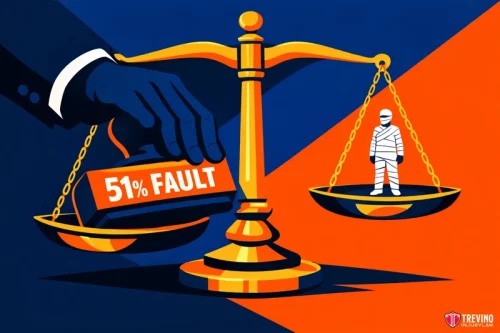
As Plaintiff Trial Lawyers, we examine the facts and apply this legal standard to expose their blame-shifting tactics. We prove the driver’s initial carelessness actually caused the crash. Drivers must follow all traffic laws and maintain a continuous legal duty to avoid collisions, especially in zones where pedestrians are likely to be present. Our Plaintiff Trial Lawyers dismantle these aggressive tactics to protect your financial recovery.
For the statutory rules behind mid-block crossings and the insurer’s “jaywalking” argument, see whether you can sue after being hit while jaywalking in Texas.
Critical Evidence Used to Defeat the “Darting Out” Defense
We conclusively defeat the “darting out” defense by immediately securing independent physical evidence, including nearby business surveillance video and commercial electronic control module data, which proves the negligent driver had ample time and distance to safely stop and avoid the collision entirely.
Our trial attorneys aggressively utilize Spoliation Letters to preserve evidence from commercial vehicles traveling on I-35 or Loop 410. These legal demands prevent Trucking Companies from destroying vital crash data. We conduct thorough skid mark analysis and review dashcam footage to prove the pedestrian was visible for several seconds prior to impact. This forensic approach completely undermines the insurance company’s sudden-emergency defense. Securing this proof is absolutely vital for victims, especially considering that 1,452 pedestrians suffered suspected serious injuries in Texas traffic crashes in 2024 (TxDOT, 2025).
Does Distracted Driving Cancel Out a Pedestrian’s Failure to Yield?
Yes, a driver’s severe distraction, such as texting while driving, legally outweighs a pedestrian’s failure to yield under Texas proportionate responsibility laws because drivers have a higher duty of care to avoid hitting vulnerable individuals on the roadway, especially near school zones or areas where children play.
Even if a pedestrian crossed mid-block on San Pedro Avenue, a distracted driver instantly loses their right-of-way privileges. We demonstrate how cell phone records are subpoenaed to prove the driver was not exercising reasonable care. By exposing this severe negligence, we keep the fault securely on the negligent motorist and protect the pedestrian’s right to maximum financial compensation. Proving this driver’s negligence is critical, as official records show that a driver’s failure to yield the right of way to a pedestrian was a contributing factor in 1,373 urban crashes in Texas during 2024 (TxDOT, 2025).
Understanding how we defeat false claims of darting into traffic is crucial, but it is equally important to know how we overcome accusations involving alcohol or impairment.
Is a Pedestrian Automatically at Fault if They Were Intoxicated When Hit?
A pedestrian is not automatically 100 percent at fault simply because they were intoxicated. Liability depends entirely on whether the driver’s own negligence, such as speeding or running a red light, was the primary cause of the catastrophic collision that resulted in the victim’s injuries. This aligns with the foundational proximate cause principles set in Lear Siegler, Inc. v. Perez, 819 S.W.2d 470 (Tex. 1991). The Texas Supreme Court established that if a party’s action merely furnishes a condition that makes the injury possible, it is not the legal cause of the crash.
We litigate to a verdict to prove the negligent driver was the active, substantial factor that destroyed your family’s financial stability. The tragic reality is that these collisions are often deadly, with Texas seeing 768 pedestrian fatalities in 2024, sometimes leading to a wrongful death claim (TxDOT, 2025).
This represents one of the most difficult defenses to overcome. Insurance companies will immediately point to toxicology reports from University Health System to claim the victim caused their own injuries by wandering into traffic. They weaponize the stigma of impairment to undervalue your claim and deny you justice for your lost wages and pain.
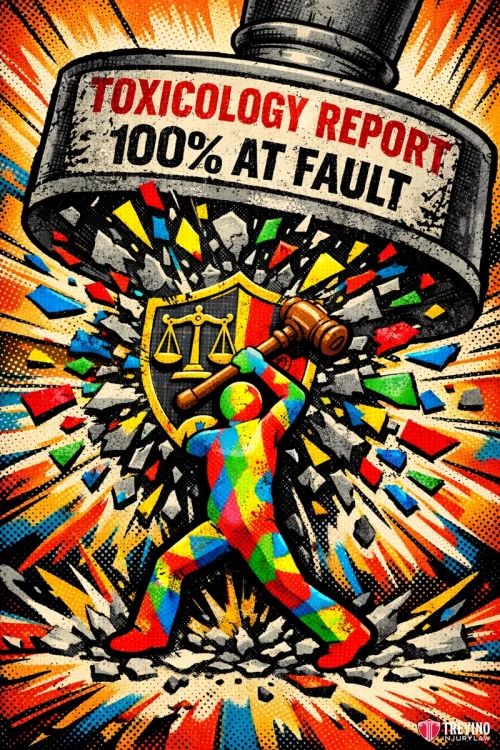
However, Texas law requires a judge or Bexar County jury to assign fault based on the actual mechanics of the crash, not just the pedestrian’s blood alcohol content. The core issue is always who caused the physical impact. If an 18-wheeler driver runs a red light downtown near the River Walk and strikes an impaired pedestrian who is legally walking in the crosswalk, the negligent driver remains heavily liable for both economic and non-economic damages.
How Texas Courts Apportion Liability for Impaired Pedestrians
Texas courts apportion liability for impaired pedestrians by examining who possessed the last clear chance to avoid the collision and whose direct physical actions served as the immediate proximate cause of the devastating impact, regardless of the pedestrian’s blood alcohol content at the time.
Juries in South Texas carefully evaluate complex scenarios to fairly distribute fault. We rely on our experience of taking over 80 cases to trial to demonstrate that while intoxication assigns heavy fault to the pedestrian, a severely speeding or drunk driver may still bear the majority of the liability. This aggressive courtroom advocacy preserves the victim’s right to recovery under the Texas proportionate responsibility statutes.
While impairment presents unique challenges in proving liability, the pedestrian’s location at the time of the crash introduces another complex layer of right-of-way rules.
Was the Pedestrian at Fault for Walking on the Road Instead of a Sidewalk in Texas?
A pedestrian may be assigned partial fault for walking on the road if a safe, accessible sidewalk is provided and legally required to be used under the strict regulations of the Texas Transportation Code, though this fault rarely reaches the 51 percent threshold. Pedestrians must follow traffic laws, but drivers must remain vigilant as well.
Statutory duties strictly govern where pedestrians can travel. If a pedestrian walks directly in the high-speed traffic lane of Loop 1604 where pedestrian access is explicitly prohibited, they will likely bear significant fault for the resulting crash. The law requires pedestrians to use dedicated pathways when they are available and safe.
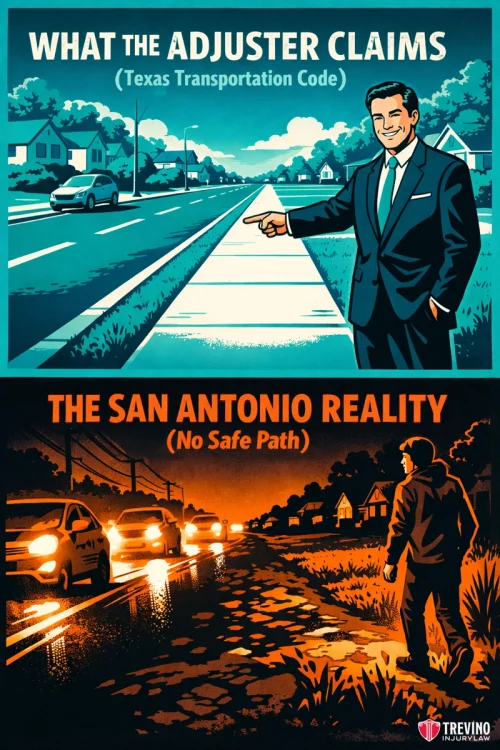
However, on many San Antonio arterial roads, such as Potranco Road and Marbach Road, rapid suburban growth has outpaced infrastructure development. In these expanding zones, sidewalks simply do not exist. We aggressively fight Insurance Adjusters who try to blame pedestrians for walking on the shoulder when absolutely no other safe path was available to them.
What Are the Statutory Exceptions for Walking on San Antonio Roadways?
Pedestrians are legally permitted to walk on the extreme left edge of the roadway facing oncoming traffic if no sidewalk is provided or if the existing sidewalk is completely obstructed, damaged, and unsafe for foot travel, placing the burden of caution back on the approaching driver.
The law recognizes several practical exceptions where a pedestrian is excused from using a sidewalk:
- Construction zones physically blocking the designated pedestrian pathway.
- Flooded pathways making the existing sidewalk completely impassable.
- Missing infrastructure on rapidly expanding suburban roads.
We document these hazardous conditions immediately with photographs to prove the pedestrian was acting reasonably and in full compliance with Texas law prior to the crash. This forensic evidence defeats the adjuster’s attempt to shift blame.
These infrastructure exceptions protect your right to compensation, which leads directly to how we challenge preliminary crash investigations that mistakenly place the blame on you.
Can You Overturn a San Antonio Police Report That Blames the Pedestrian?
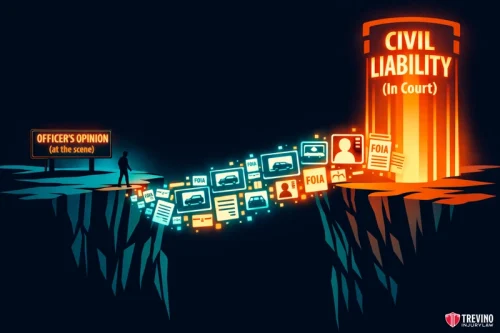
You can successfully overturn a San Antonio Police Department crash report that incorrectly blames the pedestrian by securing objective, independent evidence, such as dashcam footage and sworn eyewitness testimony, that directly contradicts the investigating officer’s preliminary, often biased findings at the accident scene.
This aggressive legal action bridges the critical gap between a police officer’s initial on-scene opinion and actual civil liability in a courtroom. We frequently see that responding officers on busy thoroughfares like Culebra Road often rely solely on the uninjured driver’s self-serving statement simply because the pedestrian is unconscious, hospitalized, or physically incapacitated. The driver uses this opportunity to completely control the narrative of the crash.
As a Plaintiff Trial Lawyer, we do not accept these one-sided, biased reports as the final word on fault. We immediately use Freedom of Information Act (FOIA) requests to review police body camera footage, 911 audio, and secure independent witness testimony to prove the driver was actually at fault.
While overturning a flawed police report requires aggressive evidence gathering, knowing exactly how to respond when the negligent driver points the finger at you immediately after the crash is your strongest defense.
What Steps Should You Take if the Driver Claims You Were at Fault?
If the driver claims you were at fault, you must immediately decline to give a recorded statement to their insurance company, secure the crash scene if physically able, and contact a specialized San Antonio pedestrian accident lawyer to aggressively preserve vital forensic evidence before it disappears.
To effectively fight for families when liability is disputed, we launch an immediate investigation during the critical first week using this trial-first response:
- Decline Recorded Statements: Do not speak to adjusters from Progressive or Allstate, as they will use your disoriented words to shift the blame to you.
- Preserve Digital Evidence: Launch a rapid investigation to secure dashcam and business surveillance footage before it is permanently overwritten.
- Consult Trial Attorneys: Engage a Plaintiff Trial Lawyer immediately to capture evidence before the defense can destroy it, building a case meant for the courtroom rather than a quick settlement.
Do Witness Statements Override a Driver’s Claim of Pedestrian Fault?
Yes, sworn testimony from independent eyewitnesses can completely override a negligent driver’s self-serving claim that the pedestrian darted into traffic and caused the crash.
We rapidly identify and interview bystanders who saw the impact on busy intersections like Austin Highway. Their objective accounts provide undeniable proof of the driver’s actions, dismantling false narratives fabricated by the uninjured motorist and their aggressive insurance adjusters to deny your rightful compensation.
Can Black Box Data Prove the Driver Saw the Pedestrian in Time?
Yes, commercial vehicle black box data shows exactly when the driver applied the brakes, demonstrating whether they were distracted before striking the pedestrian.
By issuing immediate Spoliation Letters, we force Trucking Companies to surrender the data from this electronic control module. This crucial telemetry reveals their exact speed and reaction times, mathematically proving they had ample opportunity to stop their vehicle and avoid the catastrophic collision entirely.
Why a Pedestrian’s Failure to Yield Does Not Excuse a Driver’s Negligence
Even if a pedestrian is technically at fault for crossing mid-block, Texas law dictates that this failure to yield does not excuse a driver who fails their overarching common-law duty to brake, honk, or exercise reasonable care to avoid the collision.
| The Action | Pedestrian Statutory Duty | Driver Common-Law Duty |
| Crossing mid-block | Must yield right of way to vehicles | Must exercise reasonable care |
| Walking near traffic | Must use provided, safe sidewalks | Must honk horn to warn pedestrians |
| Entering roadway | Cannot suddenly leave a curb into traffic | Must apply brakes to avoid collision |
This visually proves that even if a pedestrian makes an error while navigating a poorly planned street near The Pearl, the driver is not legally permitted to run them over. By aggressively proving the driver breached this continuous duty of care, we keep the pedestrian’s assigned blame well below the strict 51 percent threshold.
For the broader framework that connects these duties with crossing location, driver conduct, and proportionate responsibility, see our guide to Texas pedestrian accident liability and fault rules.
What Happens if You Cannot Prove the Driver Was Distracted?
If you cannot secure objective physical evidence proving the driver was actively distracted or speeding, the aggressive insurance company will likely succeed in pinning the majority of the fault on you, permanently barring your financial recovery under the Texas 51 percent rule.
Without early attorney involvement and forceful evidence preservation, your injury case rapidly devolves into a “he-said, she-said” argument where the uninjured driver holds the ultimate advantage. This is exactly why high-volume settlement mills fail in disputed liability cases; they do not prepare for complex litigation or secure the hard proof needed to forcefully shift fault percentages back to the negligent driver.
When Is a Pedestrian Considered 100% at Fault in Texas?
A pedestrian is generally considered 100 percent at fault only if they intentionally jumped directly into the path of a motor vehicle that was operating legally, traveling the speed limit, and had absolutely no time or physical distance to avoid the catastrophic collision.
This establishes the extreme, absolute limitation of liability. For example, if a pedestrian suddenly vaults a concrete median barrier onto I-10 directly in front of an 18-wheeler traveling the exact speed limit, the driver cannot be held liable because they breached no legal duty of care. Unless these highly specific, impossible-to-avoid parameters are met, the driver usually shares at least some percentage of the blame under Texas proportionate responsibility.
If you are dealing with a disputed claim and wondering, “Was the Pedestrian at Fault After Being Hit in Texas? Liability Rules and Common Defenses,” our experienced trial team will aggressively investigate your crash to protect your rights and secure the maximum financial compensation your family deserves.
Why Hire a Pedestrian Accident Lawyer?
You must hire a specialized San Antonio pedestrian accident lawyer immediately because aggressive insurance adjusters will intentionally manipulate crash facts, weaponize flawed police reports, and exploit the Texas 51 percent rule to unjustly blame you and entirely deny your rightful financial compensation.
Want to Protect the Full Value of Your Claim?
You’ve seen how this affects your case — but this is only one piece of the puzzle. Our Pedestrian Accident Lawyer page breaks down what a trial-ready firm does differently.
We do not let companies like State Farm or Progressive dictate who is at fault. Whether they falsely accuse you of darting out into traffic on Culebra Road or walking on a roadway without a sidewalk, our trial attorneys secure the dashcam footage and eyewitness testimony needed to force liability back onto the negligent driver. This is the expert leverage you secure with San Antonio accident attorneys.
We are not a high-volume settlement mill; we litigate to verdict to protect your family. Do not let the insurance company use your silence against you. Call Trevino Injury Law at 210-TREVINO for a free consultation. Se Habla Español.