Yes, you can sue a driver after being hit while jaywalking in Texas if the driver’s negligence contributed to your injuries. Crossing outside a crosswalk does not automatically defeat your claim. To recover compensation, your share of responsibility cannot exceed 50 percent, and your compensation is reduced by your share of fault.
Texas crosswalk laws impose duties on both pedestrians and drivers. Pedestrians crossing outside marked or unmarked crosswalks must yield to vehicles. Drivers must still exercise reasonable care to avoid a collision. An insurer’s argument that you failed to yield or suddenly entered traffic requires examining the circumstances, including speed, visibility, and the driver’s opportunity to react.
According to TxDOT, Texas recorded 6,077 pedestrian crashes in 2024. Insurers routinely exploit these collisions, deliberately ignoring the speeding or distracted driver who actually caused the impact to protect their own profit margins.
What Could Your Pedestrian Accident Case Be Worth?
Answer a few quick questions about your accident. Takes about 60 seconds.
See What My Case Might Be WorthThe insurance company offered less than $20,000. I ended up with over $1 million. — Jackie Galindo
Surveillance video, witness accounts, and available vehicle data can establish where you crossed and whether the driver had time to respond. Preserve that evidence promptly before footage is overwritten or witnesses become difficult to locate. Trevino Injury Law uses early evidence preservation to build disputed pedestrian injury claims around the collision’s facts.
Electronic Control Module data proving the driver never hit the brakes disappears rapidly. A Spoliation Letter, a legal demand that prevents the defense from destroying black box evidence, must be issued immediately to lock down the vehicle’s telemetry before it is overwritten. Texas gives you two years to file a lawsuit before the claim expires entirely.
At Trevino Injury Law, our pedestrian accident lawyers secure available footage, review witness accounts, and challenge unsupported fault allegations with evidence. Call 210-TREVINO for a free case review. You pay nothing unless we win. Se Habla Español.
What Are the Exact Texas Pedestrian Right-of-Way Laws for Mid-Block Crossings?
Under Texas Transportation Code § 552.005, a pedestrian crossing a roadway outside of a designated crosswalk must yield the right of way to a vehicle, but this does not grant the driver a legal license to cause a collision. This creates a critical dual-duty dynamic in Texas personal injury law.
First, we must define the location. A legal unmarked crosswalk simply connects the lateral sidewalk lines at an intersection. Along dense, high-traffic commercial corridors like San Pedro Ave or S. Zarzamora St, marked crosswalks are often miles apart, making mid-block crossings frequent. Nationally, these non-intersection locations are the site of the vast majority of tragedies, accounting for 5,334 pedestrian fatalities in a single year (NHTSA, 2023). When an accident occurs in these zones, fault is never based on a single variable.
Bexar County courts weigh multiple factors to determine legal liability and responsibility for the accident. Your crossing location is just one element. The driver’s speed, attention, and visibility are equally weighted.
For the broader framework governing crosswalk duties, driver conduct, and allocation of fault, see our guide to Texas pedestrian accident liability and fault rules.
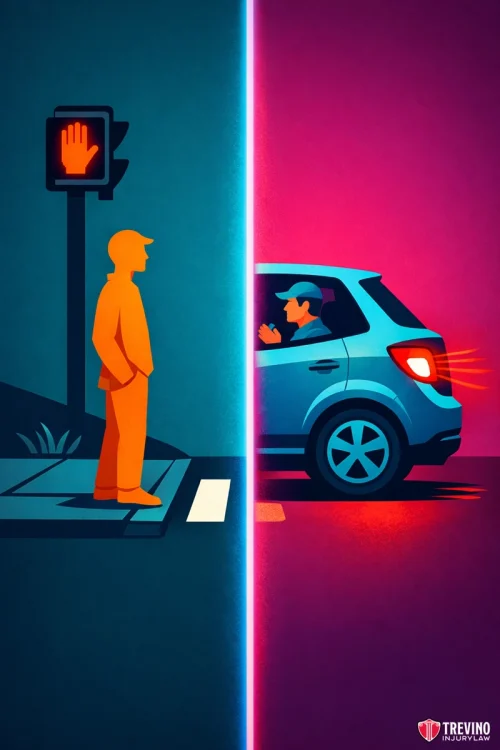
The Dual-Duty Breakdown:
- The Pedestrian’s Duty: Yield to oncoming traffic when crossing a road mid-block.
- The Driver’s Duty: Exercise reasonable care to avoid striking a pedestrian. This duty overrides the pedestrian’s failure to yield if the person was clearly visible.
Quick Reference: Texas Right of Way Rules by Location
The determination of legal priority depends entirely on the pedestrian’s location at the time of the collision, strictly differentiating between marked crosswalks, unmarked intersections, and mid-block crossings.
| Location | Who Yields? | The Governing Texas Statute |
| Marked Crosswalk | The driver yields to pedestrian | TTC § 552.003 |
| Unmarked Intersection | The driver yields to the pedestrian | TTC § 552.003 |
| Mid-Block Crossing | Pedestrian yields to driver | TTC § 552.005 |
Why Is “Jaywalking” a Dangerous Insurance Myth Under Texas Transportation Code § 552.008?
“Jaywalking” is a manufactured insurance industry buzzword, not a recognized state statute. Instead, Texas Transportation Code § 552.008 imposes a paramount duty on drivers to exercise due care to avoid colliding with any pedestrian on the roadway. Adjusters use “jaywalking” to imply automatic 100 percent liability. We counter this by citing § 552.008. This statute legally mandates that drivers must honk their horn and apply brakes if a pedestrian is visible, overriding the pedestrian’s failure to yield.
This shifts the narrative away from the insurance company’s preferred terminology and forces them to confront the actual legal standard of the driver’s duty of care. While factors like improper crossing of the roadway or intersection are frequently cited in national fatality statistics, they do not automatically negate the driver’s overriding legal obligation to prevent a crash (NHTSA, 2023).
Understanding these exact statutory definitions establishes your foundational rights, but knowing how insurance carriers twist them against you reveals why aggressive legal protection is necessary. An accident attorney can help clarify these rights.
How Do Insurance Adjusters Weaponize Your Crossing Location to Deny Claims?
Insurance Adjusters from companies like State Farm or Fred Loya weaponize your crossing location by securing early recorded statements designed to trick you into admitting you “darted out” or failed to look for traffic. This is a calculated, predatory tactic. Adjusters specifically target victims within days of the crash to secure these statements while the pedestrian is heavily medicated or incapacitated.
They rely almost entirely on the initial Texas Peace Officer’s Crash Report (CR-3). Because the severely injured pedestrian is usually being transported to the hospital, the San Antonio Police Department often only records the uninjured driver’s self-serving narrative. The stakes in these manipulative interviews are incredibly high, especially when considering that Texas saw 1,452 suspected serious pedestrian injuries and 768 pedestrian fatalities reported in a single year (TxDOT, 2024).
The Insurance Adjuster’s Playbook:
- Blame the Location: Labeling the victim a “jaywalker” to imply automatic 100 percent fault.
- Extract Admissions: Asking leading questions to make you admit you misjudged the vehicle’s speed or the time to stop.
- Lowball Offers: Offering a fraction of the actual case value before you have the chance to hire a Plaintiff Trial Lawyer.
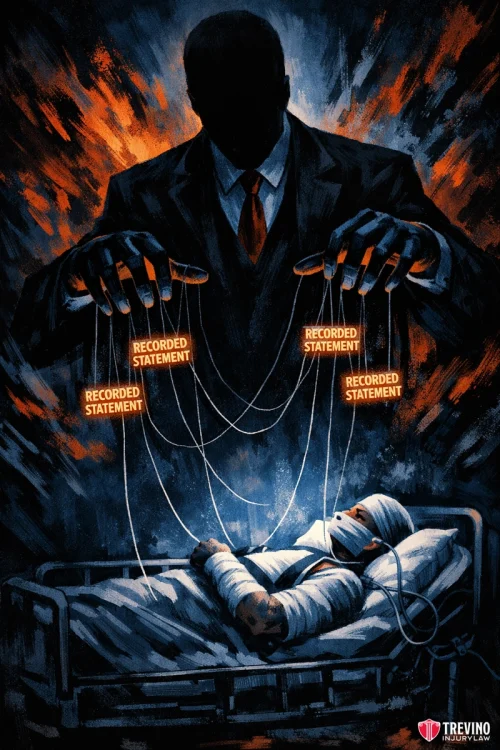
At Trevino Injury Law, our 20+ years of trial experience and insurance defense background mean we know their playbook. We immediately shut down these manipulative interviews. In the Jose Simon Arriaga Jr. case, the defense tried to minimize the injuries and offered just $5,000. We took the case to trial and secured a $536,007 Jury Verdict.
What Evidence Disproves the “Sudden Dart-Out” Defense?
We disprove the “sudden dart-out” defense by aggressively deploying Spoliation Letters and Freedom of Information Act (FOIA) requests. This secures physical evidence that proves the driver had sufficient time and distance to stop. We build an undeniable timeline by taking the following steps:
- Retrieving Electronic Control Module (black box) data to show braking latency, proving they never even hit the brakes.
- Pulling business surveillance video along corridors like Bandera Road.
- Securing officer body-cam footage.
This proves the driver was speeding or distracted, which was the proximate cause of the crash.
Can You Recover Financial Compensation If You Were Intoxicated While Crossing Outside a Crosswalk?
Yes, you may still be able to recover financial compensation if you were intoxicated while crossing mid-block. A Bexar County jury must determine if the driver’s gross negligence, such as extreme speeding or texting, was the primary cause of the collision. Texas follows a modified comparative negligence system. This applies even in extreme scenarios, such as late-night pedestrian accidents near nightlife hubs like the San Antonio River Walk or Southtown. While public intoxication assigns heavy fault to the pedestrian, a severely distracted driver may still bear the majority of the legal liability if they had ample time and distance to avoid the strike.
Intoxication is only one way an insurer may try to shift responsibility after a pedestrian collision. Our guide to when a pedestrian may be at fault after being hit in Texas covers other disputed-fault scenarios, including dart-out allegations, roadway walking, and police-report blame.
How the 51% Bar Rule Works in Texas:
- 50 Percent or Less at Fault: You can still recover damages even if you are partially at fault, though your final compensation will be reduced by your percentage of responsibility.
- 51 Percent or More at Fault: You are strictly barred from recovering any financial compensation from the driver.
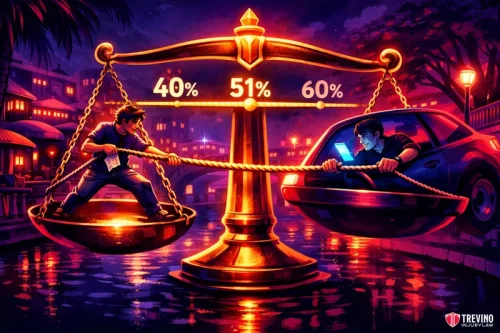
For example, if a jury awards $100,000 but finds the intoxicated pedestrian 40 percent at fault and the speeding driver 60 percent at fault, the pedestrian successfully recovers $60,000. This is why aggressive litigation is necessary to properly apportion blame and ensure you receive the compensation you deserve.
How Do Speeding Drivers Lose Their Statutory Right-of-Way Privileges?
A driver entirely forfeits their statutory right-of-way privileges over a mid-block pedestrian if forensic crash reconstruction proves the vehicle was exceeding the posted speed limit at the time of the accident. Speeding automatically destroys the “I had the right of way” defense.
A driver exceeding the speed limit on arterial roads like Austin Highway or De Zavala Road loses their privileges. This legally shifts the liability away from the pedestrian’s crossing location and squarely onto the driver’s negligence.
What Evidence Is Needed to Overcome a “Jaywalking” Defense in Texas?
To successfully overcome a “jaywalking” defense in Texas, you must immediately secure objective forensic evidence. Electronic Control Module data and nearby business surveillance video can mathematically prove the driver failed their overriding statutory duty of care and caused your injuries. We bypass biased preliminary police reports by deploying Spoliation Letters in the first week to lock down the vehicle’s black box data.
This aggressive action leverages the strict evidentiary protections detailed by the Texas Supreme Court in Brookshire Bros., Ltd. v. Aldridge, 438 S.W.3d 9 (Tex. 2014). It lays the groundwork for severe legal penalties against defendants or insurers who allow critical physical evidence to be destroyed or overwritten.
While the law theoretically protects mid-block pedestrians, winning your claim requires tangible proof that the driver violated Texas Transportation Code § 552.008. The San Antonio police crash report (CR-3) routinely defaults to blaming the pedestrian for a “failure to yield” based solely on the uninjured driver’s biased statement.
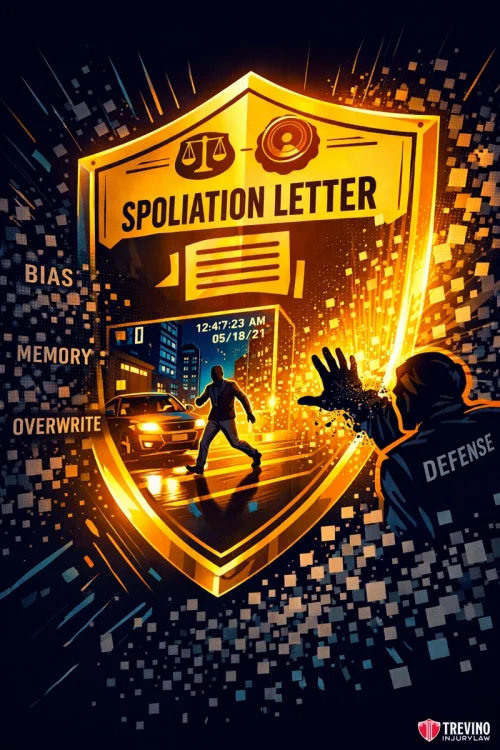
We bypass this preliminary report by deploying Spoliation Letters in the first week to lock down the vehicle’s black box data. We also actively canvass high-injury corridors, such as Potranco Road, to secure crucial camera footage before it is overwritten. This rapid evidence preservation transforms a “he-said, she-said” liability dispute into a scientifically undeniable timeline of the driver’s negligence.
Securing this objective video and electronic evidence establishes the foundation for your case. Leveraging it effectively requires specialized forensic analysis to dismantle the insurance company’s remaining legal arguments.
How Do Accident Reconstruction Experts Prove Driver Negligence in Disputed Cases?
We use accident reconstruction experts in disputed liability cases to scientifically prove the driver’s exact speed, point of perception, and braking distance. This decisively destroys the defense’s false claim that the pedestrian collision was physically unavoidable and secures the evidence needed to file a personal injury claim.
When an adjuster unfairly blames a pedestrian for an accident, this forensic process provides the definitive proof needed to establish fault.
Experts analyze the physical evidence to build an undeniable, minute-by-minute timeline of the crash that forces insurers to recognize their driver’s overarching negligence. This scientific investigation typically includes evaluating:
- Skid marks left on the pavement.
- Crush damage sustained by the vehicle.
- Electronic Control Module (ECM) data.
Can You Sue If You Were Hit on a Texas Highway?
Yes, you can sue if you were hit on a Texas highway, such as I-35 or Loop 1604, provided the driver failed to maintain a proper lookout or exercise due care. While pedestrians are generally prohibited on interstate highways, Texas Transportation Code § 552.008 still requires a driver to take evasive action, such as honking or braking, if they see a person in the roadway.
If a commercial 18-wheeler driver is distracted or speeding and strikes a pedestrian, their negligence can still be the primary cause of the collision. This overrides the pedestrian’s illegal location.
Do You Automatically Lose Your Case If You Received a Jaywalking Citation?
No, receiving a jaywalking citation from a San Antonio police officer does not automatically destroy your civil personal injury case. A traffic ticket is merely an officer’s preliminary opinion.
Often, this citation is issued based solely on the uninjured driver’s biased narrative, because the severely injured pedestrian was already being transported to a hospital for emergency treatment.
Final legal liability is ultimately determined by a judge or a Bexar County jury, not a preliminary police report. If you’ve been involved in a jaywalking accident, a personal injury attorney can evaluate your case.
Texas Transportation Code § 552.005 vs. Municipal Ordinances: What Is the Difference?
Texas Transportation Code § 552.005 dictates state-wide yield rules for mid-block crossings. Municipal ordinances can enact stricter, hyper-local rules that outright prohibit crossing at specific dangerous intersections in San Antonio. Insurance adjusters often attempt to confuse these different legal standards to wrongly deny valid pedestrian accident claims.
Insurance companies will aggressively try to use a local San Antonio city ordinance violation, such as crossing outside a designated area near the Downtown River Walk, to deny the pedestrian’s claim. We counter this tactic by proving that regardless of the local rule, the driver still violated the state-level common-law duty to avoid harm. Even if a municipality restricts pedestrian traffic, the overarching Texas law requires a driver to always exercise due care to prevent catastrophic injuries.
What Happens If the Driver Had No Scientifically Possible Time to React?
If forensic evidence definitively proves the pedestrian stepped directly into the path of a vehicle traveling at a lawful speed, leaving the driver no physically possible time to react, the pedestrian will likely be barred from recovering compensation for their sustained injuries under Texas law.
If the “dart-out” defense is actually proven by black-box data showing the driver had less time to react than the standard 1.5 seconds of perception-reaction time, the legal outcome shifts dramatically. In these specific scenarios along corridors like Marbach Road, the pedestrian will likely be assigned more than 50 percent of the blame. Under Texas law, this triggers the 51% Bar Rule. The injured individual cannot recover financial damages from the driver because their own proportionate responsibility exceeded the legal threshold.
When Is a Driver Exempt from the Statutory Duty to Exercise Due Care?
A driver is never entirely exempt from the statutory duty to exercise due care under Texas law. They must always take evasive action even when a pedestrian is crossing illegally on a major interstate highway like I-10 or Loop 410.
The boundaries of this legal obligation are absolute. Even in restricted areas that strictly prohibit pedestrians, if a driver sees a person in the roadway, they legally must take evasive action. The law requires the driver to honk their horn and apply the brakes immediately. Failure to take these basic safety measures constitutes negligence, regardless of the pedestrian’s illegal location at the time of the collision. Drivers have a legal obligation to watch for pedestrians and drivers sharing the road.
Why Should You Hire a Trial-Ready Pedestrian Accident Lawyer?
You must hire a San Antonio personal injury lawyer because insurance adjusters will weaponize your mid-block crossing to automatically deny your claim. While you recover, companies like State Farm or Fred Loya build defenses claiming you “darted out” into traffic. They use biased police reports to protect their profits and shift the blame entirely onto you. Accidents can cause physical pain, emotional distress, and loss of enjoyment of life.
Want to Protect the Full Value of Your Claim?
You’ve seen how this affects your case — but this is only one piece of the puzzle. Our Pedestrian Accident Lawyer page breaks down what a trial-ready firm does differently.
We back this authority with a $536,007 jury verdict against lowball offers. Before critical evidence vanishes, we execute strict spoliation letters to lock down vehicle black box data. This is the expert leverage you secure with a dedicated San Antonio personal injury lawyer near me.
Protect your family today. Contact us for a free consultation. Se Habla Español. We litigate to a verdict.