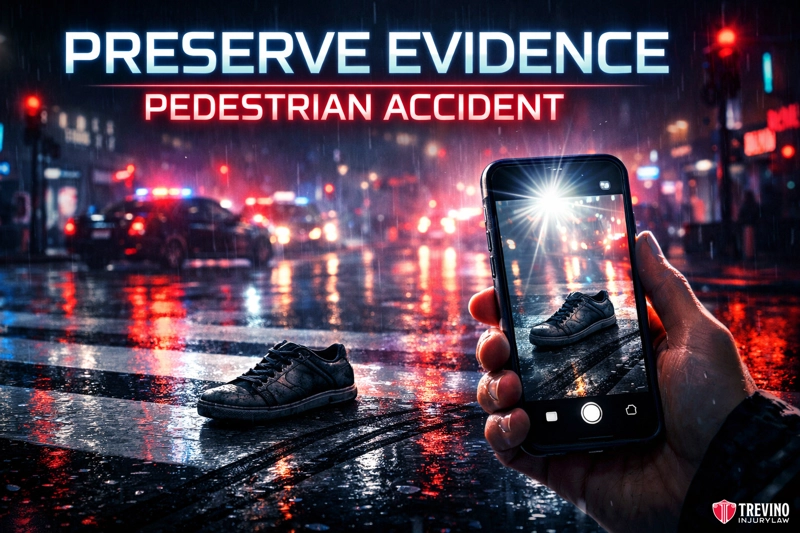
You preserve pedestrian accident evidence by immediately photographing physical roadway debris and forcing nearby businesses to freeze their security drives before the surveillance footage overwrites. First responders sweep the intersection clean within hours, taking the skid marks and shattered glass with them.
The Insurance Adjuster assigned to your claim uses your hospitalization against you, waiting silently while commercial deletion protocols wipe the dashcam video that proves their driver ran the light. Even government archives vanish quickly; according to the San Antonio Police Department, body-worn camera footage categorized as a standard crash is legally destroyed after just 180 days under their 2022 retention schedule.
What Could Your Pedestrian Accident Case Be Worth?
Answer a few quick questions about your accident. Takes about 60 seconds.
See What My Case Might Be WorthThe insurance company offered less than $20,000. I ended up with over $1 million. — Jackie Galindo
A Spoliation Letter, a legal demand that prevents the property owner from destroying evidence, must be sent to commercial entities along the crash corridor immediately to secure the data. That urgency shapes the pedestrian accident claim timeline in San Antonio, as critical evidence can disappear long before the legal case is fully developed. Once the automatic system resets, the undeniable digital truth of the collision is lost completely.
Trevino Injury Law pedestrian accident attorneys will subpoena the footage and lock the scene down before the defense builds a false narrative. Call 210-TREVINO now for a free case review. You pay nothing unless we win. Se Habla Español.
How Do You Document the Accident Site and Physical Scene in San Antonio?
Documenting the accident site requires immediate photographic preservation of skid marks, crosswalk positioning, traffic signal states, and scattered personal items before heavy traffic on corridors like Bandera Road destroys the evidence. Statewide, the volume of these incidents is massive. Texas recorded 6,077 total pedestrian crashes across all severities in a single year, making prompt scene documentation absolutely essential (TxDOT, 2024).
Physical evidence is highly transient. Because first responders must prioritize medical care and clearing the roadway, critical forensic details are often swept away rapidly. Debris such as broken glass, vehicle fragments, and personal belongings typically stays at a busy San Antonio intersection for less than a few hours before it is permanently removed by city crews or traffic. You must photograph these elements immediately.
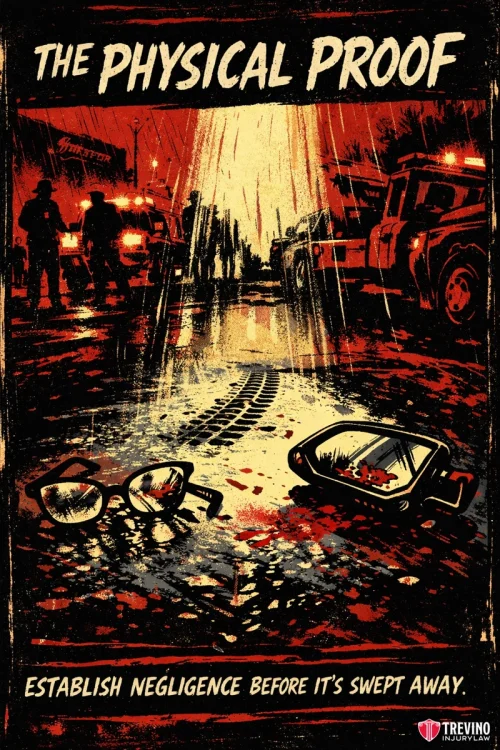
The Texas Supreme Court has long held in landmark cases like Lynch v. Ricketts, 314 S.W.2d 273 (Tex. 1958), that negligence and causation can be established entirely by circumstantial physical evidence, such as road conditions, skid marks, and the resting position of a vehicle. This is one of the most important steps to support your claim.
What Clothing and Physical Evidence Should a Hit Pedestrian Keep?
A struck pedestrian must preserve all torn clothing, damaged shoes, and shattered cell phones in an unwashed, unaltered condition because these items act as physical proof of the vehicle’s impact angle and vehicle speeds. Defense attorneys frequently try to argue that the pedestrian simply “walked into the side of the car.” This blame-shifting is especially common in severe collisions involving right-of-way disputes, considering nearly 1 out of every 4 pedestrians killed (24%) in the United States are victims of hit-and-run crashes where the driver attempts to evade responsibility entirely (NHTSA, 2023).
Forensic examination of fabric tears and shoe scuffs provides objective, undeniable proof of the actual mechanism of injury and the extent of injuries, stripping the insurance company of its primary defense. Moving from inanimate physical evidence to human testimony, the next critical step is securing eyewitness accounts before they disappear to evaluate the sequence of events.
How Do You Gather and Verify Witness Statements After Being Hit by a Car?
To gather evidence effectively, you must independently track down bystanders and secure recorded audio or written testimonies before their memories fade or insurance adjusters manipulate their accounts. Responding officers often fail to interview every single witness at chaotic scenes, especially near major hubs like the South Texas Medical Center.
Bystanders naturally leave once the ambulance arrives. Our trial attorneys send dedicated investigators to canvass the area, locate 911 callers, and lock in their immediate observations regarding driver behavior, speed, distraction, and failure to yield.

Securing witness contact information early will significantly strengthen your case. Witnesses may recall contributing circumstances like poor visibility or ignored traffic laws that citations issued by police might miss.
Can You Use a Cell Phone to Document a Pedestrian Accident Scene?
Yes, if you are physically able, using your cell phone to record continuous video of the driver’s behavior, the license plate, and spontaneous witness reactions provides unimpeachable digital evidence that contradicts later defense lies. Video captured in the immediate aftermath often contains spontaneous admissions of fault by the negligent driver.
Under Texas Rule of Evidence 803(2), these real-time reactions fall under the ‘excited utterance’ exception to the hearsay rule. Statements made under the severe stress of a startling event are considered inherently reliable, making your raw cell phone video powerful evidence in court before the insurance company can coach their driver to change their story.
While capturing evidence yourself at the scene is incredibly valuable, your law firm must subsequently execute formal strategies to extract hidden digital data from the defendant.
How Do Spoliation Letters Prevent the Destruction of Pedestrian Crash Video?
A spoliation letter is a powerful legal demand sent to nearby businesses and trucking companies that immediately halts the deletion of security systems and dashcam video, legally forcing them to preserve the footage. This is where we transition from scholars of the law to courtroom warriors. We do not ask politely for evidence; we demand it under the direct threat of court sanctions.

Businesses along high-traffic routes like San Pedro Avenue overwrite their security footage constantly, which is why we immediately send FOIA requests to police and spoliation letters to private entities within the first week of the case. Traffic cameras and exterior video offer crucial information about the crash.
What Is a Spoliation Letter in a Pedestrian Accident Case?
In a pedestrian accident case, a spoliation letter is a formal directive warning a defendant that destroying or “spoliating” digital video, physical debris, or electronic logs will result in severe legal penalties.
This critical document aggressively shifts liability. If a company deletes their footage after receiving this letter, the jury is legally instructed to assume the deleted video proved the company’s negligence.
How Do You Get Dashcam Footage of a Pedestrian Crash?
Securing dashcam footage requires a plaintiff trial lawyer to execute immediate preservation demands against the commercial fleet’s safety director before the proprietary software overwrites the incident. In complex commercial crashes, trucking companies often try to hide their driver’s distraction or fatigue.
Our team strictly details the technical process of extracting both forward-facing and driver-facing camera data to prove fault. Understanding these aggressive legal preservation tactics naturally raises the question of why victims cannot simply handle this process on their own during this challenging time.
Why Is Early Attorney Intervention Required to Preserve Pedestrian Accident Evidence?
Acting quickly is absolutely required because a dedicated plaintiff trial lawyer will immediately take control of the investigation, issuing aggressive legal demands in the first week to secure vanishing evidence while your family focuses entirely on your medical recovery. Transitioning from the technical mechanisms of evidence preservation to practical legal application requires facing a harsh reality: an injured pedestrian simply cannot physically or legally serve subpoenas from a hospital bed.
Because our team at Trevino Injury Law has taken 80+ jury trials to verdict across South Texas courts, we know exactly what evidence persuades juries. We act immediately in those crucial first days. High-volume settlement mills, on the other hand, often wait months for basic police reports, allowing critical surveillance footage and physical debris to completely degrade or be actively destroyed by negligent corporate defendants.

Securing this foundational legal representation perfectly positions your case to utilize the advanced digital tracking methods necessary to conclusively prove driver fault and seek fair compensation for pain and suffering, mounting medical bills, and lost wages.
What Digital Footprints Prove a Driver Hit a Pedestrian?
Beyond video surveillance, the most critical digital footprints include the negligent driver’s cell phone records to definitively prove texting and driving, and the striking vehicle’s black box data to verify exact speed and braking inputs at the moment of impact. Accident reconstruction experts utilize cellular forensic downloads and analyze Event Data Recorders (EDRs) to uncover the hidden digital truth of the crash.
These deeply technical, objective data points completely override a distracted driver’s false testimony. When an at-fault driver lies to the San Antonio Police Department about their speed or phone usage, this digital footprint provides the undeniable mathematical proof needed to secure maximum compensation in court.
Do Police Reports Contain All Pedestrian Accident Evidence?
No, police reports only contain preliminary officer opinions and basic diagrams, missing the deep digital data necessary to win your trial. While obtaining a regular copy of a Texas Peace Officer’s Crash Report (CR-3) costs just $6 via the state system, this document serves only as a starting point and is legally insufficient on its own to prove complex liability (TxDOT, 2024).
You need comprehensive medical records and medical evidence to build your case. Medical records create a timeline of your injuries sustained and the required treatments, including imaging.
Can a Lawyer Force a Business to Hand Over Security Video?
Yes, a San Antonio plaintiff trial lawyer can force an uncooperative business to surrender exterior security video by filing a lawsuit and issuing a binding subpoena.
Cameras often capture incidents in school zones, residential areas, and intersections with heavy traffic around pedestrians, providing invaluable context about factors like road design and lighting.
Independent Investigation vs. Insurance Adjuster Evidence
While an independent plaintiff trial lawyer rigorously preserves all objective evidence to maximize your financial compensation, an insurance adjuster selectively gathers only the evidence that helps minimize your catastrophic injuries and deny your claim entirely to protect their corporate profits.
| Evidence Focus | Trevino Injury Law (Trial Lawyer) | Insurance Company Adjuster |
| Video & Surveillance | Secures all commercial dashcams and exterior business security video. | Ignores commercial cameras; relies only on their driver’s biased statement. |
| Witness Coordination | Interviews all bystanders and canvases the scene for 911 callers. | Only requests recorded statements designed to trick the injured victim. |
| Digital Footprints | Downloads vehicle black box data and subpoenas cellular records. | Searches exclusively for medical gaps in your treatment history to deny payment. |
What Happens If Evidence Is Destroyed Before You Hire a Lawyer?
If critical evidence is destroyed before you hire a trial lawyer, you permanently lose the objective proof needed to force a high-value settlement, leaving your entire case highly vulnerable to insurance company blame-shifting tactics and lowball offers.
Without intersection video, black box data, or preserved physical debris, cases rapidly devolve into “he-said, she-said” disputes. The defense will inevitably argue that you darted into the street or failed to use a crosswalk. By waiting to seek representation, you give insurers the exact leverage they need to issue unacceptable settlement offers or deny your claim completely.
When Is Evidence Preservation No Longer Possible in a Pedestrian Claim?
Evidence preservation becomes completely impossible once standard deletion protocols wipe commercial surveillance drives, digital vehicle logs are permanently overwritten by new driving data, and physical roadway debris on streets like Marbach Road is completely cleared away by city maintenance crews. Government archives also have strict expiration dates. For example, San Antonio Police Department body-worn camera video categorized simply as a ‘Crash’ is scheduled for retention for only 180 days before it is legally destroyed (SAPD, 2022).
This represents the absolute limit of your pedestrian accident claim timeline in San Antonio. Emphasizing the harsh reality of these systems, once these physical and digital systems reset, that critical evidence is gone forever. This absolute loss reinforces the urgent need for immediate, aggressive legal intervention from a dedicated trial lawyer within the very first week of your pedestrian accident.
Why Hire a San Antonio Pedestrian Accident Lawyer?
Hiring a San Antonio pedestrian accident lawyer is absolutely critical because a proven plaintiff trial lawyer immediately deploys aggressive spoliation letters to lock down vanishing dashcam video, cellular records, and witness testimonies before insurance adjusters intentionally destroy this objective proof to deny your compensation.
Want to Protect the Full Value of Your Claim?
You’ve seen how this affects your case — but this is only one piece of the puzzle. Our Pedestrian Accident Lawyer page breaks down what a trial-ready firm does differently.
Every hour you wait, vital physical and digital evidence degrades. If you’ve been injured, remember that while you focus on surviving your injuries, insurance companies are already executing their playbook to shift the blame onto you.
We proved this across South Texas with over 80 jury trials. To build this leverage, your San Antonio personal injury wreck attorney immediately issues a spoliation letter to preserve vanishing Marbach Road surveillance and black box data before the defense destroys it.
Stop the destruction of your evidence today. Do not give a recorded statement to the insurer. Call Trevino Injury Law at 210-TREVINO for a free consultation. Se Habla Español.