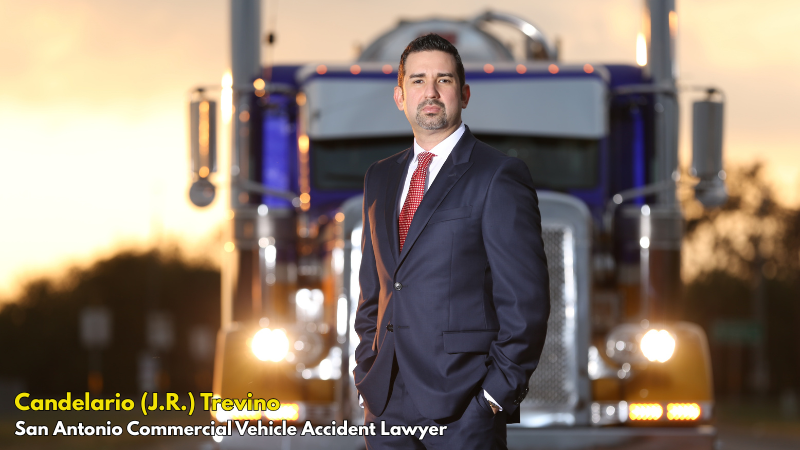
A San Antonio commercial vehicle accident lawyer investigates the driver, employer, vehicle owner, and other companies whose conduct may have caused the crash, then pursues compensation from the parties the evidence supports.
Commercial cases can involve vicarious liability, which holds an employer responsible for an employee’s negligence within the course and scope of employment.
What Could Your Commercial Vehicle Accident Case Be Worth?
Answer a few quick questions about your accident. Takes about 60 seconds.
See What My Case Might Be WorthThe insurance company offered less than $20,000. I ended up with over $1 million. — Jackie Galindo
The investigation must separate each role. A driver may have caused the collision, while an employer, maintenance contractor, manufacturer, or cargo company faces a claim only when the facts establish that party’s connection to the harm. Commercial insurers can dispute injury causation, seek recorded statements, or press for an early release before treatment defines loss.
Trevino Injury Law protects the claim by preserving Electronic Logging Device records, event data recorder information, driver qualification files, maintenance records, and scene evidence. A Spoliation Letter, a legal demand that stops the company holding crash evidence from destroying it, can secure proof before it disappears. Trevino Injury Law secured a $17 million settlement in an 18-wheeler wrongful death case.
At Trevino Injury Law, our truck accident attorneys identify responsible parties, preserve crash evidence, and build the liability record for negotiation or trial. Call 210-TREVINO for a free case review. You pay nothing unless we win. Se Habla Español.
Why Commercial Vehicle Accidents Are Legally Different
Commercial vehicle accidents are legally distinct from standard car crashes because they involve higher insurance policy limits, complex vicarious liability rules that hold employers responsible for their employees’ negligence, and aggressive corporate defense strategies that activate immediately after the crash.
While a personal injury claim typically involves one driver and a modest policy, a commercial case often requires navigating multi-layered litigation against well-funded corporate entities.
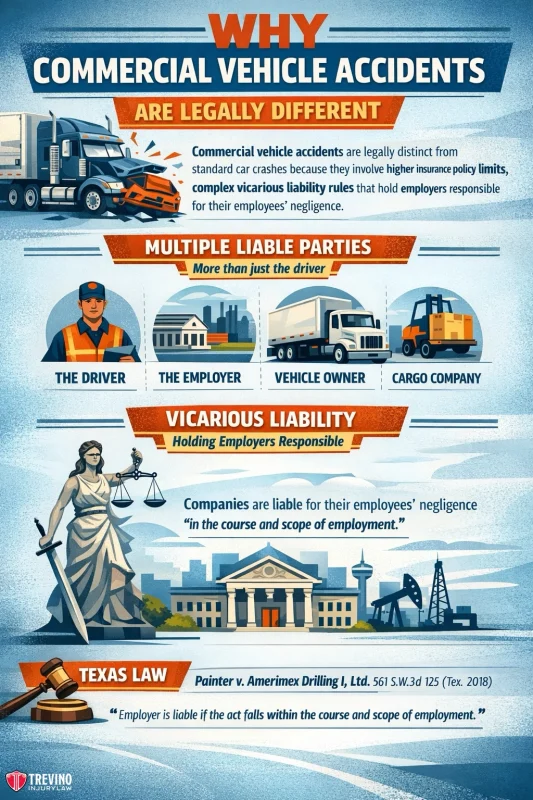
The primary difference lies in the number of potential defendants. In a standard wreck on Loop 410, you sue the at-fault driver. In a commercial crash, we must investigate the driver, the employer, the vehicle owner (if different), and the company responsible for loading the cargo.
This is known as vicarious liability or respondeat superior, a legal doctrine that holds companies accountable when their employees cause harm while on the clock. In Texas, this principle is strictly applied; as the Texas Supreme Court clarified in Painter v. Amerimex Drilling I, Ltd., an employer is liable for an employee’s negligence if the act falls within the course and scope of employment, even if the specific details of the drive were not explicitly micromanaged.
Identifying All Liable Parties
Identifying every liable party is the only way to ensure there is enough insurance coverage to pay for catastrophic injuries, as a single driver’s policy is rarely sufficient. We meticulously investigate the corporate structure to find every entity that contributed to the negligence.
- The Driver: For errors like speeding, distraction, or fatigue.
- The Employer: For negligent hiring, poor training, or forcing illegal schedules.
- The Maintenance Company: If brake failure or tire blowouts caused the crash.
- The Manufacturer: For defective parts within the vehicle.
The Threat of Rapid Response Teams
Corporate defendants dispatch “rapid response teams” to the crash site immediately to gather favorable evidence, interview witnesses before police arrive, and coach the driver on what to say to avoid liability.
These teams effectively build the defense case while the victim is still receiving emergency care at University Hospital or Brooke Army Medical Center. We counter this by deploying our own investigators to document the scene, measure skid marks, and secure surveillance footage before it is overwritten or “lost.”
Understanding these complexities helps explain why a generalist attorney may miss critical avenues for compensation, but taking immediate action to secure the evidence is the only way to prove what actually happened.
Immediate Action Required: Stopping Evidence Spoliation
You must stop evidence spoliation immediately by having your Commercial Accident Vehicle lawyer send a formal Letter of Spoliation to all potential defendants, demanding they preserve every piece of physical and digital data related to the crash. For a practical sequence covering the immediate aftermath, evidence collection, medical attention, and preservation issues, see what to do after a commercial vehicle accident in San Antonio.
This is critical because under the framework established in Brookshire Bros., Ltd. v. Aldridge, a court may impose only severe sanctions, such as instructing the jury to assume that the missing evidence would have been damaging, if we can prove the company intentionally destroyed evidence it knew was relevant to the lawsuit.
“Spoliation” refers to the destruction or alteration of evidence that is relevant to pending or reasonably foreseeable litigation. In commercial cases, the most damning evidence is often electronic.
We act fast to preserve the Electronic Logging Device (ELD) records, which track how long a driver has been behind the wheel. These logs often reveal violations of federal Hours-of-Service regulations, indicating the driver was fatigued at the time of the crash.
Securing the Black Box (Event Data Recorder)
The Event Data Recorder, or “black box,” provides an objective, unalterable account of the vehicle’s actions in the seconds before impact, recording speed, braking inputs, and steering angles.

- Speed at Impact: Proves if the driver was speeding on I-35 or ignoring limits in construction zones.
- Braking History: Indicates whether the driver never applied the brakes, indicating distraction or sleep.
- Throttle Position: Reveals if the driver was accelerating aggressively
Driver Qualification Files
We also demand the immediate preservation of the Driver Qualification File, which contains the driver’s violation history, training records, and medical certifications. This file frequently exposes that a company hired a driver with a suspended license or a history of drug use, establishing a direct claim for negligent hiring.
Preserving this evidence prevents the defense from hiding the truth, yet knowing what evidence to look for depends entirely on the specific type of commercial vehicle involved in your accident.
Types of Commercial Fleet Cases We Handle
We handle a wide range of commercial fleet cases, including delivery vans, construction vehicles, corporate sedans, and heavy industrial transport. This is a high-volume threat on San Antonio roads. In a single year, Bexar County saw 281 “possible injury” crashes and 203 “suspected minor” crashes involving commercial fleets.
Based on TXOTD information, with over 450 possible injuries reported in 2022 alone, it is clear that whether you are hit by a plumber’s van in Castle Hills or an oil field truck from the Eagle Ford Shale, the statistical probability of a commercial collision remains dangerously high. We apply specific regulatory knowledge to the unique operational risks of each vehicle class to counter this threat.
San Antonio’s diverse economy means our roads are filled with a variety of commercial threats. We represent clients injured by:
- Amazon & Delivery Vans: Last-mile delivery drivers often face unrealistic quotas, leading to reckless driving in residential neighborhoods such as Stone Oak.
- Company Cars: Pharmaceutical reps or tech salespeople distracted by phones while driving corporate sedans.
- Utility & Construction Trucks: Heavy vehicles carrying unsecured loads or equipment on Bandera Road or Loop 1604.
- Oil Field Vehicles: Sand haulers and water tankers that are frequently overloaded and poorly maintained.
When going up against the well-funded insurance companies protecting these commercial fleets, the choice between a trial lawyer and a settlement mill dictates the true value of your case. Many San Antonio personal injury firms focus on quick settlements rather than litigation, relying on volume and limiting the time and resources spent per client. Our model is the exact opposite: fewer cases, more attention.
We approach every commercial fleet collision with a trial-first mindset, checking “trial boxes” rather than “settlement boxes.” Because we act quickly in the first week to secure critical evidence like dash cam footage and FOIA requests, a step settlement mills often skip because they intend to settle quickly, we build the leverage needed to aggressively fight insurance adjusters and force them to pay full value for catastrophic injuries
Delivery Van Liability (The 3PL Loophole)
Delivery giants often use Third-Party Logistics Providers (3PLs) to shield themselves from liability, claiming the drivers are independent contractors rather than employees.
We challenge this classification by demonstrating that the parent company exercised control over the driver’s routes, schedules, and training. This pierces the corporate veil, allowing us to access the broader insurance policies held by major logistics companies.
Oil Field and Industrial Transport
Vehicles serving the energy sector are subject to extreme wear and tear, making mechanical failure a common cause of catastrophic accidents. We investigate maintenance logs to prove that a company prioritized profit over safety by ignoring bald tires or failing brakes on heavy tankers.
Determining the specific vehicle type helps us pinpoint the exact regulations the company violated, which is essential to calculating the full extent of the damages you are owed.
Fighting the Insurance Company Tactics
Insurance companies deploy aggressive strategies to devalue your claim, including recording your statements to use against you, offering quick but inadequate settlements before your injuries are fully diagnosed, and deliberately delaying payments to exploit your financial vulnerability. These tactics are designed to protect their profit margins, not to compensate you fairly for the life-altering impact of a commercial vehicle crash.
The most common trap is when an adjuster claims they “accept full responsibility” for the accident. This is often a calculated move; they admit their driver caused the crash but will then vigorously dispute the severity of your injuries, arguing that your herniated disc or spinal trauma was a “pre-existing condition” rather than a result of the collision.
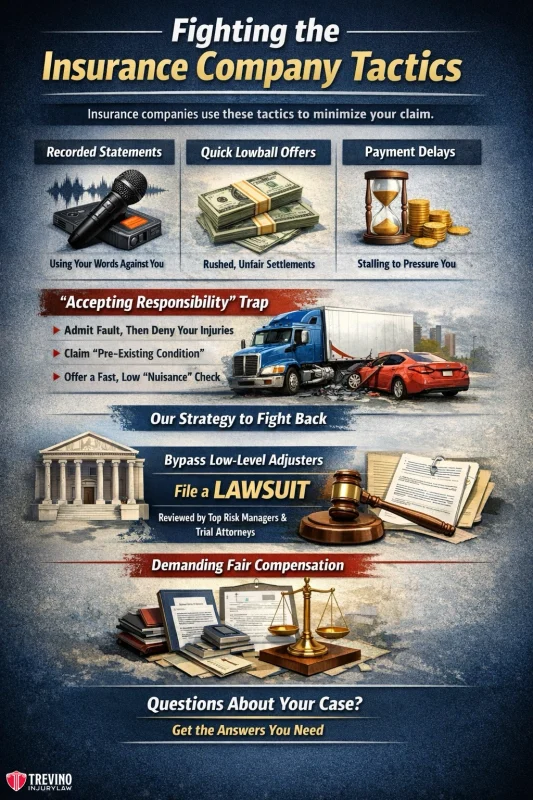
They may also offer a “nuisance value” check immediately after the wreck, hoping you sign a release that permanently bars you from seeking further compensation once the true cost of your medical care becomes apparent.
Our strategy involves bypassing these low-level adjusters by filing a lawsuit, which triggers a review by higher-level risk managers and defense attorneys who understand the real cost of a trial verdict. We know how to counter these insurance delay tactics and force the carrier to evaluate your claim based on evidence, not evasion.
While defeating these tactics clears the path for fair negotiation, you likely still have specific questions about liability laws and the timeline for resolving your case.
Who Is Liable If I’m Hit by a Company Car in Texas?
Yes, under the doctrine of Respondeat Superior, the employer is generally liable for the driver’s negligence if the crash occurred while the employee was acting within the course and scope of their employment. However, identifying all responsible parties is critical in a company car accident.
In accidents involving large trucks or commercial fleets, liability often extends beyondthe driver. It may include the loading company, the maintenance provider, or the vehicle manufacturer.
Proving someone else’s negligence in these complex hierarchies requires a deep understanding of personal injury law. If you are injured in a commercial vehicle collision, establishing this chain of liability is the first step to win your case.
What Is the Average Settlement for a Commercial Vehicle Accident?
No, there is no single “average” settlement, but commercial policies often carry limits of $1 million or more, allowing for significantly higher recovery than personal auto policies when injuries are severe.
Because the policy limits are higher, the commercial vehicle accident claim process is more adversarial. Whether you are dealing with a catastrophic accident injury or a tragic wrongful death claim, insurance adjusters will fight to minimize the payout. To ensure you receive full compensation for medical bills, lost wages, and pain and suffering, you need a strategy that targets these larger policies. Victims of commercial vehicle accidents should never accept a first offer without legal counsel.
How Long Do I Have to File a Lawsuit?
Yes, under the doctrine of Respondeat Superior, the employer is generally liable for the driver’s negligence if the crash occurred while the employee was acting within the course and scope of their employment. However, identifying all responsible parties is critical in a company car accident.
In accidents involving large trucks or commercial fleets, liability often extends beyond the driver. It may include the loading company, the maintenance provider, or the vehicle manufacturer.
Proving someone else’s negligence in these complex hierarchies requires a deep understanding of personal injury law. If you are injured in a commercial vehicle collision, establishing this chain of liability is the first step to winning your case.
Commercial vs. Personal Vehicle Settlements: A Timeline Comparison
Commercial vehicle settlements typically take significantly longer than personal car accident claims because the higher stakes prompt insurers to dispute liability more aggressively, which in turn requires a more extensive discovery process to prove corporate negligence.
In a standard car crash on Culebra Road involving a $30,000 policy, the insurer may settle quickly once liability is clear. However, in a commercial fleet case involving a $1 million policy, the insurance carrier will often drag out the process. They will demand years of medical records to find pre-existing conditions and may depose you, your doctors, and your family members.

Commercial vs. Personal Vehicle Settlements: A Timeline Comparison
- Investigation Phase (Months 1-3): We secure the black box and send spoliation letters.
- Litigation Phase (Months 4-18): We file suit, conduct depositions, and demand corporate safety records.
- Resolution Phase (Months 18-24+): Mediation or trial often occurs only after we have fully developed the life care plan.
While the timeline is longer, the potential for a life-changing recovery is much higher, provided you do not attempt to navigate this complex process alone.
What If I Don’t Hire a Commercial Accident Lawyer?
If you attempt to handle a commercial accident claim without a lawyer, you risk receiving a fraction of what your case is worth because you lack the subpoena power necessary to force the company to release damning evidence like driver logs and maintenance records.
Without legal representation, you are fighting a multi-billion-dollar insurer with just your word against theirs. You will not have access to the experts needed to prove the long-term cost of your injuries, meaning you might accept a settlement that covers your emergency room bills but leaves you bankrupt when you need surgery five years later.
Furthermore, you will likely miss the critical window to preserve the black box data, allowing the company to legally destroy the only objective proof of their driver’s negligence.
This is exactly why corporations and their insurance companies prefer you to handle the claim alone. Whether it was a semi-truck or another commercial vehicle, such as a delivery van, the type of vehicle often dictates the complexity of the applicable laws.
You need a dedicated team of lawyers who understand these specific regulations to fight for your rights. Only by leveling the playing field can you secure the justice you deserve and ensure you fully understand the challenges ahead.
Demand Justice: Call 210-TREVINO Now
Insurance carriers protect profits by destroying evidence, and settlement mills help them by folding for quick, inadequate payouts. We fight. Trevino Injury Law prepares for war in the Bexar County Courthouse to force maximum compensation from corporate defendants.
Don’t Guess About Your Rights. Get a Definite Answer.
The insurance company is already evaluating your accident. Call 210-TREVINO Now to level the playing field, or choose your next step below. For a confidential case review, contact Trevino Injury Law. It’s confidential, and you pay nothing unless we win.

We secured a $17,000,000 settlement for a commercial trucking victim by exposing systematic safety failures. Immediate action is critical. As your Commercial Accident Vehicle lawyer in San Antonio, we deploy independent investigators to send Letters of Spoliation and lock down black box data before it is erased.
Call 210-TREVINO for a free case review. Se Habla Español. We operate on a no-win, no-fee basis.