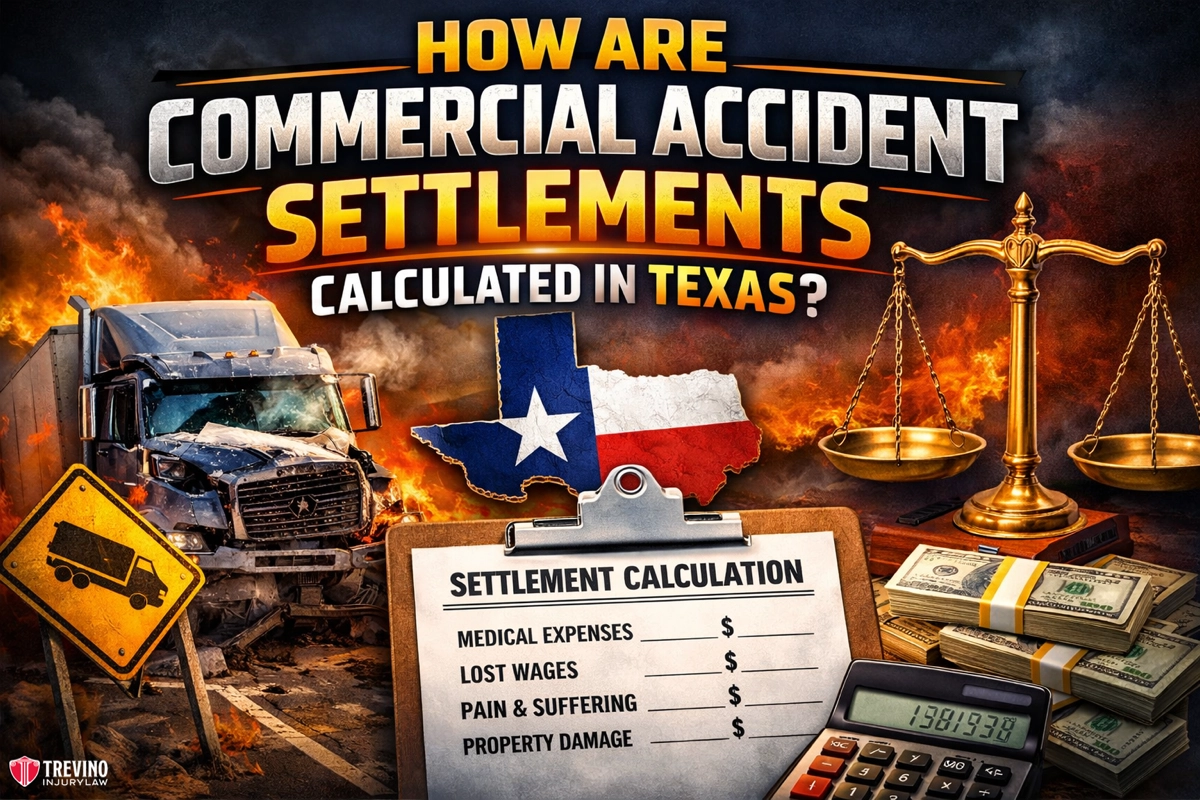
Commercial accident settlements combine your verifiable economic losses with a calculated multiplier for your intangible suffering, minus any percentage of fault assigned to you by the defense.
The insurance adjuster assigned to your file is already running your medical records through algorithmic software like Colossus to systematically reduce your claim into a standardized data point. Insurance carriers processed 2,684 commercial-vehicle crashes in Bexar County in 2024. To handle this volume, defense teams aggressively shift blame onto victims using proportionate responsibility laws, knowing that assigning you most of the fault can reduce your financial recovery to nothing.
What Could Your Commercial Vehicle Accident Case Be Worth?
Answer a few quick questions about your accident. Takes about 60 seconds.
See What My Case Might Be WorthThe insurance company offered less than $20,000. I ended up with over $1 million. — Jackie Galindo
Physical evidence from the crash scene gets cleared quickly, allowing corporate lawyers to fabricate a narrative where you made an improper maneuver. A Spoliation Letter, a legal demand to stop the negligent trucking company from destroying evidence, must be sent immediately before the black box data vanishes. Texas gives you two years to file a lawsuit, after which your legal claim is permanently barred.
Trevino Injury Law, our commercial vehicle lawyer, secures this evidence on day one to defeat comparative fault allegations and force adjusters to abandon rigid software valuations. Call 210-TREVINO today for a free case review. You pay nothing unless we win. Se Habla Español.
How Do Insurance Companies Calculate Total Damages?
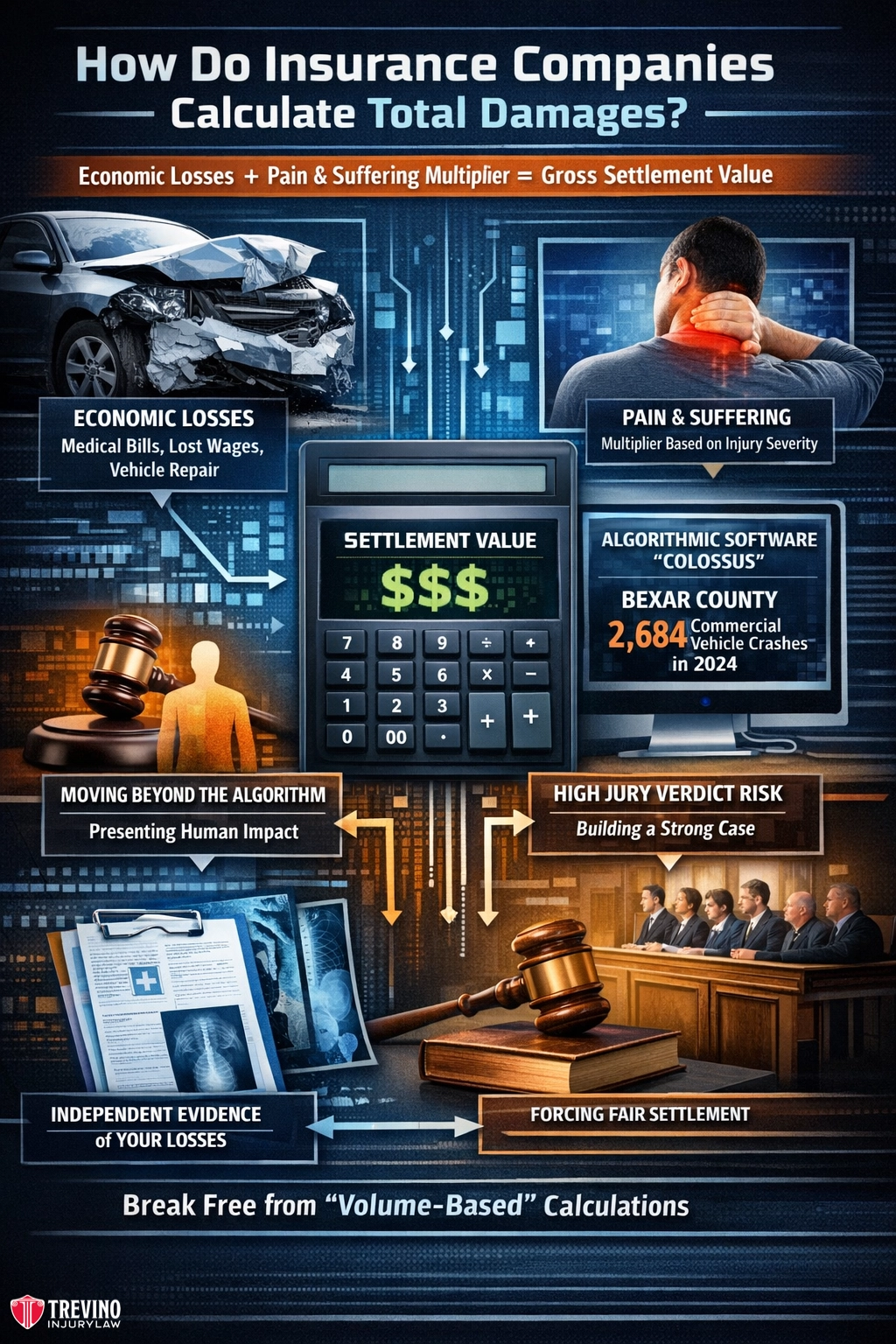
Insurance companies calculate total damages by combining your verifiable economic losses with a calculated value for your non-economic suffering, often using a multiplier based on injury severity to determine the gross settlement value before any fault deductions are applied.
While the main hub discussed general settlement averages, understanding the specific mathematical formulas adjusters use in San Antonio is critical for validating whether an offer is fair or a “lowball” tactic.
Insurance carriers use algorithmic software like Colossus not just for accuracy, but for speed. In Bexar County alone, carriers processed 2,684 commercial-vehicle crashes in 2024. With this massive volume of claims, averaging over 7 new files every single day, adjusters rely on rigid software to standardize payouts.
We force them to abandon these “volume-based” calculations by presenting the specific human cost of your injury, distinguishing your case from the 2,037 non-injury claims they automatically devalue.
These algorithms systematically undervalue claims by treating unique pain and suffering as a standardized data point, which is why we must present independent evidence of your losses. To address this, we build a valuation model that prompts the adjuster to step away from the computer and consider the risk of a high jury verdict in Bexar County.
What Are Economic vs. Non-Economic Damages?
Economic damages, also known as special damages, are the objective, verifiable financial costs incurred as a result of the accident. However, in Texas, ‘verifiable’ has a strict legal definition. Under the landmark Texas Supreme Court decision in Haygood v. De Escabedo, 356 S.W.3d 390 (Tex. 2011), you are limited to recovering only the medical expenses that have been actually paid or incurred by you or your insurance, rather than the higher ‘list price’ originally billed by the hospital.
This ruling prevents plaintiffs from recovering a ‘windfall’ for phantom costs that no one was ever required to pay, making the accurate calculation of these paid vs. incurred numbers the critical foundation of your economic claim.
Non-economic damages, or general damages, are the subjective losses that compensate you for the intangible impact of the injury, such as physical pain and suffering, mental anguish, physical impairment, and disfigurement. Because these damages lack a receipt or invoice, they are the most fiercely contested component of the calculation and require detailed testimony and expert analysis to be quantified accurately.
How Is Pain and Suffering Calculated in Texas?
While adjusters may use simple multipliers, Texas law demands much more to uphold a verdict for intangible losses. The Texas Supreme Court held in Saenz v. Fidelity & Guaranty Insurance Underwriters, 925 S.W.2d 607 (Tex. 1996), that plaintiffs cannot simply seek an arbitrary amount for mental anguish.
Instead, we must provide direct evidence of the nature, duration, and severity of your suffering to establish a substantial disruption in your daily routine. This high evidentiary standard means that without detailed testimony and documentation proving specifically how the injury has dismantled your quality of life, a jury’s award for pain and suffering may be overturned on appeal.
Establishing the total value of your losses is only the first step, as Texas law requires us to reduce that number based on your share of responsibility for the crash.
How Does the Texas 51% Rule Reduce Your Payout?
Under Texas’s proportionate responsibility law, your settlement is reduced by your percentage of fault, and if you are found to be more than 50% responsible for the accident, you are barred from recovering any compensation whatsoever. This 51% Bar Rule is the primary weapon that defense attorneys for companies like Amazon or H-E-B use to undermine claims, often arguing that you were speeding on Loop 410 or distracted at the time of the collision to shift blame.
The 51% Bar Rule is most aggressively applied in “he-said, she-said” scenarios, which make up the bulk of Bexar County’s caseload. In 2024, the county recorded 2,037 non-injury crashes and 484 possible injury crashes.
In these lower-severity impacts, physical evidence is often cleared quickly, allowing defense teams to argue that you changed lanes improperly on Loop 410. If they successfully pin 51% of the blame on you in these disputed scenarios, your recovery drops to zero, a tactic they use to clear thousands of cases from their books annually.
This makes the liability investigation phase just as financially critical as the medical treatment phase.
We aggressively fight these comparative fault allegations by securing black box data and witness statements immediately, ensuring your percentage of fault remains as low as possible to protect your payout. When the crash is recent, that liability record begins with what happens at and immediately after the scene. Review the steps to take after a commercial vehicle accident for the practical documentation and preservation sequence.
Settlement Calculation Example (The 51% Bar Rule in Action)
The proportionate responsibility calculations below demonstrate exactly how your final recovery amount changes based on the percentage of fault assigned to you by an insurance adjuster or jury:
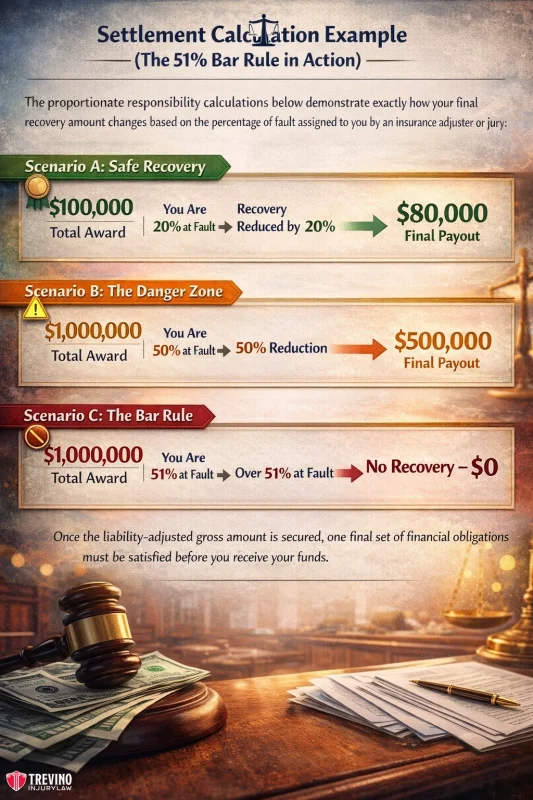
- Scenario A (Safe Recovery): The jury awards $100,000 in total damages. You are found to be 20% at fault. Your recovery is reduced by 20%, so you receive $80,000.
- Scenario B (The Danger Zone): The jury awards $1,000,000. You are found to be 50% at fault. You recover $500,000 (half the award).
- Scenario C (The Bar Rule): The jury awards $1,000,000. You are found to be 51% at fault. Because you crossed the threshold, you receive $0.
Once the liability-adjusted gross amount is secured, one final set of financial obligations must be satisfied before you receive your funds.
What Deductions Come Out of Your Settlement Check?
Your final net recovery is the amount remaining after mandatory medical liens, attorney contingency fees, and litigation costs are deducted from the gross settlement, meaning the check sent by the insurer is rarely the exact amount deposited into your account. While the main hub mentioned “medical liens” briefly, understanding the strict hierarchy of these deductions is essential for managing your financial expectations after a commercial wreck.
In San Antonio, the most significant deduction often comes from statutory hospital liens filed under Texas Property Code Chapter 55. If you were treated at a major facility like Methodist Hospital or Brooke Army Medical Center (BAMC) following the crash, they have a legal right to be paid directly from your settlement funds.
Additionally, health insurers (through subrogation) and the IRS (in specific cases) may have claims to the funds. Our role includes negotiating these liens downward to maximize the cash that actually goes into your pocket.
How Do Medical Liens Affect Your Settlement?
Medical liens allow hospitals and emergency medical services to attach a legal claim to your settlement proceeds for the cost of care provided within 72 hours of the accident, ensuring they are paid before you receive any funds.
- Hospital Liens: Facilities in Bexar County aggressively file these. If the lien amount is higher than your settlement, you could theoretically end up with nothing without legal intervention.
- Subrogation Interests: Health insurance providers (such as Blue Cross, Medicare, or Medicaid) generally have a “right of subrogation,” meaning they must be reimbursed for bills they paid for accident-related care.
- Negotiation Leverage: An experienced attorney can often negotiate these liens down significantly, arguing that the hospital should accept a reduced amount so the victim can receive a fair recovery.
With the math of valuation, reduction, and deduction clearly understood, the final challenge is convincing the insurance company to agree to your numbers.
Can You Negotiate a Commercial Accident Settlement Offer?
Yes, the initial offer from a commercial insurance adjuster is almost always a tactical starting point rather than a final verdict, and with a trial-ready attorney presenting evidence of your full damages, you can negotiate a significantly higher settlement that reflects your true long-term needs. Insurance adjusters for major carriers operate on volume, hoping you will accept a quick “nuisance value” check to close the file before you realize the extent of your injuries.
Effective negotiation cannot begin until you have reached Maximum Medical Improvement (MMI), the point at which your condition has stabilized and no further significant recovery is expected. Negotiating before reaching MMI is risky because it ignores potential future medical costs.
Once MMI is established, we send a comprehensive demand letter detailing every penny of your economic and non-economic losses, supported by expert testimony, and threaten to file suit in Bexar County court if they refuse to pay. Negotiating a commercial claim is not only about the number on the table; it also depends on how counsel responds to the insurer’s valuation tactics. See how a commercial accident attorney fights corporate insurers in San Antonio for the litigation and evidence-preservation role behind that leverage.
While negotiation is possible, recognizing what constitutes a truly “fair” number requires comparing your offer against specific benchmarks for severe commercial crash cases.
Determining a Fair Offer
A fair settlement offer for a commercial vehicle accident in Texas must cover all past and future medical expenses, lost earning capacity, and non-economic damages such as pain and suffering, often reaching into the six- or seven-figure range due to higher commercial policy limits.
Unlike personal auto policies that may cap at $30,000, commercial policies often carry limits of $1,000,000 or more, meaning the “ceiling” for your potential recovery is much higher. However, obtaining a fair number requires presenting irrefutable evidence that compels the insurance carrier to avoid a trial.
Is $100,000 a Good Settlement for a Commercial Crash?
No, for a commercial truck crash involving serious injuries like TBI or spinal damage, $100,000 is likely insufficient to cover future medical needs. When a truck driver or trucking company is at fault, the amount of compensation should reflect the true lifetime cost of the injuries sustained.
Often, a quick six-figure offer is used to resolve personal injury cases before the full extent of medical bills and lost wages is realized. To ensure you receive fair compensation, it is vital to have experienced legal counsel evaluate the potential settlement against the long-term impact on your life.

Do I Pay Taxes on a Commercial Accident Settlement in Texas?
Generally, no. The IRS excludes compensation for physical injuries and illness from gross income. This means your recovery for property damage, hospital stays, and physical pain is typically tax-exempt.
However, the tax code becomes complex regarding punitive damages and interest, which are considered taxable. A personal injury attorney can help categorize your impact settlement to maximize your take-home recovery. Because various factors, such as how the settlement agreement is structured, can affect your tax liability, these details should always be reviewed by a financial professional and your injury attorney.
Does a Pre-Existing Condition Ruin My Settlement Calculation?
No, it does not. Under the “Eggshell Skull” doctrine, the defendant is liable for aggravating a pre-existing condition, even if the accident victim was already fragile.
While insurance adjusters will use police reports and medical history to argue that your pain is related to minor injuries or age rather than the motor vehicle collision, seasoned truck accident lawyers know how to fight back.
By determining liability and proving how the truck accident exacerbated your health issues, your legal representation can protect your personal injury claim and ensure your history isn’t used against you.
Lump Sum vs. Structured Settlements
A lump sum settlement provides your entire recovery in a single tax-free payment, whereas a structured settlement pays out funds over a set period of years to ensure long-term financial stability for catastrophic injuries.
The choice between these options depends on your immediate cash needs versus your long-term care requirements. For a family in Stone Oak dealing with a breadwinner’s permanent disability, a structured settlement might guarantee income replacement for decades, whereas a younger victim might prefer a lump sum to invest immediately. We work with financial experts to model which option yields the highest net benefit for your specific situation.
While specific financial structures protect your future, a simple timing mistake in the present can destroy your entire claim before it begins.
What Happens If You Accept a Settlement Too Early?
If you accept a settlement offer before reaching Maximum Medical Improvement (MMI), you permanently waive your right to seek additional compensation for any future complications or surgeries related to the crash. This is the single most common mistake unrepresented victims make.
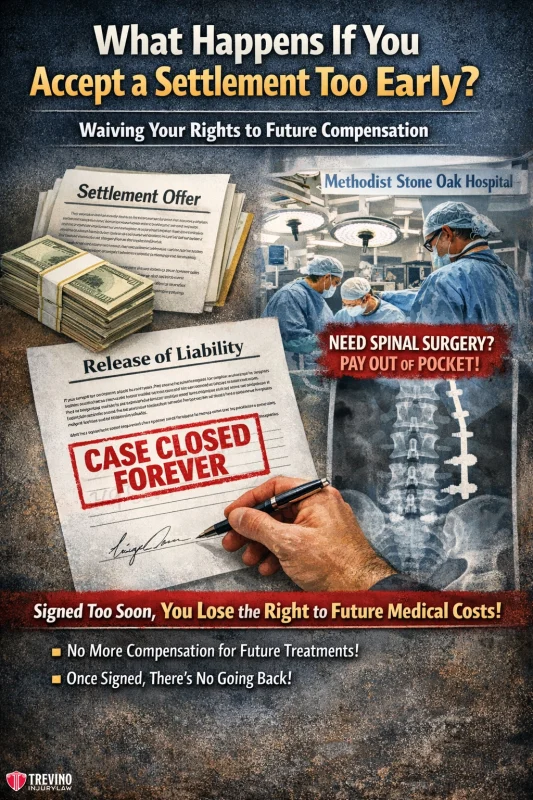
Once you sign the “Release of Liability” form, the case is closed forever. If you later discover you need a spinal fusion at Methodist Stone Oak because the initial injury didn’t heal correctly, you will have to pay for that surgery out of your own pocket.
Accepting an offer too early is a reversible negotiation error only if you haven’t signed; waiting too long to start the process creates a permanent legal deadline that cannot be remedied.
When Is It Too Late to Calculate Damages?
In Texas, the statute of limitations for filing a commercial accident lawsuit is generally two years from the date of the crash, after which your claim is permanently barred regardless of the severity of your injuries.
While two years may seem like a long time, calculating complex damages, securing expert witnesses, and negotiating with adjusters takes months. If you wait until the deadline approaches to hire a lawyer, evidence may be lost, and the pressure to file in the Bexar County District Courts before the clock runs out can compromise the quality of your case.
Why Hire a San Antonio Commercial Vehicle Accident Lawyer?
Waiting as the clock ticks on a Loop 410 crash is exactly what corporate adjusters want. High-volume settlement mills rely on delay tactics and fold quickly. At Trevino Injury Law, we do not fold; we treat every claim as a trial-ready battle to force negligent companies to pay.
Want to Protect the Full Value of Your Claim?
You’ve seen how this affects your case — but this is only one piece of the puzzle. Our Commercial Vehicle Lawyer page breaks down what a trial-ready firm does differently.
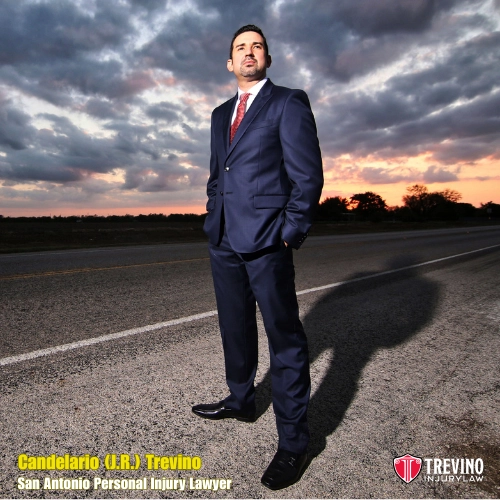
We secured a $17,000,000 settlement by exposing negligence others missed. Don’t let evidence disappear before it reaches the Bexar County District Courts. A San Antonio accident compensation lawyer immediately sends spoliation letters to preserve black box data.
Call 210-TREVINO today for a free case review. Se Habla Español. We fight on a strict No Win, No Fee basis.