Texas allows you to sue for a slip and fall if you share the blame, provided your responsibility does not exceed the property owner’s negligence. A momentary distraction or casual footwear does not automatically eliminate anything.
The Insurance Adjuster is already scanning security footage for a single frame of a downward gaze. They use that footage to reclassify the hazard as an open-and-obvious condition, shifting most of the fault onto your shoulders by accusing you of distracted walking. But slip and fall liability does not disappear just because a property owner claims you were not watching where you were going. According to the Department of State Health Services, Texas trauma facilities recorded 1,617 fatal falls in 2024. Property owners label these incidents as personal clumsiness, but they are the direct result of commercial entities skipping scheduled safety sweeps to protect profit margins.
What Could Your Slip and Fall Accident Case Be Worth?
Answer a few quick questions about your accident. Takes about 60 seconds.
See What My Case Might Be WorthThe insurance company offered less than $20,000. I ended up with over $1 million. — Jackie Galindo
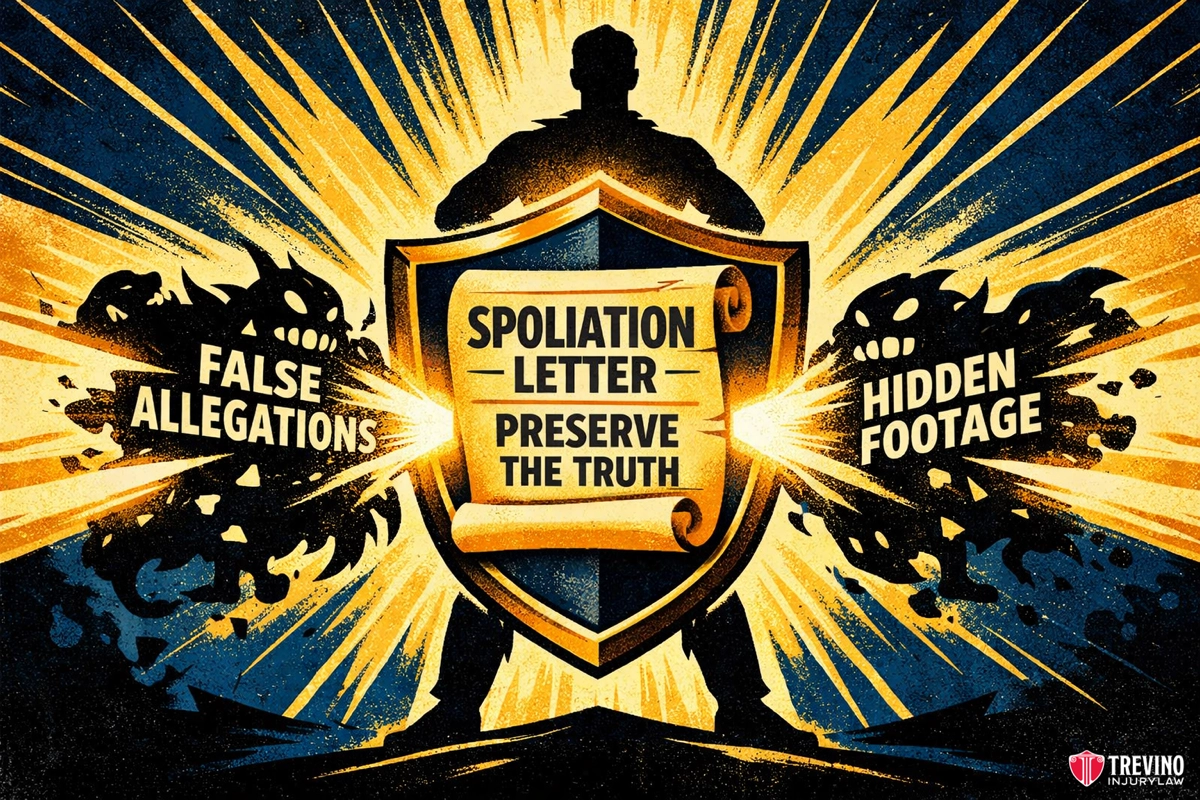
Evidence disappears rapidly as risk management teams overwrite surveillance video to hide their maintenance failures. You must send a Spoliation Letter, a legal demand that stops the property owner from destroying proof, before the statutory deadline expires.
A Trevino Injury Law slip-and-fall attorney subpoenas these internal sweep logs and forces the defense to produce the unedited video. Call 210-TREVINO now for a free case review. You pay nothing unless we win. Se Habla Español.
How Does the 51% Bar Rule Affect Your Slip and Fall Claim?
Under Texas Civil Practice & Remedies Code Chapter 33, you are barred from recovering any damages if a jury finds you are 51% or more responsible for the incident. However, you can still be able to recover a reduced amount if your degree of fault is determined to be 50% or less.
This strict “all or nothing” cutoff is unique to Texas and differs significantly from “Pure Comparative” states. This threshold is explicitly defined in Texas Civil Practice & Remedies Code § 33.001, which mandates that a claimant may sue but cannot recover damages if their percentage of responsibility exceeds 50% (Texas Statutes Online, 2024).
In San Antonio courts, this rule creates a race for evidence. Defense attorneys only need to prove you were slightly more at fault for the accident than the property owner to pay nothing. For example, if a jury in the Bexar County Courthouse decides a store was 49% negligent for a wet floor, but you were 51% negligent for not looking down, you receive zero compensation.
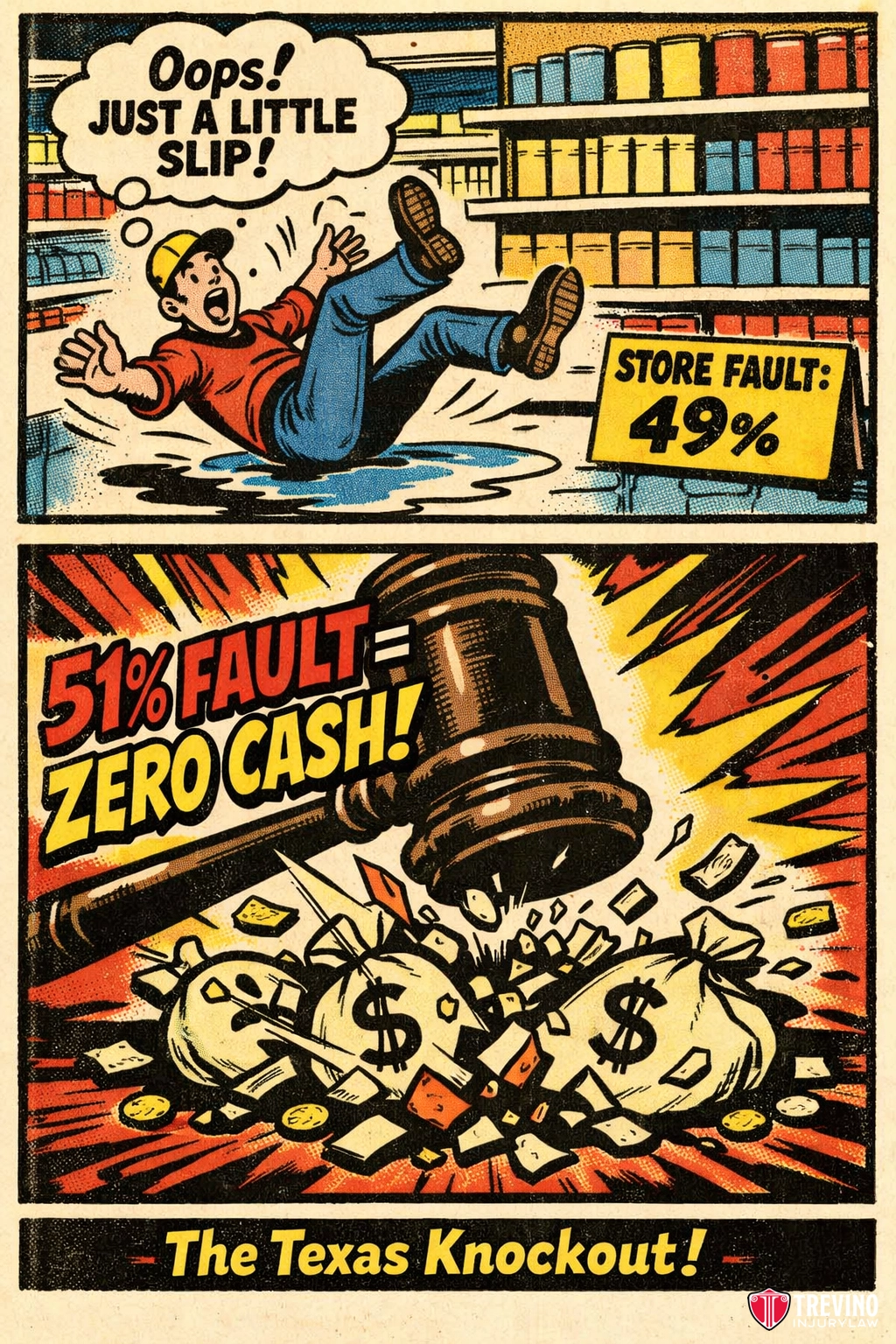
This high-stakes environment is why we immediately send preservation letters to secure evidence, ensuring major retailers cannot hide proof of their own negligence while claiming you are partially responsible.
How Is Compensation Calculated When You Are Partly at Fault?
Your total settlement award is reduced by your percentage of fault assigned to you by the judge or jury. This means the final check you receive will equal the total damages minus the specific portion attributed to your own actions. This reduction mechanism is governed by Texas Civil Practice & Remedies Code §33.012.
This calculation applies directly to your medical bills, lost wages, and pain-and-suffering awards. Consequently, your compensation will be reduced mathematically:
- Scenario A: A jury awards $100,000 but finds you less at fault (e.g., 20%). Your final recovery would be $80,000.
- Scenario B: That same jury finds you 51% at fault. The award drops to $0 instantly.
We fight to minimize your assigned percentage so you keep as much of the compensation you deserve as possible. Understanding the math is the first step, but the outcome relies entirely on the evidence we present to dismantle the store’s attempts to shift the blame onto you.
What Arguments Do Stores Use to Blame You for the Fall?
Retailers frequently argue that you failed to keep a proper lookout and that the hazard was open and obvious. That defense is tied to Texas premises-liability law, which generally does not require a property owner to warn or protect an invitee from a danger that is open and obvious or already known. In Austin v. Kroger Tex., L.P., 465 S.W.3d 193 (Tex. 2015), the Texas Supreme Court reaffirmed that rule, while recognizing limited exceptions.
Major retailers and their insurers, such as Fred Loya or USAA, rely on a standard defense playbook. They do not necessarily need to prove that they weren’t negligent; they simply need to prove that you’re partially at fault, specifically, more negligent than they were. Common defense arguments include:
- You were rushing.
- You were carrying heavy items that obstructed your view.
- You failed to pay attention to warning signs.
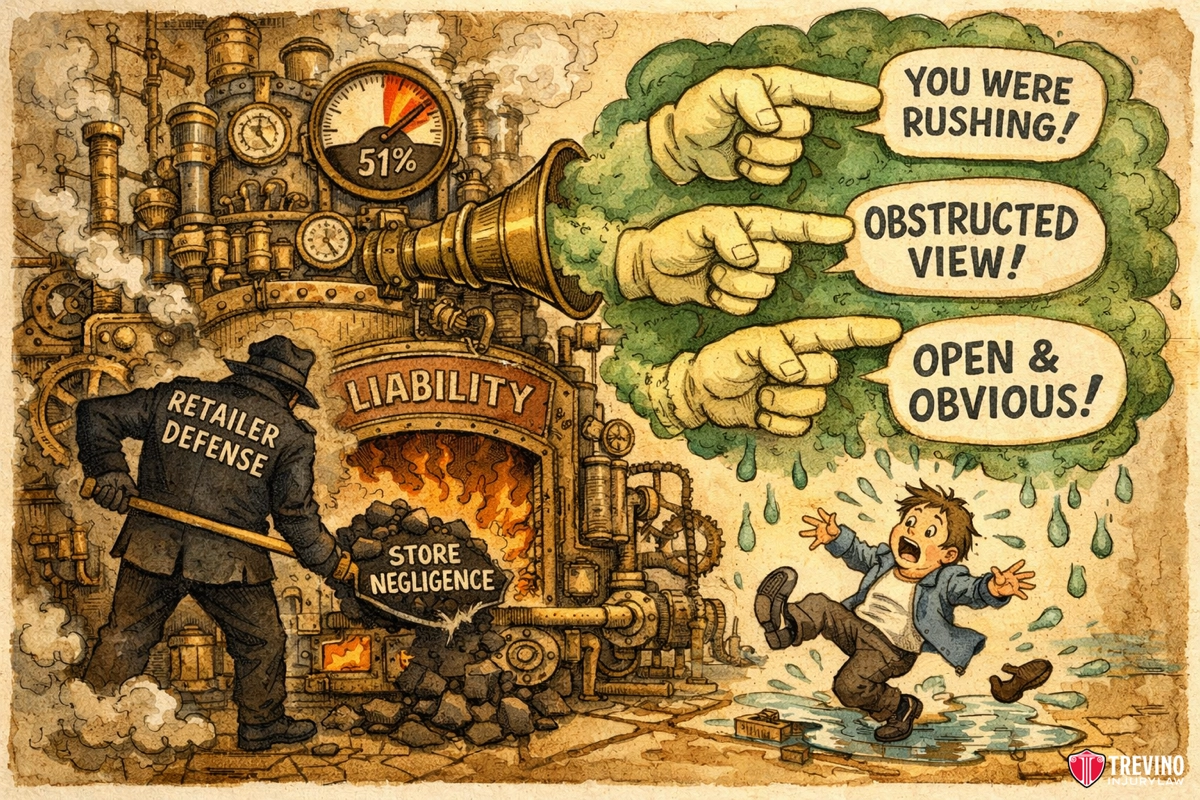
These tactics are designed to push your fault percentage over that critical 51% threshold. Minimizing the severity of these incidents is a key part of their strategy, despite data showing that falls are often fatal; in fact, Texas trauma facilities recorded 1,617 fatal falls in a single recent year (DSHS, 2024).
Does “Distracted Walking” (Phone Use) Bar You From Suing?
Using a cell phone does not automatically bar recovery. While it is strong evidence that juries use to assign partial fault, even if you were partially distracted, we can present counter-evidence showing the hazard was not visible, even if you had been looking.
Defense teams often scour security footage to find a single frame of a “downward gaze” to argue you were distracted by your phone. However, we counter this by proving the nature of the defect itself. For example, a clear liquid spill on a white tile floor at a North Star Mall department store is often invisible to the naked eye.
Can You Be Held At Fault for Wearing Improper Footwear?
Defense attorneys frequently request preservation of the victim’s shoes to argue that worn treads, high heels, or flip-flops contributed to the slip. They may argue that “I’m partially at fault” is a conclusion you should draw simply because of your shoes.
This is a common tactic in San Antonio, where flip-flops are year-round attire. Trevino Injury Law advises preserving your footwear immediately because while “bad shoes” might arguably add 10-20% to your fault, they rarely cause a fall on their own without a hazardous condition like grease or water present. We argue that a safe floor should be walkable in any standard footwear.
How Do We Disprove Allegations That You Caused the Fall?
We shift the focus back to the property owner’s duty of care by proving the hazard was unavoidable or existed long enough that they should have removed it.
Our “Warrior” mindset focuses on aggressive evidence preservation. We use “Spoliation Letters” to demand that stores preserve video footage showing you walking normally before the fall. In complex cases, we may employ accident reconstruction experts to scientifically demonstrate how the fall occurred.
A prime example of overcoming liability disputes is the Arriaga v. Montemayor verdict. The defense offered only $5,000 based on liability arguments, but the jury was convinced to award $536,007 because the negligence was clear. Even when they claim you are found partially at fault, a jury can be convinced otherwise with the right evidence.
How Does “Constructive Notice” Override Victim Fault?
If we can prove the hazard existed for an unreasonable period of time, known as Constructive Notice, the jury is more likely to place the majority of the fault on the store for failing to inspect and clean its premises.
The concept of “Time to Discovery” is critical here. If a spill was sitting on the floor of a grocery store on Culebra Road for 45 minutes, the store’s negligence in failing to clean it generally outweighs a customer’s momentary distraction. We request “Sweep Logs” to prove that employees missed their scheduled inspections.
Why Are Slip and Fall Cases Hard to Win in Texas?
Slip-and-fall cases are difficult because Texas law places a heavy burden of proof on the victim. Additionally, any inadvertent admission of fault (like saying “I’m sorry” after falling) can be used against you.
The combination of strict “Notice” requirements and the 51% Bar Rule creates a significant advantage for property owners. Insurance adjusters know that juries in Bexar County can be skeptical of falls. For example, in a busy shopping center near Loop 410, a defense attorney might argue that a spill was fresh. The courtroom reality reflects this difficulty; recently published data indicate that only 69 civil juries were selected across all District Courts in Bexar County over a 12-month period (OCA, 2024).
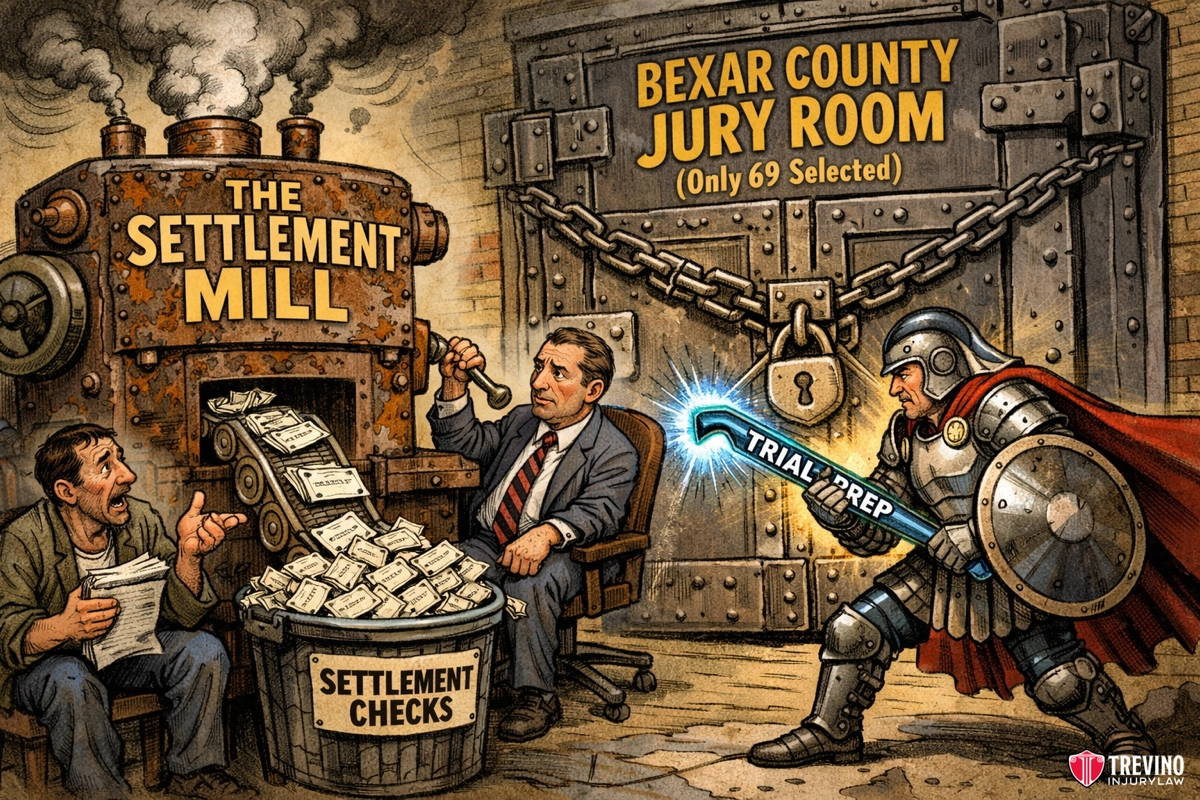
This bias is exactly why you need a San Antonio personal injury lawyer who actually tries cases rather than a “settlement mill.” It is also vital to act quickly; you generally have two years from the date of the incident to file suit, but evidence disappears much faster.
What Is the “Open and Obvious” Defense Doctrine?
The “Open and Obvious” doctrine argues that a property owner has no duty to warn an invitee of a danger that is so apparent a reasonable person would have avoided it.
This is a “total bar” defense distinct from comparative negligence. For instance, if there is a massive excavation hole in a parking lot on San Pedro Avenue in broad daylight, the court may rule the danger was so clear that you should have avoided it. However, we can often defeat this defense by proving the “obvious” danger was obscured by poor lighting or crowded conditions.
Is Texas a “Pure” Comparative Negligence State?
No, Texas is a modified comparative fault state. You cannot recover any damages if you are 51% or more at fault, unlike “Pure” states that allow recovery up to 99%.
Does a “Wet Floor” Sign Automatically Make Me 51% at Fault?
No, a sign is evidence of a warning but does not absolve the owner if it was placed poorly, fell over, or failed to identify the specific area of danger.
Can I Sue If I Was Drunk When I Fell?
Yes, but intoxication makes it highly probable a jury will assign you more than 50% fault unless the premises defect was egregious.
Claims against government entities like the City of San Antonio or VIA Metropolitan Transit face stricter liability standards. For these entities, the defect often must be classified as a “Special Defect”, like a massive roadway excavation without barriers, for liability to attach at all.
What Happens If You Are Found 0% at Fault?
If a jury determines the property owner is 100% responsible and you bear no fault, you are entitled to the full value of your calculated damages without any reduction. Achieving a finding of 0% fault usually requires strong video evidence or credible witness testimony confirming that you were walking with care.
When Does “Gross Negligence” Override Comparative Fault?
When a property owner ignores a known hazard, we look beyond mere negligence and hold them accountable. If a corporate defendant leaves a recurring oil leak or a live wire exposed, we pursue punitive damages by proving Gross Negligence. This legal standard means they showed an entire want of care and a conscious indifference to the safety of others. In cases of such extreme misconduct, we do not accept low settlement offers. We litigate to a verdict to hold them fully accountable for their malice and extreme risk-taking.
In these scenarios, a property owner knew about an extreme danger, such as a live wire at a construction site or a recurring oil leak they refused to fix, and consciously ignored it. In such cases, the focus shifts entirely to the defendant’s malice or conscious indifference, often overshadowing the victim’s minor negligence and potentially opening the door to punitive damages designed to punish the wrongdoer.
Why Hire a San Antonio Slip and Fall Lawyer?
Hiring an experienced trial attorney is the only way to effectively challenge insurance adjusters who attempt to use Texas’s 51% Bar Rule to deny your valid claim. If you try to negotiate alone, companies like HEB or Walmart will use your statements to argue you were distracted or clumsy.
Want to Protect the Full Value of Your Claim?
You’ve seen how this affects your case — but this is only one piece of the puzzle. Our Slip and Fall Lawyer page breaks down what a trial-ready firm does differently.
We proved this at the Bexar County Courthouse with a $536,007 jury verdict after a $5,000 defense offer. To build this leverage, your San Antonio injury litigation lawyer immediately issues a spoliation letter to lock down internal Sweep Logs and video before the store destroys them.
Don’t let them zero out your settlement. Call 210-TREVINO today for a free consultation. We offer a specialized consultation to review the facts of your fall and determine the best path forward.