
Calculating a catastrophic injury settlement in Texas combines your hard economic losses with a multiplier for permanent physical and emotional destruction. Every specific financial loss becomes the baseline before adding the subjective value of your lifelong anguish.
The Insurance Adjuster is already deploying reduction algorithms to suppress your baseline medical costs and shift blame onto you. They know that artificially deflating economic damages directly undercuts your pain valuation, leaving you financially stranded when long-term complications arise.
What Could Your Catastrophic Injury Accident Case Be Worth?
Answer a few quick questions about your accident. Takes about 60 seconds.
See What My Case Might Be WorthThe insurance company offered less than $20,000. I ended up with over $1 million. — Jackie Galindo
Trevino Injury Law defeats these lowball tactics in court, backing our demands with a proven trial record that includes securing a $7.9 Million jury verdict for a catastrophic crushed foot and amputation.
Evidence disappears in the first week. A Spoliation Letter, a legal demand that requires the negligent party to preserve evidence, must be sent immediately to lock down the facts. You need this evidence to substantiate your lifetime care plan before signing a liability release that forever bars additional compensation.
Trevino Injury Law’s catastrophic accident lawyers force multi-billion dollar carriers to pay for your future. Call 210-TREVINO for a free case review. You pay nothing unless we win. Se Habla Español.
What Is the Formula for Calculating Catastrophic Injury Settlements?
The standard formula for injury settlements in Texas is Economic Damages + (Economic Damages × Multiplier) + Liens = Gross Settlement Value, which combines tangible financial losses with a multiplier applied to human suffering.
This mathematical framework serves as the baseline for negotiations, ensuring that every specific financial loss, from ambulance fees to decades of lost wages, is accounted for before adding the subjective value of your physical pain and mental anguish.

This includes ‘hard numbers’ like past medical bills, future Life Care Plan costs, and lost earning capacity. However, under the Paid vs. Incurred rule established in Haygood v. De Escabedo, 356 S.W.3d 390 (Tex. 2011), we must carefully distinguish between the total amount billed by providers and the amount actually accepted as payment.
We utilize experts from institutions like the South Texas Medical Center to ensure your economic damages are calculated accurately under this strict Texas Supreme Court standard.
Insurance companies attempt to suppress this baseline number because it directly inflates the final settlement value; a higher economic base yields a significantly higher pain-and-suffering calculation.
How Does the Multiplier Method Work in Texas?
To justify a multiplier of 4x or 5x, we must provide evidence meeting the high standard set by the Texas Supreme Court in Parkway Co. v. Woodruff, 901 S.W.2d 434 (Tex. 1995). This landmark decision requires us to prove that your mental anguish goes beyond mere worry or anger, causing a ‘substantial disruption’ in your daily routine. By thoroughly documenting this disruption, we compel insurers to accurately assess the value of your suffering.
This method assumes that the intensity of your pain correlates with the cost of your medical care, meaning a minor fender bender might warrant a 1.5x multiplier, while a catastrophic injury resulting in permanent paralysis or amputation justifies a multiplier of 4x, 5x, or even higher.
For example, if a victim incurs $100,000 in medical bills and lost wages after a severe crash on Loop 1604, a 4x multiplier for severe impairment would value their pain and suffering at $400,000.
When added to the original $100,000 in economic damages, the total gross settlement value becomes $500,000. In cases of gross negligence, such as those involving drunk drivers, skilled trial attorneys fight for multipliers at the top of this range to secure a comprehensive valuation of the case.
Can You Use the Per Diem Method for Lifetime Pain?
Yes, the Per Diem (“per day”) method assigns a specific dollar value, often equivalent to the victim’s daily wage, to every single day of pain they are expected to endure for the remainder of their life expectancy. This approach is particularly effective for younger victims with permanent injuries, as it accounts for decades of future suffering rather than offering a single lump sum based on a multiplier.
In Texas courts, attorneys often advocate this method because it humanizes the suffering for the jury, asking them to consider what one day of paralysis is “worth” and then doing the math over 40 or 50 years. While insurance adjusters prefer the multiplier method because it caps their exposure, the Per Diem method can yield significantly higher results for clients facing a lifetime of disability.
Establishing the total value of your claim is the first step, but understanding that you don’t keep the entire amount is critical to planning your financial future.
How Much of a Settlement Do You Actually Keep?
Your Net Recovery is the actual amount you deposit after attorney fees, case expenses, and medical liens are deducted from the Gross Settlement, meaning you typically keep about 50% to 60% of the total offer, depending on the complexity of the litigation.

It is a dangerous misconception to assume the “big number” announced in a settlement is the amount you will take home, as the costs of funding a lawsuit and repaying healthcare providers must be satisfied first. To understand the breakdown, consider a hypothetical $100,000 settlement under a catastrophic policy limit.
First, the attorney’s contingency fee (typically 33% to 40%) is deducted, followed by case expenses, including filing fees, deposition costs, and expert witness fees, which can range from a few thousand to tens of thousands of dollars in complex cases.
Finally, outstanding medical bills must be paid, leaving the remaining balance as your net check. This reality makes it vital to secure a settlement large enough that the “net” amount still covers your future living needs.
How Do Medical Liens Impact Your Net Recovery?
Subrogation Liens are legal claims that allow hospitals, health insurance companies, and government entities like Medicare or Medicaid to be repaid directly from your injury settlement proceeds before you receive a dime. Under Chapter 140 of the Texas Civil Practice & Remedies Code, these entities have a statutory right to recover the money they spent on your care, which can sometimes consume a large portion of a settlement if not managed correctly.
Hospitals in San Antonio, such as University Hospital or Brooke Army Medical Center (BAMC), are aggressive about filing these liens, often perfecting them within 72 hours of your admission.
A skilled trial lawyer adds value by negotiating these liens down, often reducing them by 30% to 50%, so you put more money back in your pocket. Without this negotiation, a victim with massive medical bills could technically win their case but end up with zero dollars in actual recovery.
While huge medical bills can drain your settlement, being found partially at fault for the accident can eliminate your right to compensation entirely.
How Does the 51% Rule Affect Your Payout?
Under Texas’s Modified Comparative Negligence law (commonly known as the “51% Bar Rule”), your settlement is reduced by your percentage of fault, and if you are found 51% or more responsible for the accident, you recover $0. This strict rule turns every catastrophic injury case into a fierce liability dispute, as insurance companies know that shifting just a small percentage of blame onto you can save them millions of dollars.
For example, if a jury determines your damages are $1 million but finds you 20% at fault for speeding on I-35, your payout is reduced to $800,000. However, if that same jury finds you 51% at fault, you receive nothing.
Because liability determines whether you get paid at all, objective evidence is critical. Does an MRI increase settlement value? Yes, because diagnostic tools like MRIs provide indisputable proof of injury severity, increasing the “Economic Damages” baseline that drives the multiplier calculation and making it harder for insurers to downplay the claim or shift blame.
This “all or nothing” cliff is why insurance adjusters work so hard to obtain recorded statements immediately after a crash. They are looking for any admission, like saying “I didn’t see him,” that they can use to push your liability over that fatal 51% threshold.
Once liability is established and the final number is agreed upon, the immediate question becomes how long you must wait to receive the funds.
How Long Does It Take to Receive a Payout?
Once a settlement agreement is signed, it typically takes 2 to 6 weeks to receive the final check, though the entire catastrophic lawsuit process often takes 18 to 36 months to reach that point. This final administrative phase is distinct from the litigation timeline and involves strict banking and legal clearance protocols that must be completed before funds can be released.
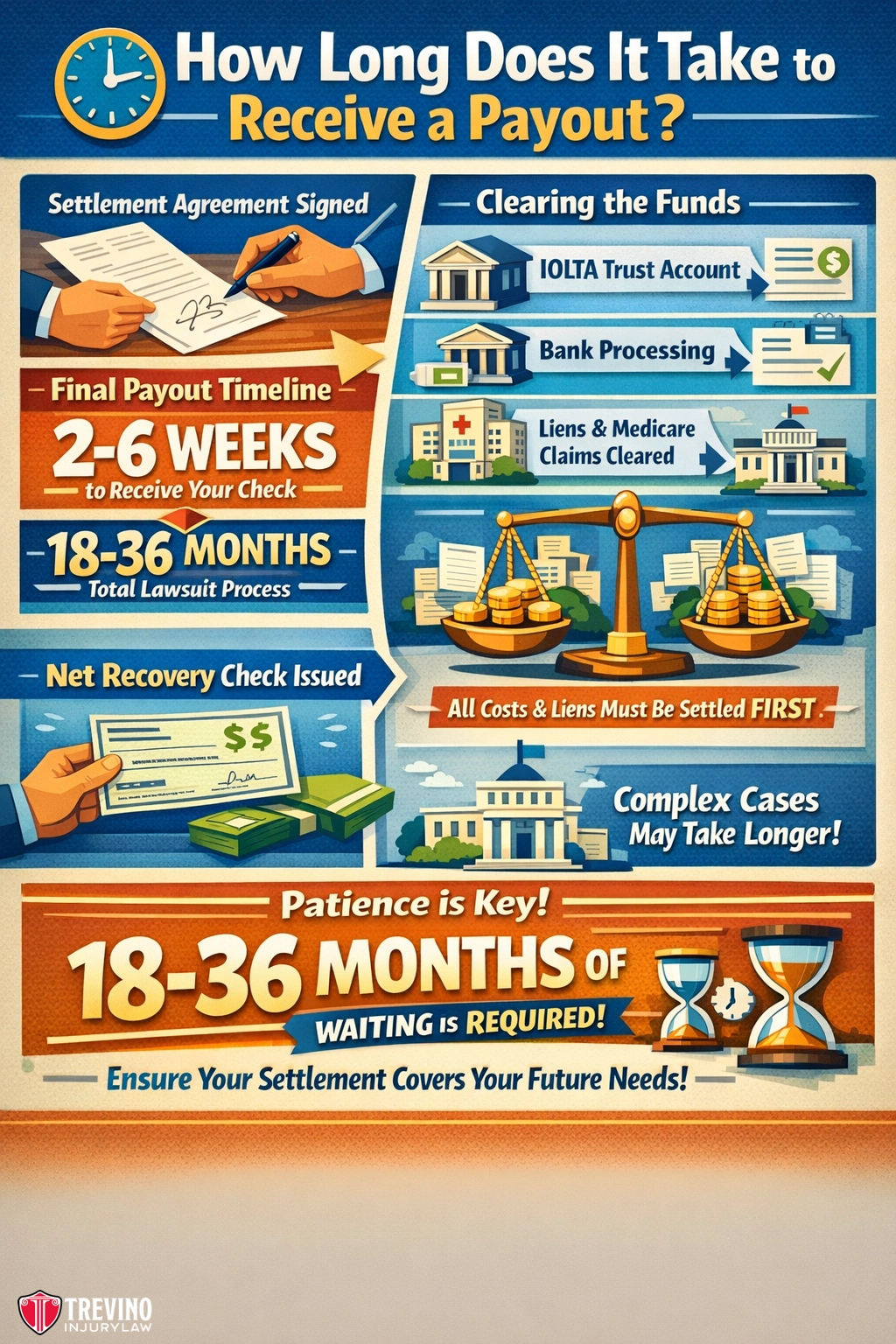
It is critical to distinguish between “reaching a settlement” and “funding.” After you sign the Release of Liability, the insurance company sends a check to your attorney, which must be deposited into a regulated IOLTA trust account. The funds cannot be disbursed immediately; they must clear the bank, and your attorney must verify that all third-party interests, such as outstanding liens from providers like Methodist Hospital or federal Medicare claims, have been fully satisfied.
Only after every penny of case costs and liens is accounted for can the firm cut your “net recovery” check. Complex cases involving government liens often sit at the upper end of this 6-week window due to bureaucratic processing delays.
Understanding the timeline helps manage expectations, but ensuring the settlement amount itself is actually sufficient to cover your lifetime needs is the far more critical challenge.
What Is a “Day in the Life” Video?
A Day in the Life video serves as forensic evidence to substantiate the “Pain and Suffering” multiplier, visually documenting the victim’s daily struggles rather than merely describing them.
In high-stakes litigation, we employ professional videographers to record a typical day for the client, showing the jury the humiliating reality of needing assistance with showering, dressing, or eating.
This visual evidence often compels insurance carriers to significantly increase their settlement offers to avoid a jury viewing the footage, effectively turning abstract legal arguments into undeniable emotional reality.
What Happens If You Accept the First Settlement Offer?
Accepting the first offer almost always results in undervaluation, as insurance adjusters are trained to start with a “lowball” number that deliberately ignores future medical needs and lost earning capacity.
This initial bid is a test of your desperation; by accepting it, you lock in a number calculated to save the insurance company money rather than restore your life. Once accepted, you cannot go back and request more if you realize the funds won’t cover your second surgery or home modifications.
Is a $50,000 Settlement Good for a Catastrophic Injury?
No, a $50,000 settlement is likely a “policy limits” trap that fails to cover long-term care for catastrophic injuries like TBI or spinal cord damage, leaving you personally liable for future medical bills.
A catastrophic injury is one that permanently alters your trajectory, often costing millions over a lifetime. Victims of catastrophic accidents frequently suffer from traumatic brain injuries or spinal cord injuries, where the initial medical expenses alone far exceed $50,000.
Accepting such a low offer ignores the long-term impact of the injury, including rehabilitation, 24/7 care, and home modifications. The true value of a catastrophic injury depends on several factors, primarily the severity of the injury and its devastating effect on your quality of life.
An experienced attorney will calculate these lifetime costs to prevent you from settling for a fraction of what you are owed. Always consult a personal injury attorney before signing any release to ensure the offer reflects the full reality of your damages.
Do I Have to Pay Taxes on Pain and Suffering?
No, under IRS rules, settlement proceeds for “physical injuries or physical sickness” (including pain and suffering) are generally tax-free in Texas, meaning the net amount you receive is yours to keep without federal income tax liability. However, injury claims in Texas can be complex when distinguishing between different types of damages.
Generally, pain and suffering damages and compensation for loss of enjoyment of life tied to a physical injury remain tax-free. In contrast, punitive damages and compensation for lost income are typically taxable because the IRS treats lost wages as replacement income.
Additionally, emotional distress damages that are not directly due to your injury (physical bodily harm) may be subject to taxation. Because tax implications often depend on the specific language used in your settlement release, it is vital to handle your injury lawsuit with precision.
How Do Structured Settlements Work?
A structured settlement pays out your compensation in guaranteed tax-free installments over time rather than a single lump sum, providing long-term financial security for victims who cannot return to work.

For a family in a residential area like Stone Oak, a structured settlement can be designed to release funds at specific milestones, such as paying for college tuition or replacing a wheelchair van every 5 years.
While a lump sum offers immediate flexibility, structured payments prevent the risk of premature spending and ensure that funds remain available for medical needs 20 or 30 years down the road.
When Is It Too Late to Negotiate a Higher Amount?
Once you have signed the release of liability, it is legally impossible to reopen your claim or negotiate for more money, even if your medical condition worsens significantly or new complications arise.
This document functions as a permanent contract ending the dispute; if you sign it before a forensic economist has fully calculated your lifetime damages, you are forever barred from seeking the difference. This finality is why no catastrophic injury victim should ever sign insurance paperwork without the review of a trial attorney. When negotiations depend on credible courtroom leverage, trial readiness in a Bexar County catastrophic injury claim becomes the next practical issue to understand.
Why Hire a San Antonio Catastrophic Injury Lawyer?
Signing a release of liability before calculating lifetime damages is exactly what insurance adjusters and high-volume settlement mills want. They rely on desperation to lock in lowball offers that leave you bankrupt. At Trevino Injury Law, we reject these tactics. We treat every case as a trial waiting to happen, fighting to force multi-billion dollar carriers to pay for your future.
Want to Protect the Full Value of Your Claim?
You’ve seen how this affects your case — but this is only one piece of the puzzle. Our Catastrophic Injury Lawyer page breaks down what a trial-ready firm does differently.

Our trial authority is proven by turning $15,000 offers into 107x jury verdicts, exposing bad-faith tactics in Bexar County. When you hire a San Antonio trial attorney, we immediately deploy Life Care Planners to substantiate the true cost of your care.
Call 210-TREVINO for a free case review. We work on a No-Win, No-Fee basis. Se Habla Español.