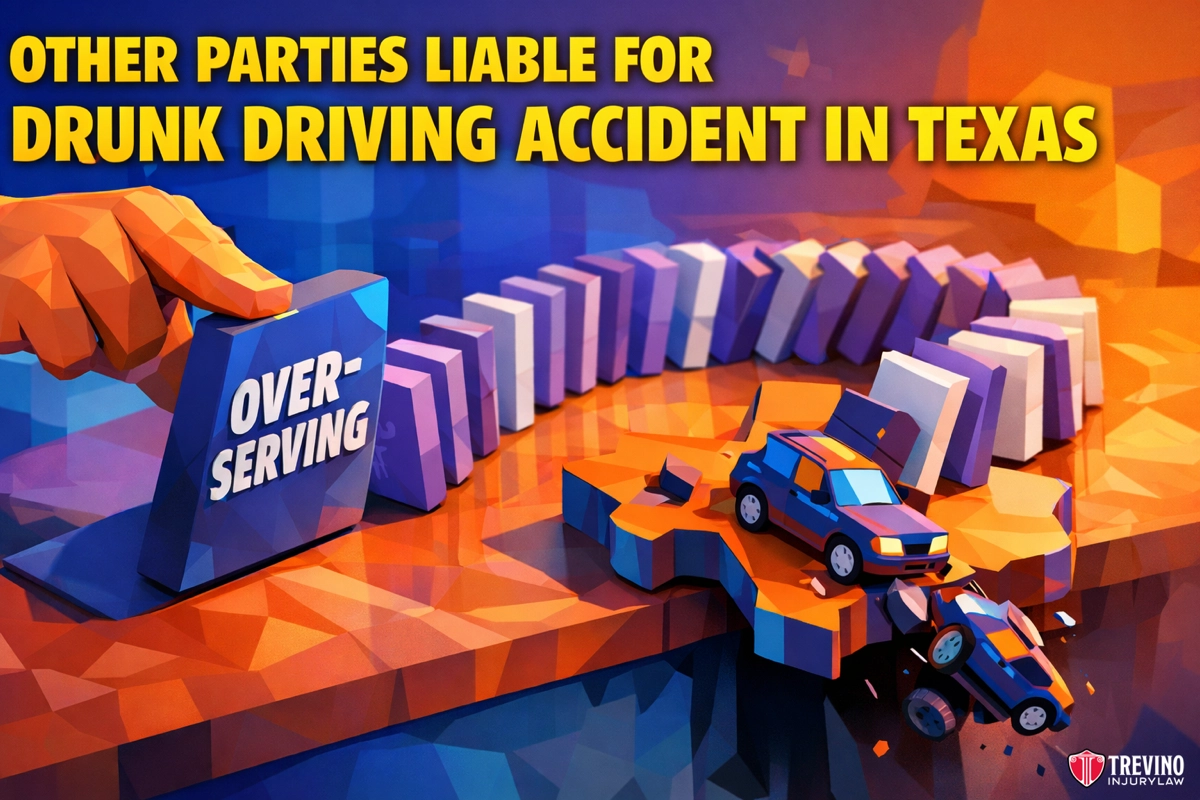
The drunk driver who caused your collision lacks the assets to cover a lifetime of medical care. The insurance adjuster is already weaponizing this reality, using the driver’s minimum coverage limits to cap your payout while actively shielding the commercial bar that over-served them and the negligent employer who handed over the keys.
According to the Texas Department of Transportation, San Antonio recorded 2,237 DUI-alcohol crashes in 2024. Behind most of these collisions is a commercial entity prioritizing profits over public safety by serving visibly intoxicated patrons or ignoring a worker’s reckless driving history, raising hard questions about determining full liability in drunk driving cases.
What Could Your Drunk Driving Accident Case Be Worth?
Answer a few quick questions about your accident. Takes about 60 seconds.
See What My Case Might Be WorthThe insurance company offered less than $20,000. I ended up with over $1 million. — Jackie Galindo
Surveillance footage from these establishments gets recorded within days. A Spoliation Letter, a legal demand that stops the property owner from destroying proof, must go out immediately to lock down bar receipts and camera feeds. Texas gives you exactly two years to file suit before the claim vanishes permanently.
Trevino Injury Law will investigate the full chain of negligence and hold powerful corporations accountable. Call 210-TREVINO now for a free case review. You pay nothing unless we win. Se Habla Español.
1. The Vehicle Owner (Negligent Entrustment Laws in Texas)
Liability attaches to a vehicle owner when they knowingly lend their vehicle to an unlicensed, incompetent, or reckless driver who then causes the accident. In Texas, ownership alone does not create liability. To hold an owner responsible, we must satisfy the strict four-part test the Texas Supreme Court established in Schneider v. Esperanza Transmission Co., 744 S.W.2d 595 (Tex. 1987).
This landmark ruling requires us to prove not only that the owner entrusted the vehicle, but that they knew, or should have known, the driver was unlicensed, incompetent, or reckless when the keys were handed over. This risk is prevalent in our community. In 2024, the San Antonio Police Department reported 3,716 DWI charges, bringing the county-wide total to 5,028 (Texas DPS, 2024).
This often happens when the owner entrusts a car to someone with a history of these convictions, a suspended license, or visible signs of intoxication when they hand over the keys. We frequently investigate this circumstance in affluent neighborhoods like Stone Oak, where parents may entrust high-powered vehicles to teenagers with prior citations or a history of reckless behavior. If a parent lets a child with a known history of dangerous driving take the car, and that choice leads to a wreck on Loop 1604, the parent may be liable for the resulting damages.
Proving this legal responsibility requires obtaining the driver’s past driving record and deposing the owner to establish what the owner knew about the driver’s competence. For a deeper analysis of how we prove knowledge and incompetence in these claims, read our guide on determining full liability in drunk driving cases. Identifying the owner is the first step, but we must also consider who employed the driver, as commercial entities often bear responsibility for their workers’ actions.
2. The Driver’s Employer (Commercial Liability in Drunk Driving Cases)
Employers are strictly liable for crashes caused by their employees if the employee was operating within the “course and scope” of their employment at the time of the accident. This legal doctrine, known as respondeat superior, means a company cannot disown the actions of a driver delivering goods, traveling to a sales meeting, or transporting equipment for the business.
Commercial involvement in accidents is significant in our region; in 2024, 3,501 crashes involved Commercial Motor Vehicles (CMVs) in Bexar County, resulting in 137 serious injuries (TxDOT, 2024). If the driver was on the clock or performing a job-related task, the company’s higher-limit commercial insurance policy becomes available to cover your damages.
This scenario is common on commercial corridors like Loop 410, where delivery drivers, sales representatives, and oil field workers commuting from the Eagle Ford Shale share the road with families. If an oil field worker is driving drunk in a company truck back to a yard in South San Antonio, the company may be liable not only for the driver’s negligence but potentially for its own negligence in hiring or supervising that driver.
We investigate whether the company conducted proper background checks or ignored red flags about the driver’s substance use. Many victims are unaware that to understand the specific boundaries of when a worker is considered “on the job,” they must review the detailed breakdown of the course and scope of liability.
While private employers are generally liable for their drivers, holding a government entity responsible for dangerous road conditions requires navigating a completely different set of rules and immunities.
3. Government Entities (Road Defects and Personal Injury Claims)
The Texas Tort Claims Act (TTCA) waives sovereign immunity for accidents caused by “premises defects” or “special defects” in the roadway, allowing victims to sue municipalities, such as the City of San Antonio.
While the government is generally immune from lawsuits, this waiver applies when the city or state knew of a dangerous condition—such as a malfunction, obstruction, or design flaw—and failed to repair it or warn drivers.
The city is actively engaged in this maintenance battle; in FY 2024 alone, San Antonio Public Works completed 95,416 pothole repairs (City of San Antonio Public Works, 2024). However, maintenance gaps and warning signs still occur. In drunk driving cases, a road defect can be a contributing factor that turns a recoverable loss of control into a fatal rollover.
Specific defects might include missing guardrails on steep curves, malfunctioning traffic lights at busy intersections, or deep potholes on I-35 that cause a driver to lose control. However, suing a government entity comes with a critical warning: strict notice deadlines. For claims against the City of San Antonio, you must file a formal Notice of Claim within 90 days of the accident.
Failure to file this specific paperwork bars you from recovery forever, regardless of how severe the defect was or how serious your injuries are. It can be difficult to navigate these short timelines without immediate legal representation.
What Qualifies as a “Special Defect” Under Texas Law?
A special defect is an unexpected and unusually dangerous condition on the roadway, such as an excavation or a massive obstruction, which legally requires the government to exercise the highest duty of care to warn drivers. Unlike ordinary premises defects, where the government is only liable if it actually knew of the problem, special defects require the government to warn drivers if it should have known of the hazard.
Examples include large sinkholes or unlit construction excavations that a driver could not reasonably anticipate. Unlike government entities that enjoy broad immunity, private contractors working on these same roads face standard liability rules when their negligence creates hazards.
4. Construction Companies (Work Zone Negligence)
Private construction firms working on highway expansion projects are liable if confusing signage, improper barriers, or debris create a hazard that contributes to a drunk driving crash. Work zones present a documented danger to South Texas drivers. In 2024, Bexar County recorded 1,360 work zone crashes, resulting in 19 serious injuries and 7 deaths (TxDOT, 2024).
These companies do not have sovereign immunity and must maintain work zones that are safe for reasonably prudent drivers. If a construction crew leaves a poorly marked lane closure or fails to use reflective barriers, they can be held partially responsible if a driver, even an impaired one, crashes as a result.
We often see this liability on Culebra Road or during the massive expansion projects on the Far West Side, where shifting lanes and temporary barriers can confuse drivers at night.
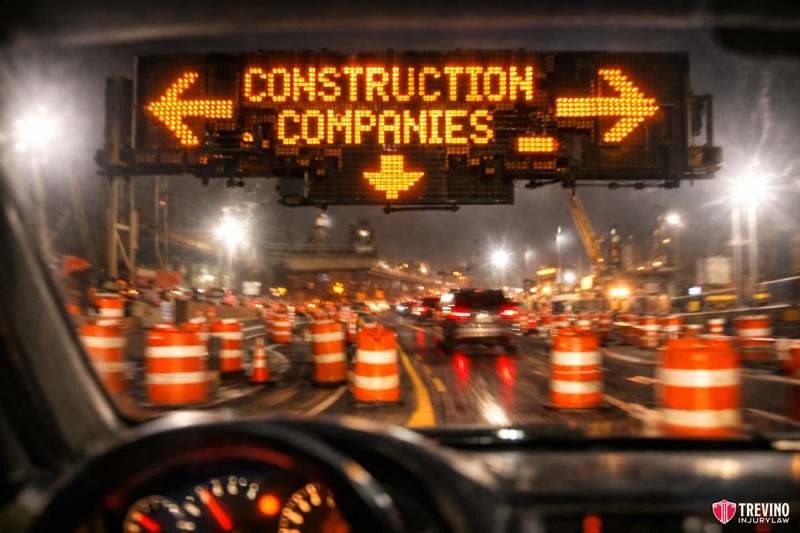
For example, if a drunk driver hits a concrete barrier that was placed in a travel lane without proper reflective tape or lighting, the driver is certainly at fault, but the construction company shares fault for creating a possible death trap.
We subpoena traffic control plans and daily logs to prove the contractor failed to follow safety standards. While road hazards are external factors, we must also investigate whether a mechanical failure within the vehicle itself prevented the driver from stopping, regardless of their intoxication level.
5. Mechanics and Manufacturers (Vehicle Failure)
Auto repair shops and manufacturers are liable under product liability or negligence theories if a mechanical failure was a “proximate cause” of the accident. Defense attorneys often try to blame alcohol for 100% of the crash, ignoring mechanical evidence that proves the driver lost control due to a blowout or brake failure.
If a repair shop in Leon Valley failed to properly install brake calipers, or a manufacturer sold a tire with a design defect, they share liability for the wreck. We investigate whether brake failure or a tire blowout prevented the driver from stopping, regardless of their intoxication level.
This investigation requires the immediate preservation of the vehicle’s “Black Box” (Event Data Recorder) and the wrecked vehicle itself before it is scrapped or sold at auction.
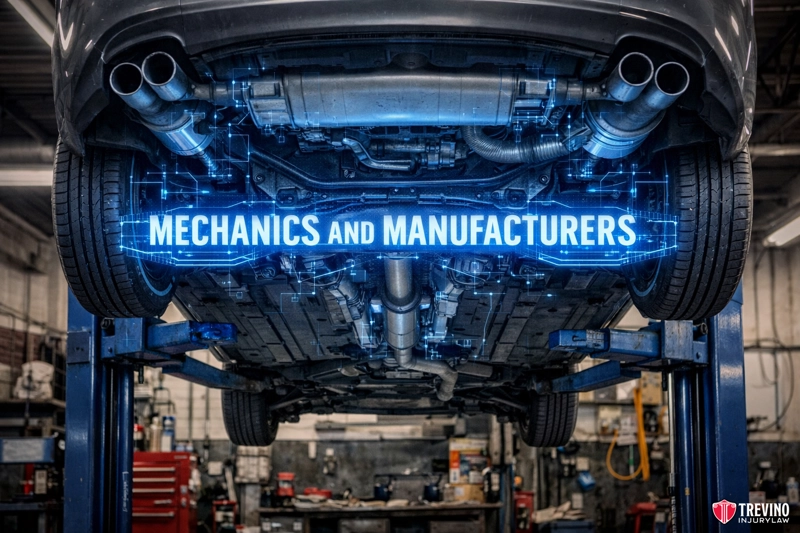
Without the physical vehicle, proving that a mechanical failure occurred becomes nearly impossible, which is why calling a lawyer immediately is critical. Beyond the vehicle and the road, we must look at the source of the intoxication itself, starting with commercial establishments that profit from serving alcohol.
6. Bars and Restaurants (Dram Shop Laws)
Commercial providers are liable for serving an obviously intoxicated person who presents a clear danger to themselves and others under the Texas Dram Shop Act. This law holds establishments like bars, restaurants, and liquor stores accountable when they prioritize profit over public safety by continuing to sell alcoholic beverages to a customer who is slurring speech, stumbling, or aggressive.
The consequences of this overserving are visible in our local emergency rooms: in 2024, San Antonio DUI crashes resulted in 155 serious injuries and 511 non-incapacitating injuries (TxDOT, 2024). The standard is high; under the Texas Alcoholic Beverage Code, we must prove that the intoxication was apparent to the provider at the time of service, not just that the person was drunk.
This liability often arises in entertainment districts like The Pearl or Southtown, where patrons may visit multiple establishments that serve alcohol in one night. We use receipts, surveillance footage, and witness testimony to reconstruct the timeline of service and prove the establishment ignored clear signs of impairment in the intoxicated person.
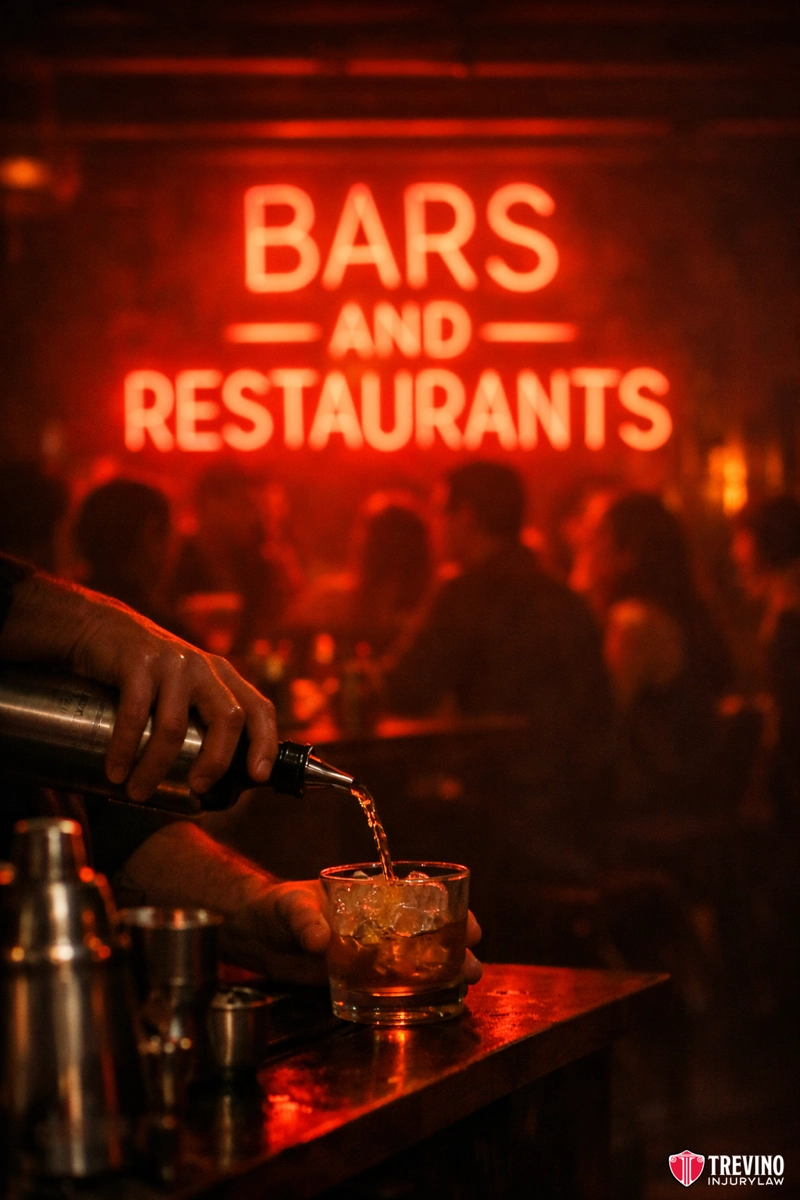
Identifying the specific bar that overserved the driver allows us to file a claim against their liquor liability insurance policy for damages caused by the intoxicated driver. For a detailed explanation of the “obviously intoxicated” standard, read our guide on Texas Dram Shop laws. While bars are strictly regulated, private individuals who serve alcohol at home generally enjoy protection from lawsuits, with one major exception.
Texas law generally protects social hosts from liability for the actions of their adult guests, unless they knowingly served alcohol to a person under the age of 18 or allowed a minor to consume alcohol on their property. Unlike many states that may impose broader liability, a person hosting a dinner party in Alamo Heights is not liable if an adult guest drives home drunk and causes a crash.
However, the law has zero tolerance for adults who provide alcohol to unrelated minors. Laws that hold homeowners accountable are designed to prevent adults from facilitating underage drinking. If a homeowner allows a high school party where teenagers are drinking, and one of those teens drives away to injure someone in a wreck, the homeowner is liable for the damages.
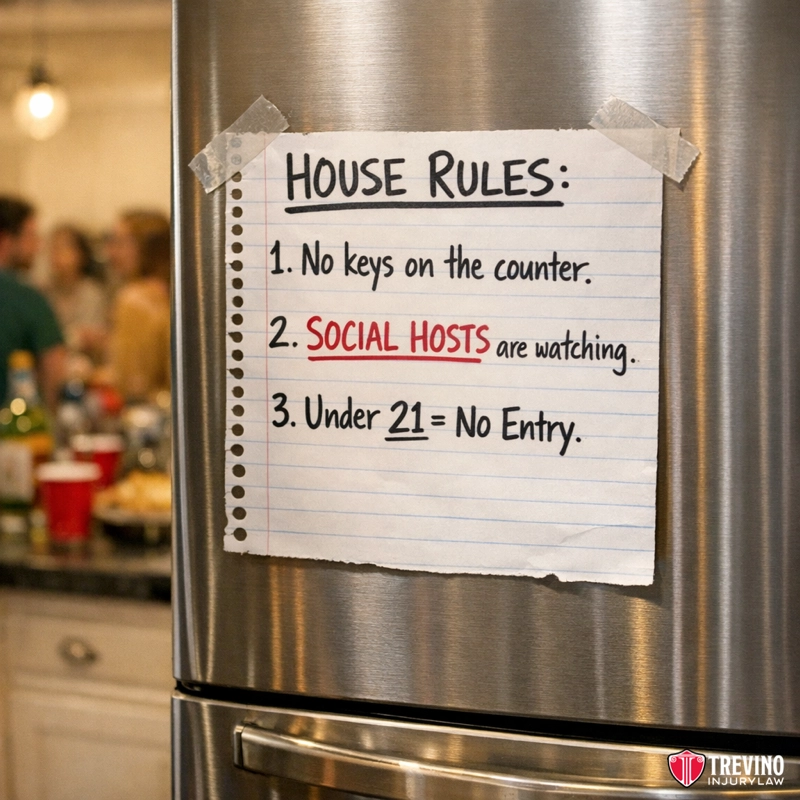
We investigate these cases by interviewing party guests and reviewing social media posts to establish who provided the alcohol and who controlled the property. It is vital to confirm the participants’ ages, as this liability specifically applies when the driver is a minor (under 18). With so many responsible parties potentially involved, a common question is how the law divides the bill for your damages among them.
How Does “Proportionate Responsibility” Work with Multiple Defendants?
Under Texas Civil Practice & Remedies Code Chapter 33, a jury assigns a percentage of fault to every party. As clarified in F.F.P. Operating Partners, L.P. v. Duenez, 237 S.W.3d 680 (Tex. 2007), the Texas Supreme Court confirmed that liability in drunk driving cases does not stop with the driver. The Court held that responsibility must be apportioned among all parties whose negligence contributed to the crash, including bars that overserve alcohol.
As the Court explained, a provider can be held responsible when its service of alcohol is a contributing cause of the injuries, even if the driver’s intoxication is obvious. This ruling is critical because it allows us to shift a significant percentage of fault onto commercial defendants with real insurance coverage, ensuring you are not left relying on a judgment-proof driver.
This means they may be forced to pay 100% of the damages, ensuring you are compensated even if the drunk driver is penniless. This legal mechanism is critical in a state where alcohol-related crashes account for over 25% of all traffic deaths (TxDOT, 2024), yet the intoxicated driver often carries only the state minimum of $30,000 in insurance (TxDMV, current requirement).
In contrast, a third party, like a construction company or a bar, often carries millions in commercial liability coverage. The strategic value of this statute cannot be overstated for victims with catastrophic injuries. If we can prove that a construction company’s negligence in a work zone on I-35 was 51% responsible for the crash because they created a confusing hazard, that company can be forced to pay the entire judgment.
We build our cases to reach these “deep pockets,” ensuring that your financial recovery is not limited by the drunk driver’s empty bank account. While establishing liability opens the door to compensation, you must also be prepared for the specific defenses these third parties will use to avoid paying their share.
Is There a Strict Deadline to File a Third-Party Claim?
Yes, while the general statute of limitations for personal injury in Texas is two years, claims against government entities like the City of San Antonio require a formal Notice of Claim be filed within 90 days of the crash, or your right to sue is permanently lost.
This strict deadline creates a “failure point” for many valid cases; if you wait six months to hire a lawyer, you may find that your claim against the city for a dangerous road defect has already expired.
This timeline applies strictly to the governmental entity itself, not the private contractors who may have been working on the road. However, identifying which entity is responsible takes time. We file notices immediately to preserve your rights against all potential government defendants, whether it is the City, the County, or the State, ensuring that a missed deadline does not bar you from the compensation you need for long-term recovery.
Can I sue the passenger for distracting the driver?
Yes, but only if you can prove “active interference,” such as grabbing the steering wheel, rather than just verbal distraction or arguing.
Are police liable for not stopping the drunk driver earlier?
Generally, no. Police have “official immunity” for discretionary decisions about whom to stop, unless they acted with extreme recklessness or bad faith.
Can I sue the car rental company?
No, the federal Graves Amendment protects rental companies from liability for their customers’ driving unless the company was negligent in maintaining the vehicle.
Can a “Superseding Cause” Protect the Third Party?
No, a superseding cause defense does not automatically protect a third party if we can prove their negligence, such as a road defect or mechanical failure, was a substantial factor in causing the accident, regardless of the driver’s intoxication.
Defendants like construction companies often argue that the driver’s extreme drunkenness was an unforeseeable event that broke the “chain of causation,” making the missing guardrail or confusing signage irrelevant.
To defeat this defense, we must demonstrate that the hazard they created would have been dangerous even to a sober driver. If a construction firm left an unlit concrete barrier in a lane of traffic on I-10, the fact that the driver was intoxicated does not excuse the company for creating a trap that could have killed anyone.
We use accident reconstruction experts to show that the defect was a primary cause of the severity of the crash.
What If the Liable Drunk Driver Fled the Scene (Hit-and-Run)?
When a drunk driver flees the scene, we must immediately investigate surveillance footage from nearby businesses and analyze license plate data to identify the vehicle’s owner, who may be liable for negligent entrustment even if the driver is never caught. If the owner cannot be identified, or if the vehicle was stolen, your recovery strategy shifts to filing a claim under your own Uninsured Motorist (UM/UIM) coverage.
In cases involving “phantom vehicles” on Loop 410, the priority is establishing the identity of the car itself. If we can trace the license plate to a parent in Timberwood Park or a commercial fleet, we can pursue a claim against that owner for allowing an incompetent driver to use the vehicle. This investigation often requires subpoenaing footage from traffic cameras or security systems at nearby intersections before the data is overwritten.
What If I Was a Passenger in the Drunk Driver’s Car?
Yes, you can sue the driver of the vehicle you were riding in, but if you knowingly entered the car with an intoxicated driver, the defense will argue you are partially at fault, which can reduce your final compensation under Texas comparative negligence laws. This “assumption of risk” argument is a standard tactic used by insurance adjusters to devalue passenger claims, essentially blaming you for getting in the car.
We fight this by focusing on what you knew at the time. Perhaps the driver seemed sober when you left a restaurant at The Rim, or you had no other way to get home safely. Even if a jury finds you have partial liability, you can still recover damages as long as your percentage of fault is 50% or less. We work to minimize your assigned fault to maximize the settlement you receive for your medical bills and pain and suffering.
Why Hire a San Antonio Drunk Driving Accident Lawyer?
The villains are the Southtown bars that over-served the driver, the construction giants hiding road defects, and the “settlement mills” too afraid to fight them. Trevino Injury Law doesn’t fold. We force powerful opponents to pay, proving our trial-authority with a $536,007 jury verdict at the Bexar County Courthouse that crushed a pathetic $5,000 offer.
Want to Protect the Full Value of Your Claim?
You’ve seen how this affects your case — but this is only one piece of the puzzle. Our Drunk Driving Accident Lawyer page breaks down what a trial-ready firm does differently.
You need a personal injury trial lawyer to immediately send spoliation letters and preserve black box data before the defense destroys it.
Call 210-TREVINO for a free case review. Se Habla Español. You pay no fees unless we win.