A box truck accident settlement in Texas holds more value than a standard car crash. Calculating it requires piercing commercial insurance layers and proving lifelong impairment.
The commercial insurance adjuster is already moving to devalue your claim. They pressure you into signing a full release of liability before doctors diagnose the true extent of your spinal or traumatic brain injuries.
According to the Texas Department of Transportation, the state recorded 18,218 serious injuries on its roadways in 2024. These collisions trigger life-altering events that demand the maximum financial recovery available under commercial policies.
What Could Your Box Truck Accident Case Be Worth?
Answer a few quick questions about your accident. Takes about 60 seconds.
See What My Case Might Be WorthThe insurance company offered less than $20,000. I ended up with over $1 million. — Jackie Galindo
Crucial evidence vanishes in the first week. A Spoliation Letter, a legal demand that stops the trucking company from destroying black box data, must go out immediately. Texas gives you two years to file suit. After that deadline passes, the right to recover anything disappears.
Trevino Injury Law’s box truck accident lawyer secures the evidence and forces commercial carriers to pay the true cost of your injuries. Call 210-TREVINO right now for a free case review. You pay nothing unless we win. Se Habla Español.
How Is Pain and Suffering Calculated in Texas Lawsuits?
In Texas personal injury lawsuits, while attorneys often use the Multiplier Method to estimate damages, the legal requirements for recovering them are far stricter. Under the landmark Texas Supreme Court decision in Parkway Co. v. Woodruff, 901 S.W.2d 434 (Tex. 1995), a victim must provide direct evidence of the “nature, duration, and severity” of their anguish to recover damages.
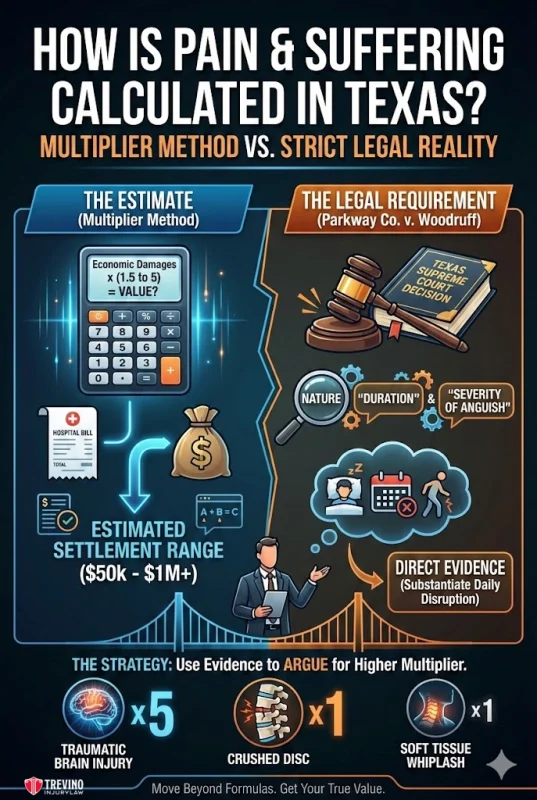
This means we must move beyond simple formulas and legally substantiate how the injury has disrupted your daily routine, so we can demand a higher settlement that reflects the true “nature and severity” required by Texas law.
While the main hub outlined a general settlement range from $50,000 to over $1 million, calculating your specific number requires an in-depth analysis of the “Multiplier Method.”
In San Antonio courts, economic damages, such as hospital bills from University Hospital, are objective and easy to prove with receipts, but “non-economic” damages for pain and impairment are subjective. To bridge this gap, attorneys use established formulas to argue that the pain of a crushed disc or a traumatic brain injury typically warrants a higher multiplier than a soft-tissue whiplash injury.
What Is the “Multiplier Method” for Commercial Claims?
The Multiplier Method is a standard formula used by insurance adjusters and attorneys, in which the victim’s total economic damages (medical bills plus lost wages) are multiplied by a number between 1.5 and 5 to determine the value of pain and suffering.
For example, if you have $50,000 in medical bills and $10,000 in lost wages (totaling $60,000 in economic damages) and your injuries are moderately severe, a multiplier of 3 might be applied. This would result in $180,000 for pain and suffering ($60,000 x 3), bringing the total settlement value to $240,000.
This method provides a starting point for negotiations, though defense attorneys will always argue for a lower multiplier while your lawyer fights for a higher one based on the impact on your daily life.
Why Box Truck Multipliers Are Higher Than Auto Accidents
Box truck accident claims often command higher multipliers (typically 4x or 5x) than standard car accidents because the injuries caused by 26,000-pound vehicles are frequently catastrophic.
According to TxDOT’s 2024 crash data, 18,218 people sustained serious injuries on Texas roadways in a single year. These aren’t just minor “fender benders”; they are life-altering events that warrant the maximum financial recovery available under commercial policies.
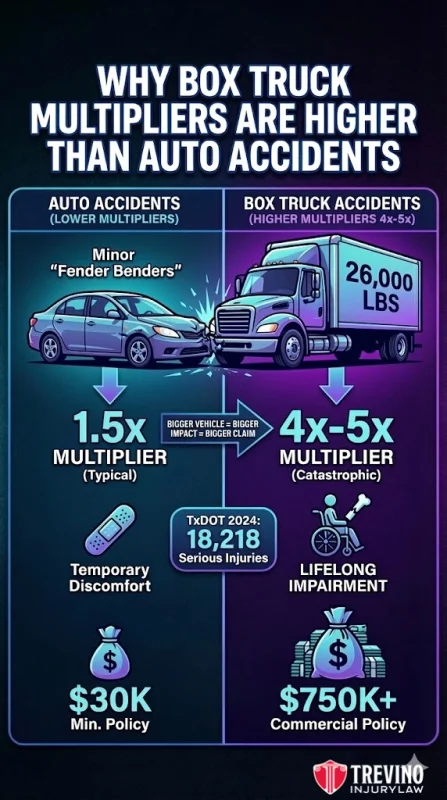
While a minor “fender bender” on Bandera Road might only justify a 1.5x multiplier due to temporary discomfort, a collision with a delivery truck often results in lifelong impairment that fundamentally alters a victim’s quality of life.
Furthermore, because commercial box trucks carry minimum liability limits of $750,000 (compared to the $30,000 minimum for passenger cars), insurance coverage is usually sufficient to pay these higher calculated amounts.
Now that you understand how the gross value of your claim is calculated using these formulas, the next critical step is understanding how much of that money actually ends up in your bank account.
How Much of the Settlement Do I Actually Keep?
You typically keep 55% to 65% of the gross settlement amount after your attorney deducts the agreed-upon legal fees, covers all case expenses, and negotiates and reimburses any outstanding medical liens or health insurance subrogation claims.
This “net payout” is the actual check you receive to rebuild your life, and an experienced attorney works to maximize this amount not just by securing a higher settlement, but by aggressively negotiating down medical bills and liens that must be paid from the proceeds.
While knowing the total settlement value is important, the “Net Payout” is the number that matters most to your family’s financial future. Settlement funds are generally divided into three categories: legal fees, case expenses (such as filing fees in the Bexar County District Court), and medical liens.
Many victims worry that legal fees will eat up their entire settlement, but the reality is that a skilled attorney often pays for themselves by increasing the gross offer significantly and then reducing the medical liens you owe to hospitals or insurers like Blue Cross Blue Shield.
How Much Do Lawyers Take from a Settlement in Texas?
Most personal injury lawyers in Texas work on a contingency fee basis, taking 35% of the gross settlement if the case settles before filing a lawsuit, and typically 45% if the case must be filed in court or goes to trial. This “No Win, No Fee” structure ensures you never pay out of pocket for legal representation; the fee is a percentage of what you recover from the trucking company’s insurance.
If your lawyer does not win your case, you owe them zero dollars for their time or services, shifting the financial risk entirely away from you and onto the firm.
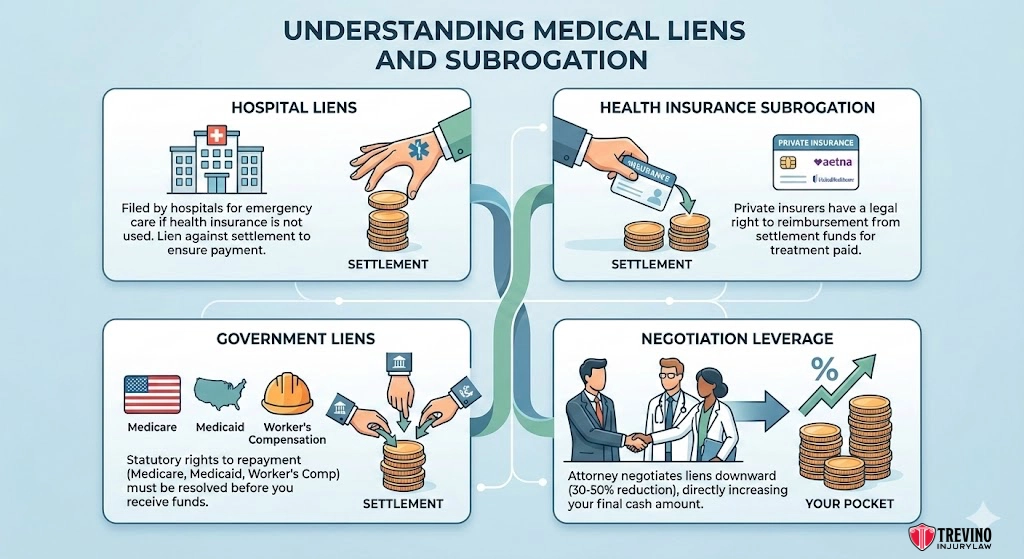
Understanding Medical Liens and Subrogation
- May file a lien against your settlement to ensure they are paid for emergency care if you did not use health insurance.
- Health Insurance Subrogation: If your private health insurance (e.g., Aetna, UnitedHealthcare) paid for your treatment, they have a legal right called “subrogation” to be reimbursed from your settlement funds.
- Government Liens: Medicare, Medicaid, and Workers’ Compensation liens are statutory federal or state rights to repayment that must be resolved before you receive your portion of the funds.
- Negotiation Leverage: A key role of your attorney is to negotiate these liens downward, often reducing the amount paid back to doctors or insurers by 30-50%, which directly increases the cash that goes into your pocket.
What Is Considered a Good Settlement Offer?
A “good” settlement offer is one that fully covers all your past medical bills, pays for all projected future medical care and rehabilitation, and compensates you for lost earning capacity and pain and suffering, rather than just reimbursing your immediate out-of-pocket expenses.
Accepting an offer that only pays off your current emergency room bills from a crash on Loop 1604 is a mistake if it ignores the fact that you will need spinal surgery in five years or can no longer work your construction job due to permanent lifting restrictions.
While the main hub covers general insurance tactics, evaluating a specific offer requires identifying “future-proof” compensation. Insurance adjusters for commercial fleets often use the “First Offer Trap,” presenting a quick check within days of the accident before you have reached Maximum Medical Improvement (MMI).
In San Antonio, a truly good offer considers the higher policy limits of box trucks and includes a Life Care Plan assessment that projects the cost of your injuries over the next 20 or 30 years, ensuring you aren’t left with bills long after the case is closed.
Under the “408 rule” for settlement negotiations, these offers and discussions are generally inadmissible in court, which encourages open negotiation but also means you must be shrewd in evaluating them privately.
Signs of a Lowball Offer from Commercial Insurers
- Pre-Diagnosis Offers: The offer arrives within days of the crash, before your doctors have fully diagnosed the extent of your spinal or head injuries.
- Quick Release Pressure: The adjuster pressures you to sign a “full release of liability” immediately in exchange for a check that barely covers your deductible.
- Excluding Future Care: The settlement amount covers past bills but includes no funds for future physical therapy, surgeries, or medications you will clearly need.
- Ignoring Pain and Suffering: The offer is calculated strictly on medical invoices (dollar-for-dollar) with no multiplier added for your physical pain, impairment, or mental anguish.
- Blaming Pre-Existing Conditions: The insurer argues that your back pain is due to “age” or a prior sports injury rather than the box truck collision, seeking to devalue the claim entirely.
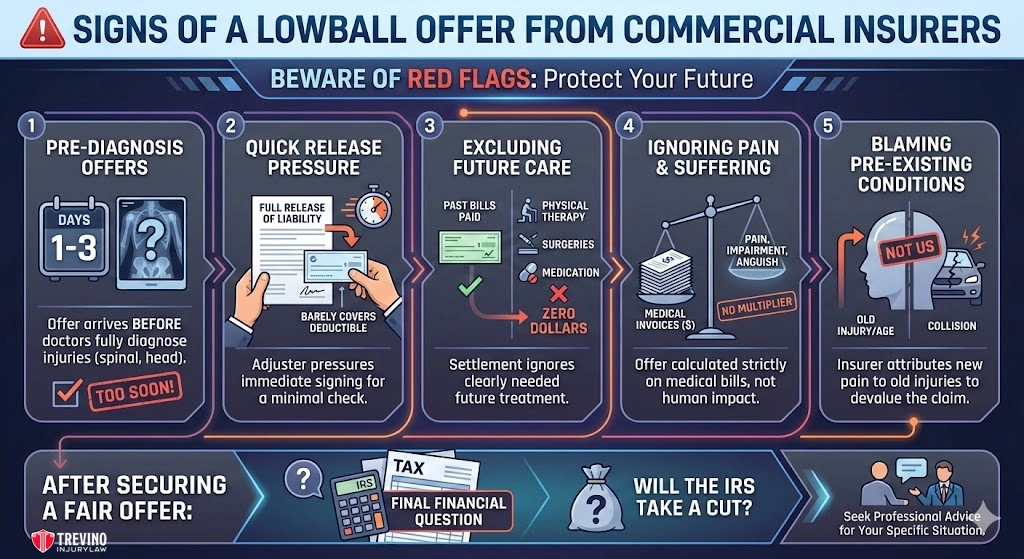
Once you have secured a fair offer that covers your future needs, the final financial question most clients ask is whether the IRS will take a cut of their recovery.
Will I Pay Taxes on My Box Truck Accident Settlement?
Generally, personal injury settlements for physical injuries are tax-free under federal law (IRS Section 104), meaning you do not pay income tax on compensation for medical bills, lost wages, or pain and suffering.
However, exceptions exist for punitive damages, which are fully taxable as income, and for any interest earned on the settlement funds if they were held in an interest-bearing account before final disbursement to you.
Box truck cases frequently command higher settlements because they often trigger “punitive damages,” which are designed to punish the company rather than just compensate the victim. In Texas, obtaining these damages requires proving “Gross Negligence,” a standard defined by the seminal case Transportation Insurance Co. v. Moriel, 879 S.W.2d 10 (Tex. 1994).
Under Moriel, we must prove that the trucking company acted with “conscious indifference” to your safety, knowing its actions created an extreme risk and proceeding anyway. Meeting this specific legal standard often forces insurers to significantly increase their settlement offers.
Because these specific damages are intended to punish the defendant rather than compensate the victim, the government views them as taxable income. It is critical to structure your settlement agreement carefully with your attorney to clearly distinguish between tax-free compensatory damages and taxable punitive damages.
Before you worry about tax implications, you first need to know how long the process takes to actually get the check in your hand.
How Long Does It Take to Get the Settlement Check?
Once a settlement agreement is signed, it typically takes 30 to 45 days for the check to be processed, liens to be paid, and funds to be disbursed to you.
This timeline allows for the physical exchange of documents and funds: you sign the “Release of Liability,” the insurance company processes the check and mails it to your attorney, and your attorney deposits it into a specialized trust account (IOLTA) to ensure the funds clear.
Before you receive your net portion, your lawyer must legally resolve any outstanding medical liens or government claims (like Medicare) to ensure you aren’t sued later for unpaid bills. While a 30-day wait can feel long when bills are piling up, this clearance period protects you from future financial liability.
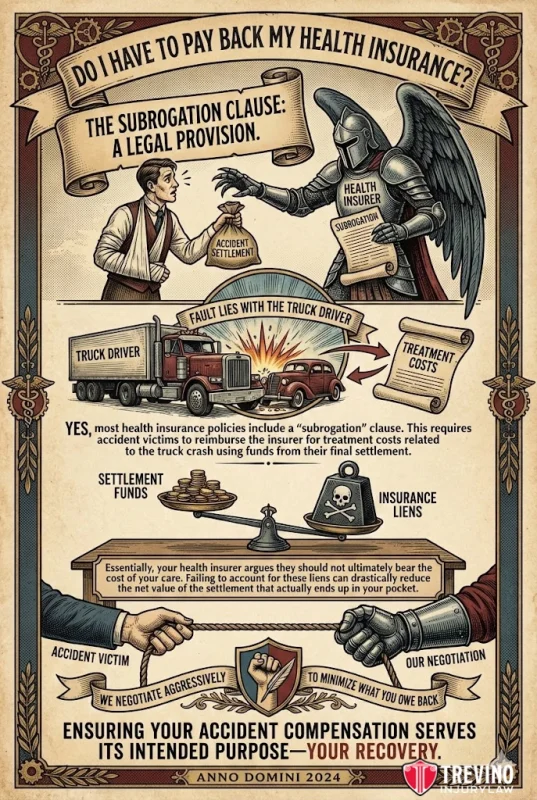
Do I Have to Pay Back My Health Insurance?
Yes, most health insurance policies include a “subrogation” clause. This legal provision requires accident victims to reimburse the insurer for treatment costs related to the truck crash from their final settlement proceeds.
Essentially, because the fault for the accident lay with the truck driver, your health insurer argues that they should not ultimately bear the cost of your care.
In a complex personal injury case, failing to account for these liens can drastically reduce the net value of the settlement that actually ends up in your pocket. This is why we negotiate aggressively to minimize what you owe, ensuring your accident compensation serves its intended purpose: your recovery.
Can I Ask for More After Signing a Settlement?
No. Once you sign a formal release of liability, your commercial truck accident claim is closed forever. You cannot demand more money or file a truck accident lawsuit later, even if the accident resulted in late-onset complications years after the date of the accident.
Insurance adjusters know this; they often push for a quick resolution before an accident reconstruction can prove the full extent of liability. To avoid this trap, experienced truck accident attorneys analyze past settlements and verdicts to forecast your long-term needs. We ensure the truck accident settlement or verdict is sufficient to cover your lifetime care before you sign away your rights.
Lump Sum vs. Structured Settlement Options
A lump sum provides immediate access to all funds, while a structured settlement pays out over time to ensure long-term financial stability. For catastrophic box truck cases involving Traumatic Brain Injuries (TBI) or spinal cord damage, a structured settlement is often recommended to cover lifetime care costs without the risk of “spending down” the money too quickly.
Structured settlements can also offer tax advantages: the interest earned on annuity payments is often tax-free, whereas investing a lump sum would generate taxable investment income.
Choosing between a lump-sum payment and a structured plan depends entirely on your family’s immediate financial needs versus your long-term medical needs.
What Happens If the Offer Is Too Low?
If the insurance offer does not cover your damages, your attorney will file a lawsuit to move the case from negotiation to litigation. Filing suit signals to the insurance company that you are prepared to take the case to a Bexar County jury rather than accept an unfair amount.
Often, the mere act of filing a lawsuit triggers a higher settlement offer because commercial insurers want to avoid the high costs of defense and the unpredictability of a trial verdict. If they still refuse to pay a fair amount, your case proceeds to discovery and eventually trial, where a judge or jury determines the final value.
When Is a Settlement “Too Late” to Accept?
A settlement offer is never “too late” to accept until a jury verdict is read, but waiting too long to file suit can violate the two-year statute of limitations. In Texas, you generally have two years from the date of the crash to file a lawsuit; if you miss this deadline, your right to sue is extinguished forever, and the insurance company has no legal obligation to pay you a dime.

While you can settle a case on the “courthouse steps” just moments before trial begins, you cannot settle or sue once the statute of limitations has expired.
Why Hire a San Antonio Box Experienced Truck Accident Lawyer?
Accepting a lowball pre-diagnosis check for a crash on Loop 1604 is exactly what commercial insurers want. Adjusters and high-volume settlement mills delay payouts, hoping you fold for pennies. Trevino Injury Law fights for families and holds negligent trucking companies accountable.
Want to Protect the Full Value of Your Claim?
You’ve seen how this affects your case—but it is only one piece of the puzzle. Our Box Truck Lawyer page breaks down what a trial-ready firm does differently.
Our trial-first approach delivers significant results, such as a $17,000,000 trucking settlement. We prepare every claim for the Bexar County courts. A San Antonio accident compensation lawyer immediately sends spoliation letters to secure black box data before evidence is lost.
Call 210-TREVINO for a free case review. Se Habla Español. You pay nothing unless we win—No Win, No Fee.