State only verifiable facts to the responding officer, explicitly request a medical evaluation, and never utter an apology to the intoxicated driver.
The insurance adjuster assigned to your file is already analyzing the police report to execute the “I’m sorry” trap, a specific tactic that twists your adrenaline-fueled shock into an admission of fault. By manipulating a polite courtesy into a legal confession, they manufacture a reason to deny your financial recovery entirely. According to TxDOT, alcohol-related crashes claimed 1,053 lives across Texas in 2024. Behind that staggering metric are victims whose words at the scene became the weapon used to defeat their own claims.
What Could Your Drunk Driving Accident Case Be Worth?
Answer a few quick questions about your accident. Takes about 60 seconds.
See What My Case Might Be WorthThe insurance company offered less than $20,000. I ended up with over $1 million. — Jackie Galindo
That is why knowing what to do after a drunk driving accident matters before the insurance company shapes the story for you.
Crucial proof of obvious intoxication disappears rapidly. A Spoliation Letter, a legal demand that prevents the opposing party from destroying evidence, must be dispatched immediately to secure the responding officer’s body and dash-cam footage. Without it, the claim devolves into a deniable swearing match.
At Trevino Injury Law, we subpoena this definitive video evidence immediately and lock down the facts before defense adjusters manipulate them. Call 210-TREVINO for a free case review. You pay nothing unless we win. Se Habla Español.
Your Immediate Communication Protocol: What to Say at the Crash Scene
Your immediate job at the accident scene is to stay safe, state only the facts, and avoid any opinions, apologies, or guesses that can be used against you. When an accident occurs, you must assume that every word you say is being recorded and will be analyzed by an insurance adjuster whose only goal is to pay you as little as possible.
Following this exact communication protocol protects your health and your right to full compensation. Do not offer any information beyond what is required.
What to Say to the Responding Police Officer (SAPD or Bexar County)
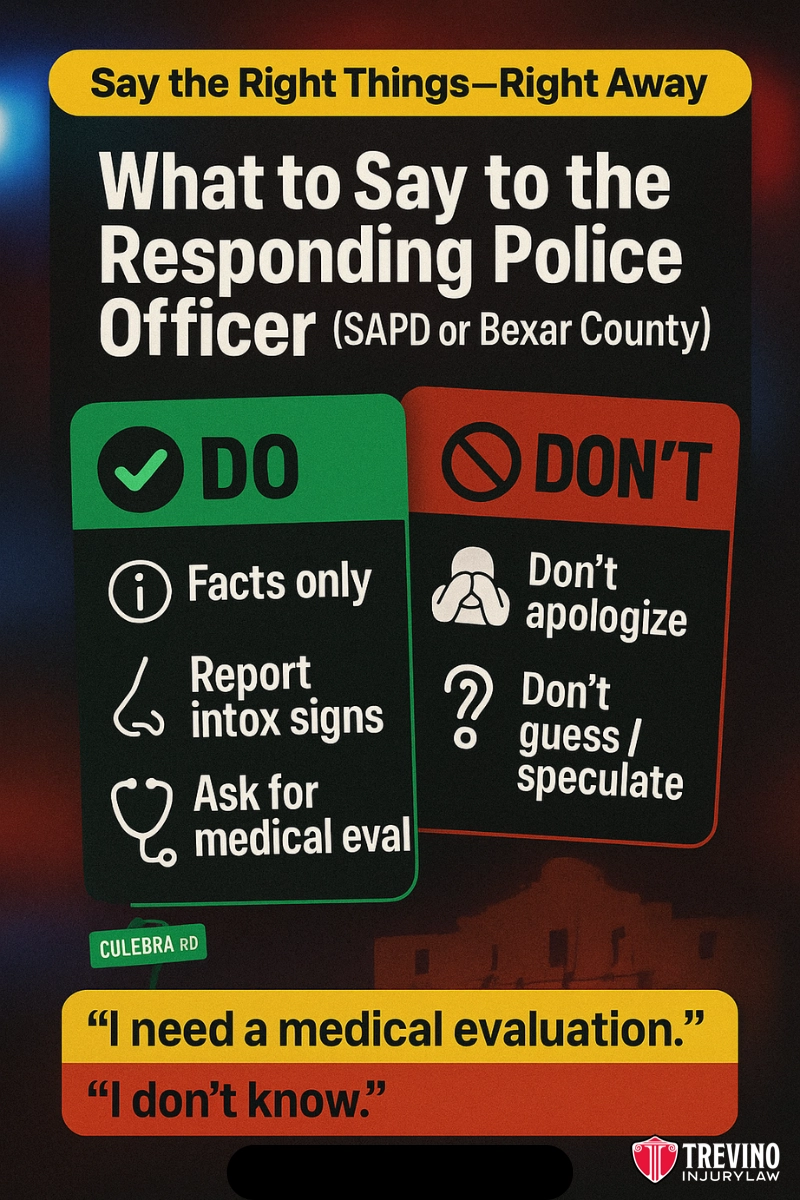
This is why you should always call the police after any car crash, no matter how minor. While you wait for police to arrive, you must provide the responding San Antonio Police Department (SAPD) or Bexar County Sheriff’s officer with clear, verifiable facts, state any observations that the driver is intoxicated, and explicitly mention your need for a medical evaluation. Avoid guessing about speed or timing; if you don’t know an exact detail, say “I don’t know” or “I am not sure” rather than speculating.
Your conversation should focus on these key points:
- DO: Stick to Verifiable Facts. State only what you know for sure. For example: “I was stopped at the red light on Culebra Road when I was hit from behind,” or “The other car crossed the center line and struck my vehicle”.
- DO: Describe the Driver’s Behavior. This is critical evidence. State your observations as facts, not opinions. Use phrases like: “I smell alcohol on the intoxicated driver,” “They are slurring their words,” or “I saw the driver throw bottles from the car before you arrived”.
- DO: State Your Need for Medical Care. Adrenaline masks serious injuries. Never say “I’m fine” or “I’m not hurt.” Instead, you must use a specific phrase like: “I am hurt, and I need to be medically evaluated,” or “I’m not sure of the extent of my injuries, I need to see a doctor”.
- DON’T: Apologize for Anything. Do not say “I’m sorry this happened”. Insurance companies will twist this simple courtesy into an admission of fault.
- DON’T: Guess or Speculate. If the officer asks your speed, and you aren’t 100% sure, do not guess. Saying “I think I was going 30” when you were going 25 gives the defense an opening. Stick to “I don’t know”.
What to Say (and Not Say) to the Drunk Driver
You should say as little as possible to the drunk driver, limiting your interaction to only the legally required exchange of information, and only if it is safe to do so. Intoxicated individuals can be aggressive and unpredictable; your priority is to de-escalate and protect yourself.
If you feel unsafe, call 911 immediately if you haven’t already, stay in your locked car, and wait until police arrive. If you do interact, follow these rules:
- DO: Exchange Information (If Safe). Texas law (Transportation Code § 550.023) requires drivers in a crash to give their name, address, vehicle registration, and the name of their liability insurer. You must also show a license on request and render reasonable aid. This law does not require you to argue or engage in conversation.
- DON’T: Engage, Argue, or Accuse. Do not accuse them of being drunk. Do not argue about who was at fault. Simply get their names and insurance information if safe, then stop. This is the police officer’s job, not yours. Engaging with an intoxicated person only creates risk.
- DON’T: Say “I’m Sorry” or “I’m Fine.” Just as with the police, these phrases are admissions that will be used against you. Do not give the at-fault driver or any passengers this ammunition.
Sticking to these facts at the scene is your first line of defense, because insurance companies are experts at twisting even the most innocent words to deny your claim.
Your Exact Scripts for the Scene
Use these exact words. Do not say more than is necessary.
What to Say to the Responding Officer: “Officer, here are the facts I know: I was stopped at the red light on Culebra Road when I was rear-ended. I smell alcohol on the other driver and observed slurred speech. I am hurt, and I need a medical evaluation. I cannot estimate speeds or timing; I do not know those details.”
What to Say to the Drunk Driver: “Here is my name, insurer, and registration as required by law. Please do the same. I am waiting for the police.”
Then, stop talking. These scripts protect you from the “I’m Sorry” and “I Think” traps while fulfilling your legal duties.
How Insurance Companies Twist Your Words to Deny Your Claim
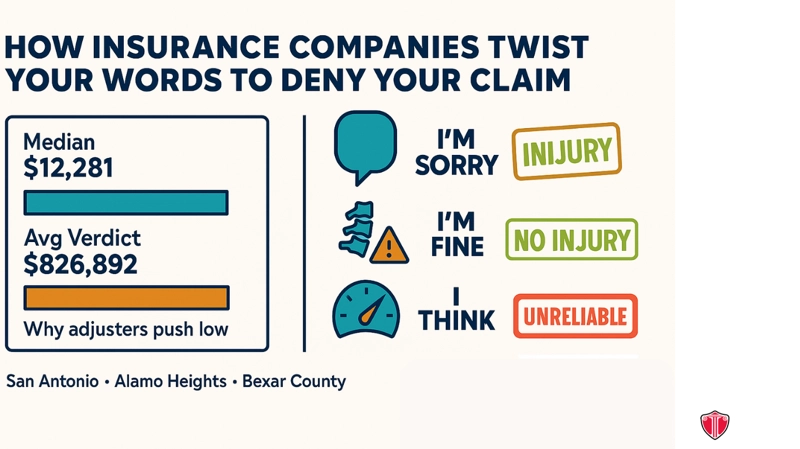
The financial motive for an insurance adjuster is simple: pay you as little as possible. The data proves it: while the median personal injury award in Texas is only $12,281, the average jury verdict is $826,892. Their job is to keep your claim near that low median number, not the high average that trial-ready firms like ours win in court.
To do this, insurance adjusters deny claims by twisting your words from the police report, interpreting polite phrases like “I’m sorry” as admissions of fault and statements like “I’m fine” as proof you had no injuries.
The at-fault driver’s insurance company will assign an adjuster who is not your friend; their job is to protect their company’s profits by finding any reason to devalue or deny your case, and your own words are their primary weapon.
They listen for three specific traps, which we have seen used to deny legitimate claims from victims in Alamo Heights and across Bexar County.
The “I’m Sorry” Trap = Admission of Fault
The “I’m sorry” trap occurs when an adjuster takes your polite, empathetic phrase, “I’m sorry this happened,” and records it in their file as a direct admission of guilt, “I’m sorry I caused this accident”.
You meant it as a simple courtesy, but the insurance company will argue it proves you accepted partial or complete responsibility for the collision, using it to slash your settlement offer.
The “I’m Fine” Trap = Denial of Injuries
The “I’m fine” trap is used to deny your medical bills by claiming you were not injured at the scene. Adrenaline from the crash can easily mask serious spinal injuries for hours or even days. When you later seek treatment, the insurance adjuster will seize on the fact that you said ‘I’m fine’ at the scene.
They will use this to argue your injuries are unrelated to the crash, attacking the critical legal element of causation and denying your right to compensation for pain and suffering.
Texas law is strict on this point. In Guevara v. Ferrer, 247 S.W.3d 662, 665 (Tex. 2007), the Texas Supreme Court held that while some car accident injuries can be proven through common experience, more serious conditions require competent medical evidence to establish causation.
The Court explained that evidence must show the accident caused the injury, not just that treatment occurred afterward. That is exactly why statements like “I’m fine” are so damaging. They give the insurance company an opening to argue there is no clear link between the crash and your injuries, forcing you to overcome a higher evidentiary burden to recover compensation.
The “I Think” Trap = Unreliable Witness
The “I think” trap is used by defense lawyers to destroy your credibility in front of a jury by painting you as an unreliable witness. When you guess at the scene, “I think he was going 60 mph” and the vehicle’s Event Data Recorder (EDR) or a formal accident reconstruction later proves the speed was 52 mph, the opposing attorney will argue that if you were wrong about the speed, you must also be mistaken about who had the green light, or that you somehow contributed to the accident.
This hard data, governed by federal law (49 C.F.R. Part 563), is a powerful tool we use to establish facts, and it will expose any guesses you made.
We are familiar with these insurance tactics intimately because we don’t just settle cases; we have a proven record of defeating these exact arguments in court to secure justice for our clients.
Our Proof: As Trial-Ready Texas Drunk Driving Accident Lawyers, We Win Against These Tactics
Our trial-ready team knows how to counter insurance company tactics, having successfully defended against them in over 80 jury trials. Most firms that advertise on billboards rarely, if ever, find themselves in a courtroom; they are designed to settle cases quickly. We prepare every case for trial from day one, and this proven readiness is precisely why insurance companies pay our clients more.
This approach is not theoretical. As an experienced attorney leading a dedicated law firm, Candelario (J.R.) Trevino has secured significant results for victims of impaired drivers, including a $1.4 million settlement for a client with a spinal injury from a drunk driving crash and a $1 million settlement in a wrongful death case involving Dram Shop (bar) liability.
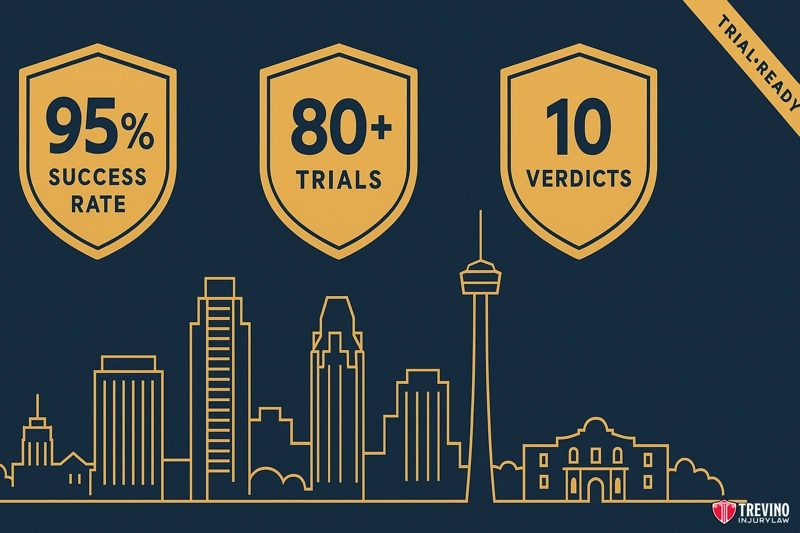
This track record of winning in the courtroom is why our attorneys are recognized by national organizations. Attorney Candelario (J.R.) Trevino has been named to the National Trial Lawyers: Top 100 and the National Association of Distinguished Counsel (NADC) Top One Percent. This recognition is not for settling cases; it’s for proving them before a jury.
How Our Trial-Ready Process Protects Your Rights from Day One
Our trial-ready process protects you by securing indisputable video evidence immediately, which neutralizes an insurance adjuster’s attempts to twist your words. The moment you hire our firm, our work begins. We don’t wait for the insurance company; we take offensive action.
Our team immediately:
- Works to obtain the police report, then analyzes the SAPD or Bexar County Sheriff’s Office accident report for any inaccuracies or misquoted statements.
- Sends immediate requests under the Texas Public Information Act for all SAPD/BCSO officer body cam and dash cam footage. We use the specific state codes (like Occ. Code § 1701.661) that govern the release of this critical video evidence.
This video evidence, along with other physical evidence we preserve, such as skid marks and photos of property damage, is the ultimate proof. It counters an adjuster’s claims, shows the other driver’s apparent intoxication, and often proves your statements were factual. This evidence can be lost or recorded over if you wait, which is why contacting a car accident attorney who is trial-ready is essential.
Securing this evidence is the first step in our trial-ready process, but your actions after leaving the scene are equally critical for protecting your rights.
Your Next Steps: What to Do After a Drunk Driving Car Wreck
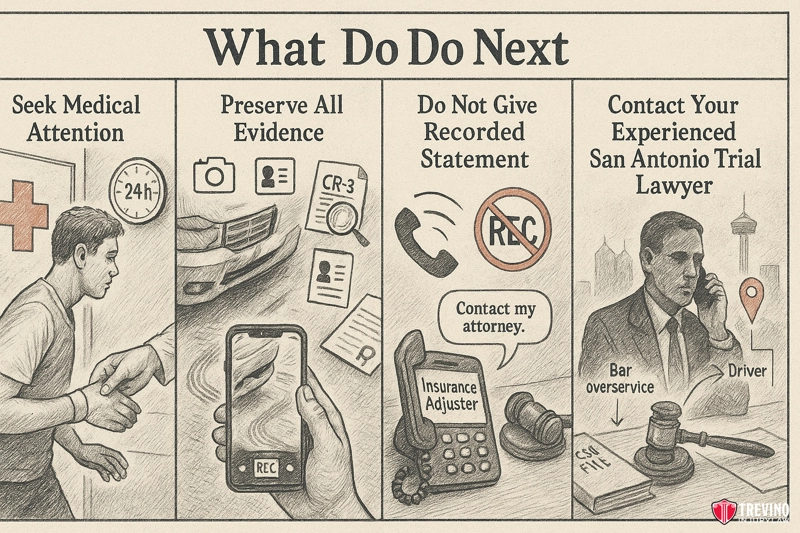
Following the accident, after you are safe and have spoken to the police, you must seek immediate medical attention within 24 hours to document your accident injuries, preserve all evidence like photos and witness information, and refuse to give a recorded statement to the at-fault driver’s insurance. Your next step is to contact a San Antonio trial lawyer to protect your rights and investigate all liable parties.
For the complete post-crash sequence, review what to do after a drunk driving accident in San Antonio, including scene documentation, the police report, medical care, insurance contact, and evidence preservation.
These steps are critical for building a strong claim and countering the insurance company’s defense.
- Seek Medical Attention Immediately. Go to an emergency room at a facility like Baptist Medical Center or an urgent care clinic within 24 hours, even if you feel “fine”. This creates an official medical record that links your injuries directly to the crash, which is essential for proving your damages.
- Preserve All Evidence. Take photos and videos of your car, your injuries, and the crash scene from multiple angles. Get the contact information for any witnesses who stopped. Write down everything you remember about the crash, the driver’s behavior, and what you told the police. For a more detailed evidence checklist, see how to preserve evidence after a DWI crash in San Antonio. Our firm will immediately audit the official accident report (the CR-3 police crash report) for any errors or incorrect codes that could hurt your claim.
- Do NOT Give a Recorded Statement to the Other Driver’s Insurance. You are not legally obligated to provide a recorded statement to the at-fault driver’s insurance adjuster. You have no contract with them. As Texas consumer guidance warns, your only duty is to stick to basic facts, not to debate your case or give a recorded interview. They will call you, acting friendly, but their only goal is to get you on record saying something they can use against you. Tell them, “You will need to contact my attorney,” and end the conversation. You should, however, contact your insurance company to report the basic facts of the auto accident.
- Contact an Experienced San Antonio Trial Lawyer. The drunk driver’s legal team is already working. An experienced lawyer can help you file a claim and investigate all potentially liable parties. This includes the bar that overserved the driver who caused your accident. This crash was caused by a drunk driver, and there may be multiple parties to hold accountable. This includes the bar that overserved the driver, which can be held liable under the Texas Dram Shop Act (TABC ch. 2). Civil liability attaches when it was apparent the person served was obviously intoxicated and that intoxication was a proximate cause of the crash (§ 2.02).
An experienced lawyer will also ensure you understand your right to seek exemplary (punitive) damages. In Texas, this requires proving the driver’s “gross negligence” by “clear and convincing evidence” (CPRC § 41.003).
This is a high bar, but in drunk driving cases, the Texas Supreme Court has been clear: the driver’s intoxication is itself powerful evidence of gross negligence. While Texas caps most punitive awards (§ 41.008), this cap may not apply in cases involving intoxication assault or manslaughter.
Following this protocol protects your case, but many victims still have specific questions about the legal process and what their rights truly are.
What Other Mistakes Can Hurt My Drunk Driving Accident Claim?
The most damaging mistakes you can make after a drunk driving crash include posting on social media, giving a recorded statement, accepting a quick settlement, or failing to follow your doctor’s treatment plan.
These actions provide the insurance company with the exact “proof” they need to argue your injuries are not severe or that you are not a credible victim.
Communication mistakes are only part of the risk. The guide to mistakes that can devalue a Texas drunk driving accident claim expands the checklist to treatment delays, evidence collection, social media, settlement decisions, and timing.
Should I post about my accident on social media?
No, you must never post anything about your accident, your injuries, or your case on social media platforms like Facebook or Instagram.
Insurance companies hire investigators to actively scan your profiles for photos or posts that contradict your injury claim, such as a picture of you at a family BBQ, which they will use to argue you aren’t “really” hurt.
Is it okay to talk to my own insurance company?
Yes, you are required to report the accident to your own insurance company, but you should only provide the basic facts of the crash.
Do not give them a recorded statement or discuss the details of your injuries until you have spoken with a lawyer, as even your own insurer may try to limit their liability.
Should I accept the first settlement offer?
No, you should never accept the first settlement offer from an insurance company, as it is typically a lowball amount that does not cover your future medical needs, pay for your car repairs, or the full extent of your suffering.
This first offer is a tactic used to close your case quickly and cheaply before the true extent of your injuries, like a spinal condition, is fully known.
What Is the Difference Between the Criminal DWI Case and Your Civil Personal Injury Case?
The difference is that the criminal DWI case (for driving under the influence or driving while intoxicated) is brought by the State of Texas under Texas Penal Code § 49.04 to punish the drunk driver with jail time or fines.
At the same time, your civil injury claim is a separate lawsuit you file to recover financial compensation for your medical bills, lost wages, and suffering. The criminal case provides justice; the civil case provides financial recovery for your family.
Even if the driver is found “not guilty” in their criminal case, you can, and often still, win your civil claim. The burden of proof is fundamentally different, a distinction clearly recognized in Texas law.
The criminal court requires proof ‘beyond a reasonable doubt’ for a conviction. In your civil claim, we only need to prove the driver was negligent ‘by a preponderance of the evidence.’ This means we must simply show it is more likely than not (over 50%) that the accident caused by the driver caused your injuries, a much lower standard.
In fact, a criminal conviction can be used as powerful evidence in your civil case.
What Happens If I Don’t Say I’m Hurt at the Scene?
If you don’t say you are hurt at the scene, the insurance adjuster will use the “I’m fine” trap to argue that your injuries must not be from the crash with a drunk driver. They will point to the police report as official proof that you admitted to being unharmed, creating a significant hurdle that your attorney must overcome to link your delayed-onset injuries, like whiplash or a back injury, back to the collision.
What Happens If I Give the Insurance Adjuster a Recorded Statement?
If you give an adjuster a recorded statement, you are handing the defense its central piece of evidence to defeat your claim. Adjusters are trained to ask misleading, “yes or no” questions that are designed to trap you.
They will get you to minimize your injuries unintentionally, guess about facts, or say something that sounds like an apology, and this permanent record will be used to deny your medical bills and discredit your testimony at trial.
Why Hire a San Antonio Drunk Driving Accident Lawyer?
The villain is the adjuster who twists your kindness into a confession—and the “settlement mills” that refuse to fight back. We silence them. Trevino Injury Law forces negligent drivers and their insurers to pay full value. We proved this resolve with the $536,007 jury verdict in Arriaga at the Bexar County Courthouse, crushing a paltry $5,000 offer.
Want to Protect the Full Value of Your Claim?
You’ve seen how this affects your case — but this is only one piece of the puzzle. Our Drunk Driving Accident Lawyer page breaks down what a trial-ready firm does differently.
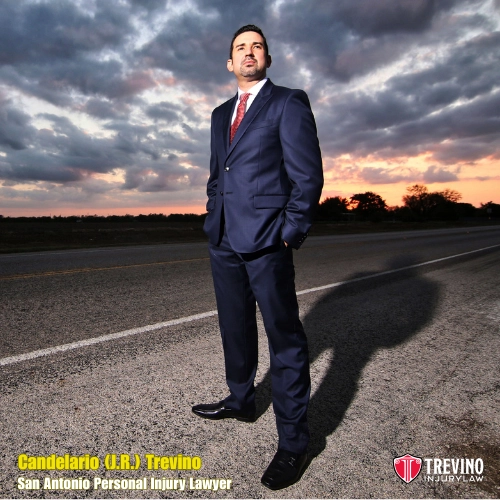
Don’t let them manipulate the truth. You need a San Antonio personal injury trial attorney to immediately subpoena police body cam footage and preserve black box data to prove your innocence.
Call 210-TREVINO for a free case review. Se Habla Español. You pay no fees unless we win.