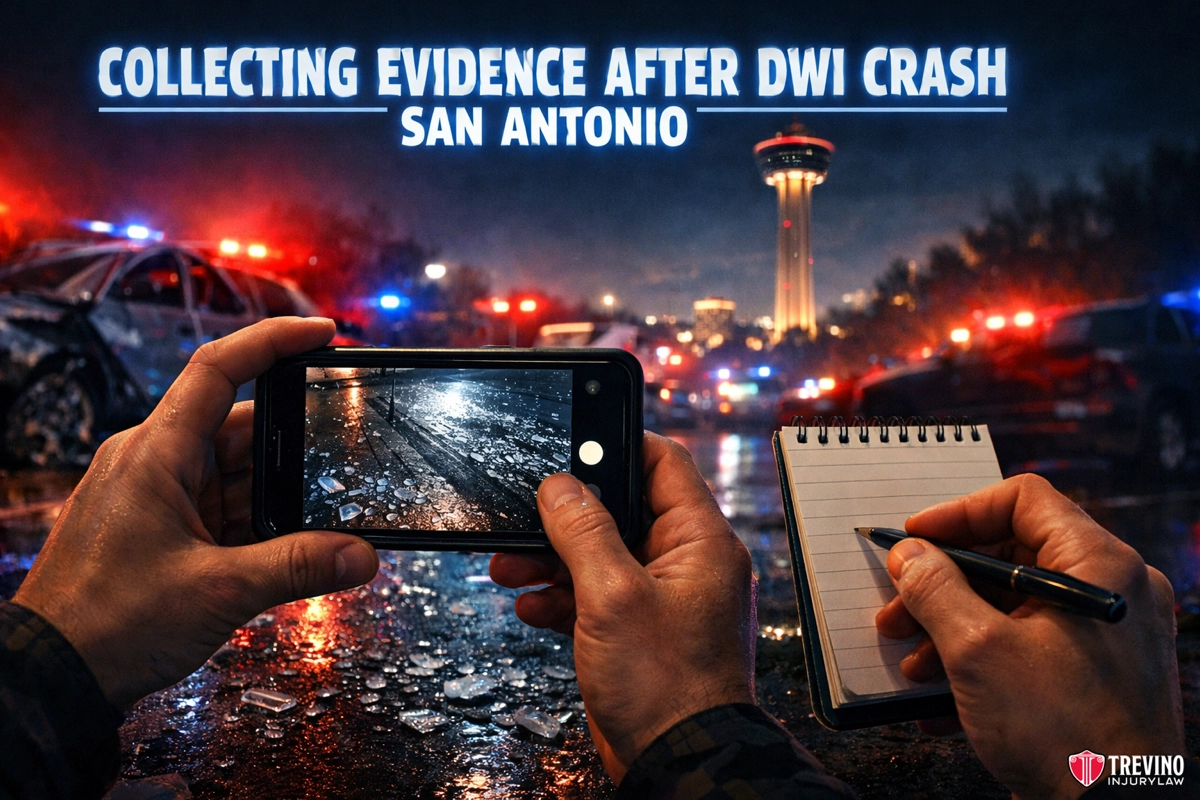
The drunk driver who hit you is sobering up, and the physical proof of their intoxication is already fading from the pavement. Skid marks wash away, and unrecorded witnesses forget critical details that prove liability.
Knowing what to do after a drunk driving accident can make the difference between preserving critical evidence and losing it for good. The insurance adjuster is actively moving to suppress witness accounts and exploit any gap in your medical care to argue the collision did not cause your injuries.
What Could Your Drunk Driving Accident Case Be Worth?
Answer a few quick questions about your accident. Takes about 60 seconds.
See What My Case Might Be WorthThe insurance company offered less than $20,000. I ended up with over $1 million. — Jackie Galindo
According to the Texas Department of Transportation, San Antonio recorded 1,394 DUI-alcohol crashes in 2024. Surviving the impact is only the first phase; you now face a defense strategy designed to erase the evidence of gross negligence before you secure it. At-fault drivers repair their vehicles, wiping the black box data that reveals their speed and braking actions. A Spoliation Letter, a legal demand to stop the property owner from destroying evidence, must be sent immediately. Texas gives you two years to file a lawsuit, but the electronic evidence you need disappears in days.
Trevino Injury Law team subpoenas the crash data and locks the evidence down before the defense deletes it. Call 210-TREVINO now for a free case review. You pay nothing unless we win. Se Habla Español.
Step 1: Call 911 to Report the Crash and the Driver
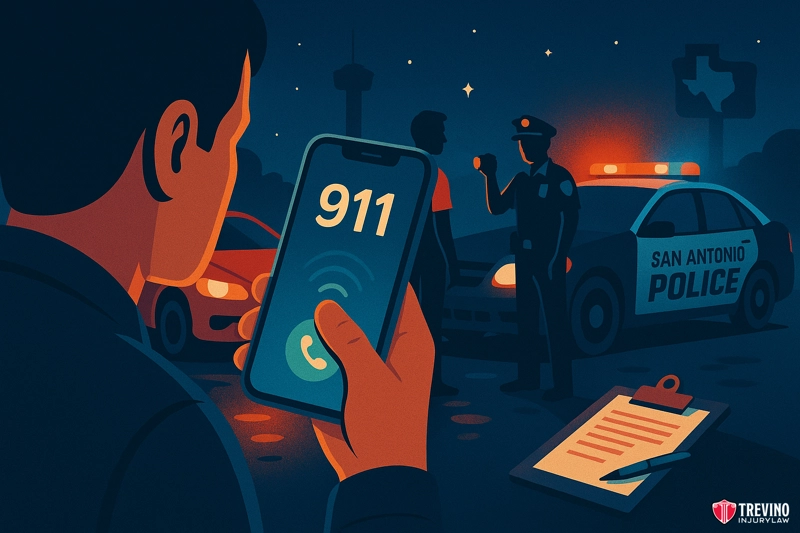
Calling 911 is the most essential first step, as it creates an official police accident report, which becomes the primary piece of evidence establishing the facts of the crash and the driver’s intoxication.
- Tell the dispatcher you suspect the other driver is intoxicated. This ensures officers are dispatched to conduct Field Sobriety Tests.
- Get the officer’s name and badge number.
- Request the report number before leaving the scene.
This official report (formally known as a Texas Peace Officer’s Crash Report or CR-3) is the cornerstone of your claim, and getting a copy of the report is a key first step. While the SAPD creates the report, it is filed with the Texas Department of Transportation and is typically available 3 to 10 business days after the crash. It can be purchased online from the official TxDOT CRIS portal for a $6 fee.
We obtain this report for our clients immediately to identify the driver, their insurance, and any citations, which is the cornerstone of proving liability.
Once the official report is initiated, your next priority is to capture the evidence the police won’t.
Step 2: Photograph and Video Everything at the Scene
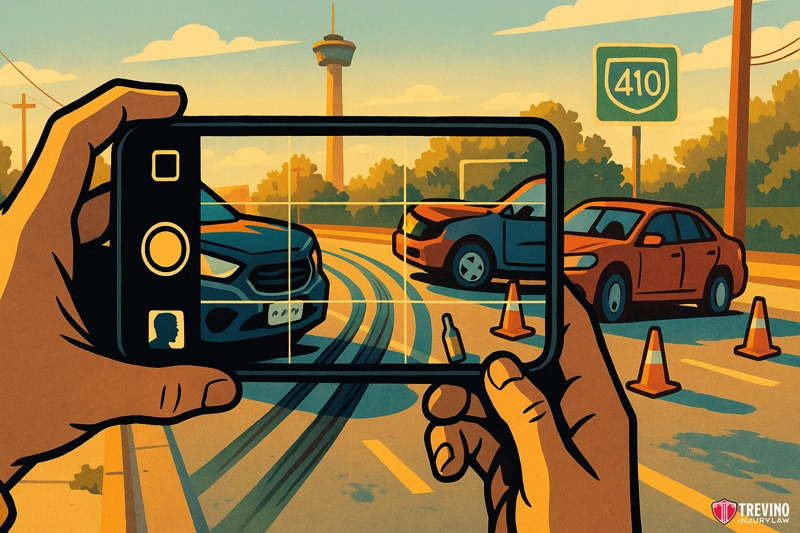
Use your phone to document the accident scene immediately. Take wide, medium, and close-up photos of all vehicles, license plates, skid marks, property damage, and specific vehicle damage before the scene is cleared. This physical evidence of the accident is irreplaceable and is often the most powerful proof you can gather.
This photo and video evidence are powerful and prevent the insurance company from changing the facts later.
- Capture: The driver’s face (if safe), open alcohol containers, and the final resting positions of the cars.
- Context: Get pictures of the road, weather, and any contributing factors like poor lighting on a dangerous corridor like Culebra Road, identified as San Antonio’s deadliest non-freeway road, or at the Loop 410 interchange. This visual proof is powerful and prevents the insurer from changing the facts later.
Visual evidence of the scene is critical; so is evidence from people.
Step 3: Get Information from All Witnesses
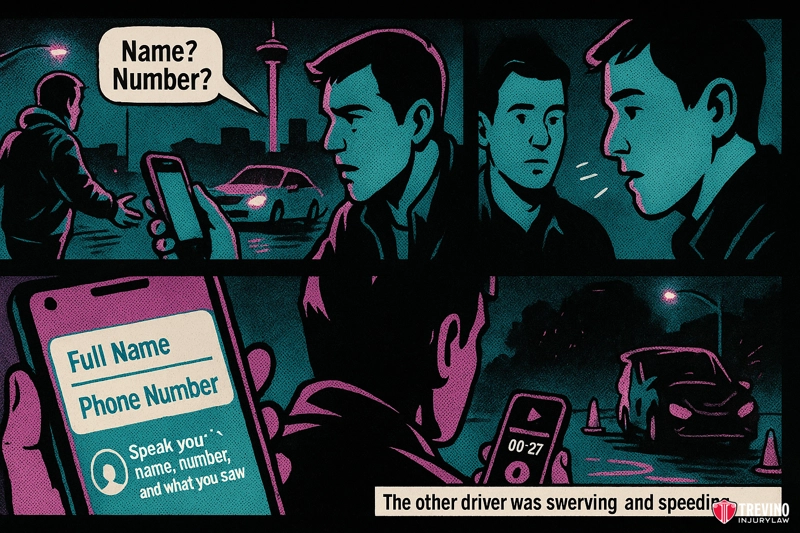
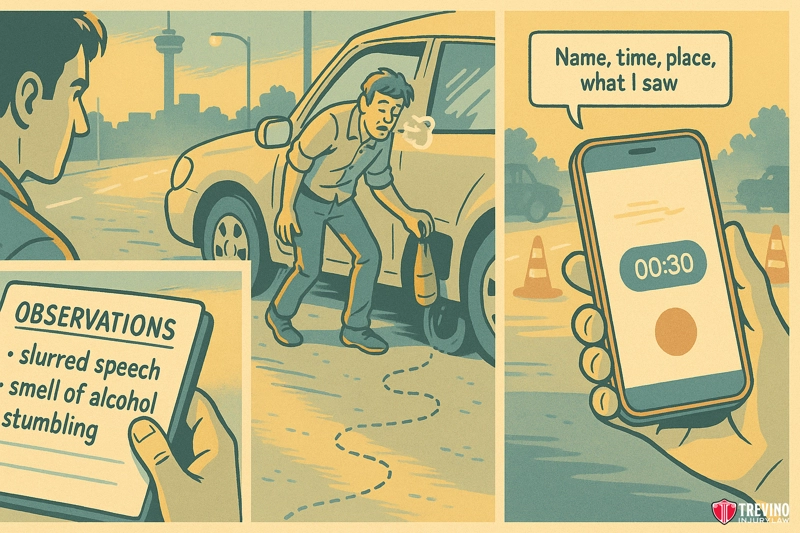
You must obtain the full name and contact information of everyone who witnessed the crash, as independent witness testimony is powerful proof against an insurance company’s attempt to blame you. Witnesses disappear quickly. If you can, use your phone’s audio recorder to capture a 30-second summary of what they saw. A neutral third party who confirms the other driver was swerving or speeding is invaluable when fighting an adjuster.
While witnesses can describe what happened, you also need to document why it happened, such as the driver’s intoxication.
Step 4: Document the Drunk Driver’s Behavior
Evidence proving intoxication includes your own observations of the driver’s slurred speech, smell of alcohol, and erratic behavior at the scene, which you should write down immediately. Note everything you observe: Are they stumbling? Hiding containers? Trying to flee? A drunk driver may also try to use mints, gum, or apologize excessively. Write it down or make a voice memo.
We will later subpoena the official chemical test results (which show the driver’s blood alcohol concentration, or BAC), field sobriety test results, and any 911 calls. However, you cannot assume this evidence will exist.
Shocking 2024 TxDOT data reveal that nearly half (47.41%) of all fatally injured drivers in Texas were never tested for blood alcohol. This is why your personal observations are not just helpful, they are critical proof we can use to prove ‘gross negligence’ in complex drunk driving cases.
This evidence of ‘gross negligence’, a conscious and extreme degree of risk, is what allows us to pursue punitive damages (also called ‘exemplary damages’).
As established by Texas case law, such as Transportation Ins. Co. v. Moriel, 879 S.W.2d 10 (Tex. 1994), and codified in the Texas Civil Practice & Remedies Code, Chapter 41, Texas law requires a high burden of ‘clear and convincing’ evidence for these damages. Your observations of the driver’s slurred speech, stumbling, or smell of alcohol are critical parts of meeting that standard.
While you gather scene proof, you must also create the evidence for your injuries.
Step 5: Seek Immediate Medical Evaluation (Even If You Feel Fine)
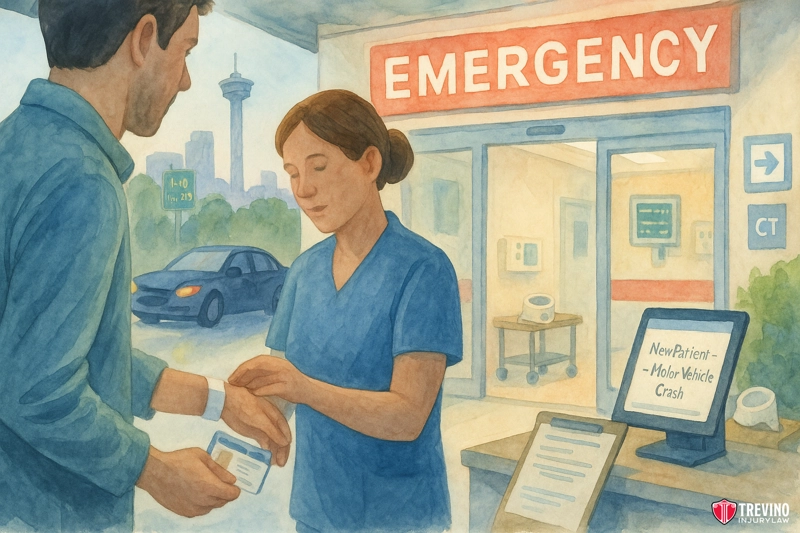
You must seek immediate medical evaluation at an ER, such as University Hospital’s trauma center or an urgent care clinic, as this creates an official medical record that links your injuries directly to the crash. This record is the foundation for seeking compensation for your injuries, including all related medical bills.
Insurance companies will use any delay in treatment to argue your injuries aren’t severe, are unrelated to the crash, or don’t require payment for all your medical bills. Never “tough it out”.
Adrenaline can mask serious injuries like spinal damage or internal bleeding. Insurance companies will use any delay in treatment to argue your injuries aren’t severe or are unrelated to the crash.
This medical evidence proves your injuries; you must also preserve the proof on your vehicle.
Step 6: Preserve Your Vehicle and Personal Property
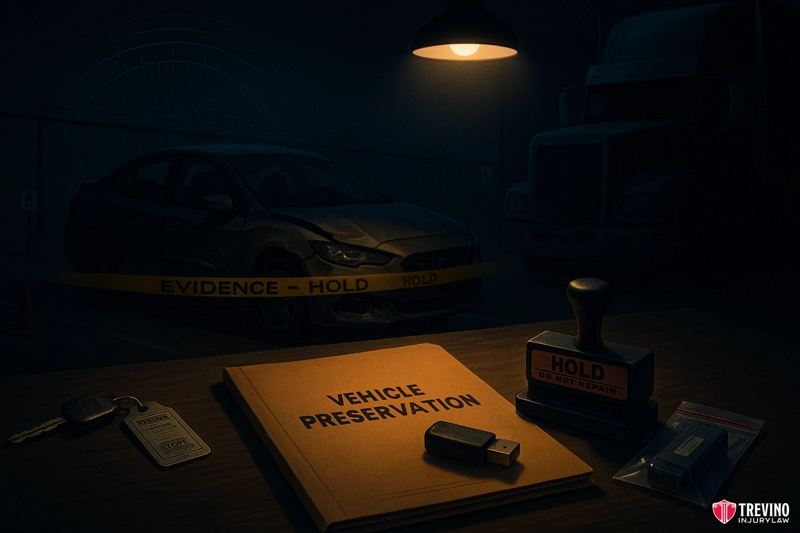
Do not have your car repaired or junked immediately; you must preserve it as evidence. This data helps accident reconstruction experts determine the other driver’s speed and braking actions from the “black box” (EDR). This is especially critical in 18-wheeler accidents, but also applies to modern passenger cars. The EDR data is often the only objective proof of what happened in the seconds leading up to impact. We will send a legal preservation letter to the tow yard to ensure this evidence isn’t destroyed.
These first six steps are the actions you can take. The final step is what we do to protect you.
Step 7: Call a Trial-Ready Attorney Before Speaking to Insurance
The most crucial step is to call a trial-ready car accident lawyer before you file an insurance claim or give any statement to an adjuster. They are trained to use your words against you to devalue your claim, often by trying to prove you caused the accident.
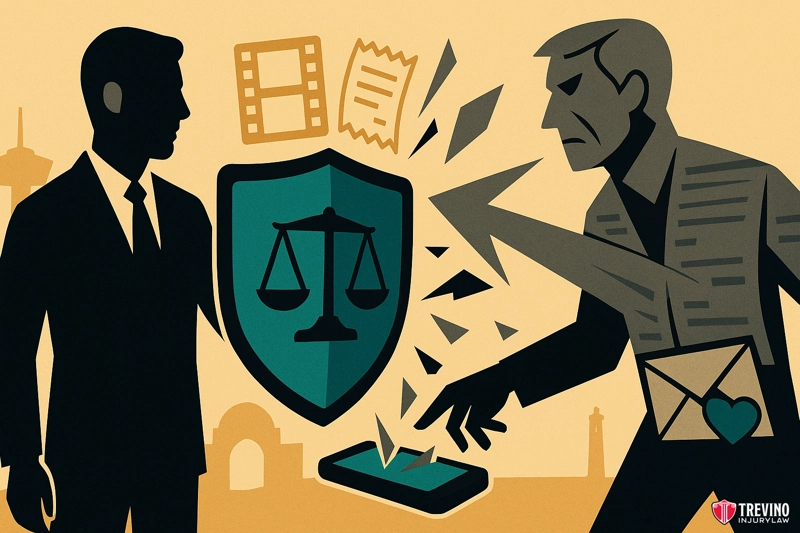
Adjusters are not on your side. Their job is to pay as little as possible. As soon as you hire us, we take over all communication. We handle proof preservation, from FOIA requests for police video to subpoenaing bar receipts. This allows you to focus on healing while we build your case for a Bexar County jury.
Following these seven steps builds your case; now, let’s explore how we use that case to fight for you.
How Does a Car Accident Attorney Use Strong Evidence to Support Your Civil Claim?
A trial-ready lawyer organizes all these valuable pieces of evidence, your scene photos, medical records, the police report, and the driver’s criminal file, into a comprehensive demand package that proves liability and the full value of your damages, forcing the insurance company to pay a fair settlement or face us in court.
The strong evidence you collect is the foundation. We build upon it to support your claim, sending legal “spoliation” letters to preserve proof, subpoenaing BAC results and arrest videos, and hiring accident reconstruction experts to analyze vehicle black box data. We front all these costs to build the strongest case possible.
This is the “Trial-First Mindset”. We don’t just gather enough to settle; we collect enough to win at the Bexar County Courthouse. This aggressive preparation is why insurance companies like USAA often pay our clients maximum value.
This evidence isn’t just for the driver; it’s also used to find other responsible parties.
How We Use Evidence in Drunk Driving Cases to Hold Bars Accountable (Dram Shop Law)
In many DWI cases, the driver has only minimum insurance, which is not enough to cover a family’s catastrophic losses. That is why we immediately investigate where the driver was drinking. We use valuable evidence, like receipts and credit card records, bar tabs, and surveillance video, to prove a bar violated the Texas Dram Shop Act (found in the Texas Alcoholic Beverage Code § 2.02).
The legal standard is high: we must prove the bar served an obviously intoxicated patron whose intoxication was the “proximate cause” of your injuries.
This is a critical link. Official 2024 TxDOT data shows the hour from 2:00 a.m. to 3:00 a.m. is the single worst time for urban DUI-alcohol crashes in Texas. This statistical evidence shows that bars are likely over-serving patrons who then get behind the wheel. The seminal Texas Supreme Court case, El Chico Corp. v. Poole, 732 S.W.2d 306 (Tex. 1987), affirmed that these commercial servers have a duty to protect the public.
While the driver may be underinsured, the bar often has a multi-million dollar commercial liability policy. Proving these cases requires a swift, aggressive investigation to obtain surveillance video before it is erased and to secure receipts.
We have experience with this, securing a $1 million settlement in a wrongful death case involving this exact type of dram shop liability. This deep investigation is the only way to overcome the tactics insurance companies use to devalue your evidence.
How Does the Criminal DWI Case (and Police Report) Help My Civil Claim?
The driver’s criminal DWI case provides powerful leverage. Under the doctrine of ‘negligence per se’, their violation of a criminal safety statute (such as Texas Penal Code Chapter 49, ‘Intoxication Offenses’) can be used as definitive proof of their negligence in your civil claim.
Furthermore, as affirmed in Texas cases such as Eagle Trucking Co. v. G.M., 783 S.W.2d 695 (Tex. App. San Antonio 1989, no writ), a driver’s prior guilty plea can prevent them from denying fault in a subsequent civil trial. And all the evidence collected by the police, such as BAC results, becomes available for your civil case.
The two cases are separate, but we monitor the criminal proceedings at the Bexar County Courthouse to harvest this evidence. A high BAC level or a prior DWI conviction demonstrates “gross negligence,” the legal standard required to obtain punitive damages from a jury.
This “Trial-Ready” evidence collection is your greatest weapon against the insurers playbook.
Why Insurance Companies Devalue the Evidence That Supports Your Drunk Driving Accident Claim?
Insurance companies may try to devalue your evidence because their business model is built on paying as little as possible. They will use any gap in your medical records or inconsistency in your story to argue your injuries aren’t severe or that you were partially at fault for this Texas car accident.
Adjusters are trained professionals. They will call you immediately, acting friendly, and ask for a recorded statement. They will use your polite “I’m sorry it happened” as an admission of guilt. They will see a two-day gap before you went to the ER as “proof” you weren’t really hurt.
This is why Step 7 (calling us first) is so important. We take over all communication. We provide them only with the fully developed evidence that proves the accident caused your injuries and that their client is 100% at fault. We know their playbook because some of our team members used to be insurance defense lawyers.
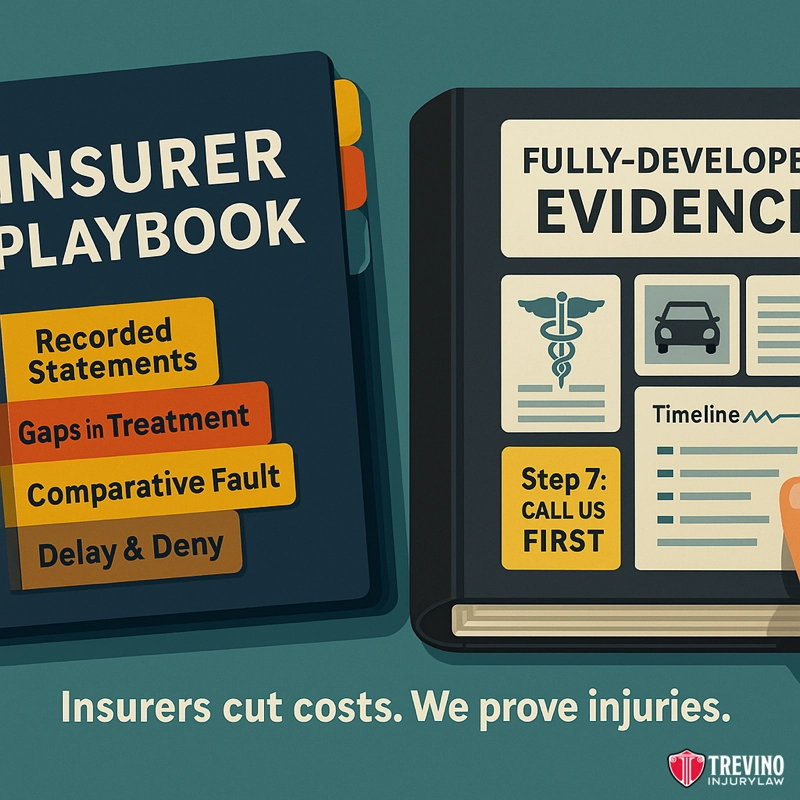
This experience is proven by our track record of turning “devalued” claims into substantial jury verdicts.
How Our Strong Evidence Strategy in a Car Accident Case Turned a $5,000 Offer into a $536,000 Verdict
In Jose Simon Arriaga Jr. v. Emily Montemayor, the defense offered only $5,000 for a low back injury. Still, we took it to trial, and our meticulous presentation of evidence resulted in a $536,007 jury verdict, over 100 times the offer. This is the difference. The insurance company believed its evidence was sufficient for a $5,000 offer. We believed in our client and our evidence. We presented the facts to a jury, and the jury agreed with us. This is the leverage our trial-readiness creates. We aren’t afraid to go to court, and the insurance companies know it.
This meticulous evidence collection is critical, but it all depends on one crucial factor: time.
What Are the Most Critical Types of Evidence in a Drunk Driving Car Accident Claim?
While the official police report and BAC results are powerful for proving the crash was caused by a drunk driver, the most important evidence for proving the value of your claim is your complete, uninterrupted medical treatment record.
You can have definitive proof that the other driver was drunk, but if you have gaps in your medical care, the insurer will argue your injuries aren’t related to the crash. Both types of proof are essential. The criminal evidence (BAC, police report) establishes liability and opens the door for punitive damages. Your medical evidence (hospital records, physical therapy notes) establishes the value of your economic damages (like lost income) and non-economic damages (like pain and suffering). To recover damages and win fair compensation.
Evidence matters in all personal injury cases, but proof matters in drunk driving claims even more. A successful case requires both criminal and medical proof.
All this evidence is worthless, however, if you wait too long to act.
If you wait, critical proof will be lost.
You need evidence to win, and this delay allows ‘spoliation’ (the legal term for evidence destruction) to permanently weaken your case. As established by the Texas Supreme Court in Trevino v. Ortega, 969 S.W.2d 950 (Tex. 1998), the remedy for spoliation is often a court instruction allowing the jury to presume the lost evidence was unfavorable to the party who destroyed it.
This is why immediate action is non-negotiable; the most important proof disappears fast:
Surveillance Video: Most convenience store and bar surveillance video is erased on an automatic loop, often within 72 hours. If we don’t send an immediate legal preservation letter, that proof is gone forever.
Vehicle Data: The at-fault party may “repair” their truck or car, which wipes the “black box” data (EDR) that shows their speed and braking before the crash.
Witness Memories: After just a few weeks, witness memories fade, and their testimony becomes less reliable in court.
Police prove fault; your medical records prove value, act before proof disappears.
The “Timeline Trap”: Why You Can’t Wait
Many victims believe they should wait for the “official” police reports. This is a critical mistake.
The Texas Department of Public Safety (DPS) crime lab, for example, averaged 24 days to report blood alcohol toxicology results in fiscal year 2024. By the time those official BAC results are ready, the 72-hour window to get the bar’s surveillance video has been closed for weeks.
The proof needed to win your case is often destroyed long before the criminal case even begins. Our team sends legally binding preservation letters on day one to stop this from happening.
How to Collect Evidence After a Drunk Driver Fled the Accident Scene (Hit-and-Run)
If you were hit by a drunk driver who was uninsured or fled the scene (a hit-and-run), we immediately shift the evidence focus to filing a claim with your own insurance under your Uninsured/Underinsured Motorist (UM/UIM) policy, a form of coverage governed by Texas Insurance Code § 1952.101.
Hit-and-Run: In a hit-and-run, we work with the SAPD to find the driver. We pull surveillance footage from nearby businesses on congested corridors like Bandera Road (SH-16) or I-35 and look for witnesses. If the driver can’t be found, your UIM claim is the path to recovery.
Uninsured Driver: If the driver is caught but has no insurance, you can still sue them personally, but collecting is hard.
The better path is your UM/UIM claim. You still must prove the other driver was at fault, which is why all the scene proof (photos, witness info, official report) is still absolutely critical.
In all these scenarios, your right to use this evidence is governed by a strict, non-negotiable deadline that impacts your ability to recover damages.
Types of Evidence: How We Preserve Digital Data Like Cell Phone Records
Digital evidence is critical for proving a driver’s distraction, and we secure it by sending legal preservation letters for the driver’s cell phone data, social media accounts, and electronic bar receipts. You cannot get this evidence yourself; it requires a swift legal process.
We immediately subpoena phone records to see if the driver was texting or calling at the moment of impact. We also search for and preserve any social media posts where the driver or witnesses discuss the crash. In a Dram Shop case, we can also subpoena a bar’s point-of-sale system to get electronic receipts showing exactly how many drinks the driver purchased. This digital trail is often the objective proof a Bexar County jury needs to see.
What Happens If I Don’t Gather Evidence Before the Statute of Limitations Expires?
If you fail to file a lawsuit before the two-year statute of limitations expires, you are permanently barred from seeking the compensation you deserve. This two-year rule is governed by Texas Civil Practice & Remedies Code § 16.003(a).
The Texas two-year deadline is absolute. It doesn’t matter if you have a video of the drunk driver admitting fault. If you have not filed a formal lawsuit in the Bexar County Courthouse within two years of the crash date, your case is over. This isn’t a standard accident claim; the insurance company will use this deadline against you. Insurance companies know this and will often “delay” and “investigate” your claim, hoping you’ll miss this deadline.
Missing the deadline is one way to lose your case; accepting the insurance’s first offer is another.
When Is It Too Late for a Drunk Driving Accident Attorney to Collect Evidence?
It is too late to hire a lawyer if the two-year statute of limitations has already expired, but it can also be practically too late if critical evidence has been lost or you have already accepted a final settlement offer from the insurance company.
Beyond the two-year deadline, practical realities can also make a case impossible to win. If you wait weeks, the bar’s video is gone, and the truck’s black box is wiped. If you have already signed a release in exchange for a settlement check, you have permanently given up your right to sue for more money.
The best time to hire a car accident attorney, specifically a skilled drunk driving attorney, is immediately after the accident, which is why understanding the 7 Critical Steps for Collecting Evidence After a DWI Crash (San Antonio) is so important.
Why Hire a San Antonio Drunk Driving Accident Lawyer?
The villain is the insurance adjuster who smiles while waiting for the statute of limitations to expire—and the “settlement mills” that fear the courtroom. Trevino Injury Law doesn’t hide. We force negligent drivers and bars to pay for the devastation they cause. We proved this resolve by securing a $536,007 jury verdict in Arriaga at the Bexar County Courthouse, even though the insurer offered just $5,000.
Want to Protect the Full Value of Your Claim?
You’ve seen how this affects your case — but this is only one piece of the puzzle. Our Drunk Driving Accident Lawyer page breaks down what a trial-ready firm does differently.
To win, you need a San Antonio personal injury lawyer to send immediate spoliation letters and preserve black box data before it is destroyed.
Call 210-TREVINO for a free case review. Se Habla Español. You pay no fees unless we win.