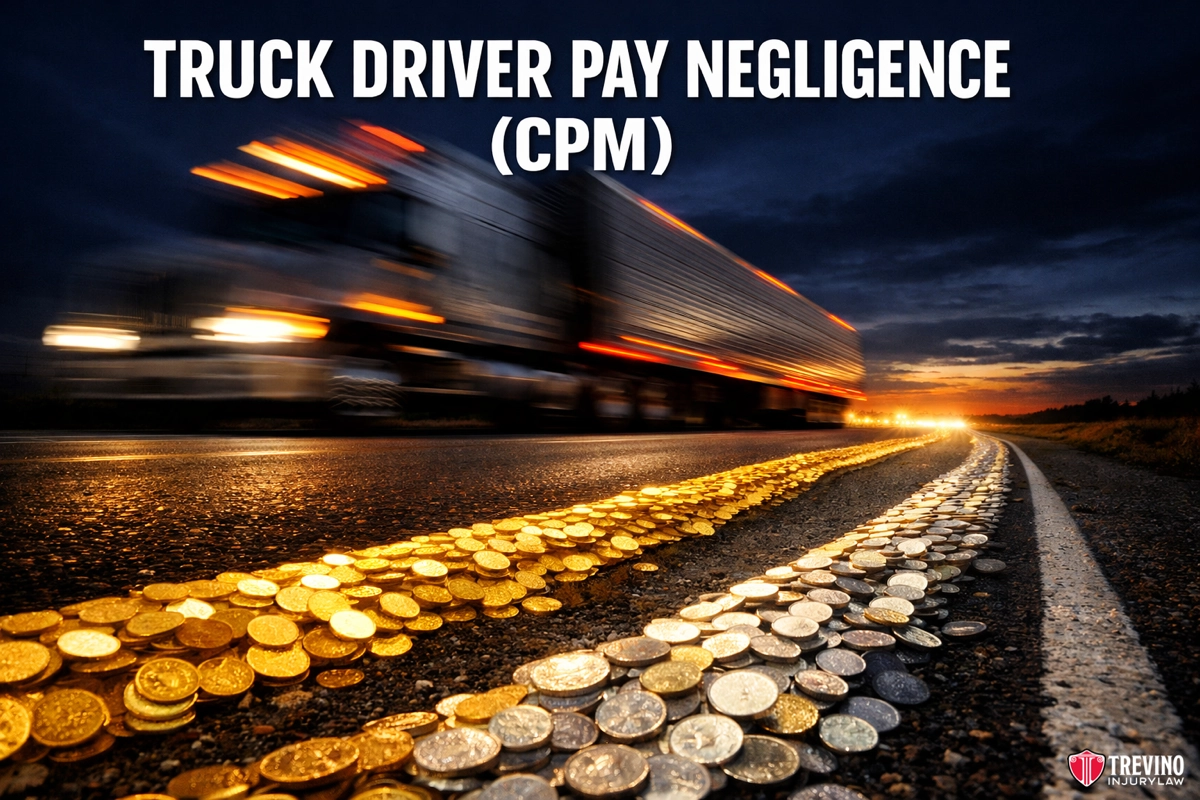
Cents-per-mile models force commercial drivers to work for free during loading delays. They lose time at the dock, so they steal speed from the highway to survive.
The trucking company’s defense team immediately blames the crash on a rogue driver to shield their dangerous payroll system. They hide the settlement sheets proving the driver was financially penalized for patience. According to a 2018 Department of Transportation Office of Inspector General report, unpaid detention time increases the expected crash rate by 6.2 percent. This is systemic negligence.
The carrier deletes ghost logs to erase the link between their pay rate and your injuries. A Spoliation Letter, a legal demand that prevents the property owner from destroying evidence, must be sent to lock down the raw payroll logs. Texas gives you two years. Wait, and the corporate entity walks away clean.
At Trevino Injury Law, our 18 wheeler accident lawyer cross-references electronic timestamps with pay stubs to expose corporate greed. Call 210-TREVINO for a free case review. You pay nothing unless we win. Se Habla Español.
What Does Cents Per Mile (CPM) Compensation Mean for Trucker Safety?
CPM (Cents Per Mile) is the industry-standard pay structure in which drivers earn a fixed rate, typically between $0.50 and $0.70, only when the wheels are turning, meaning they are effectively working for free during loading, unloading, or traffic delays. This model fundamentally conflicts with road safety by penalizing caution and patience. In the San Antonio freight market, a driver might spend hours waiting at a warehouse on the South Side or stuck in gridlock on Loop 410. Under a CPM model, that time is unpaid “dead time.”
To understand the severity of this pressure on the average truck driver, we must look at the industry benchmarks. According to the American Transportation Research Institute’s (ATRI) 2024 cost benchmarks, the standard driver wage cost, their effective base pay, is approximately $0.798 (79.8 cents) per mile. However, in San Antonio, the economic reality of actual earnings is often far harsher.
Recent data indicate that the average annual pay for a truck driver in San Antonio is approximately $48,821 (ZipRecruiter, Dec 2025), significantly trailing the national median of roughly $57,440 (BLS, 2024). This nearly $9,000 deficit creates an immediate desperation the moment a local driver starts the engine. New drivers desperate to secure a position often accept these rates, and to bridge this gap and pay their bills, they are often forced to drive faster and longer than the law allows.
If they lose four hours to a delay, they must drive faster than the legal limit allows to recover that lost income before their federal driving clock expires.
Why Standard Truck Driver Pay Structures Exclude Detention and Loading Time?
Standard CPM pay packages rarely cover detention or loading time because carriers treat driver time as a free resource, only paying when the truck is generating revenue. This is a massive time expense for drivers, particularly those hauling specific trailer types. Flatbed drivers, for instance, often perform physically demanding load securement without any additional pay.
“Detention time” refers to the hours a driver spends waiting at a shipper or receiver’s facility before their truck is loaded or unloaded. While some contracts offer minimal pay after a 2-hour grace period, many drivers sit for 4 to 6 hours at distribution centers in Von Ormy or China Grove without earning a single cent.

This unpaid waiting period is the primary trigger for aggressive driving; this desperation transforms the highway into a racetrack where safety checks and speed limits are viewed as obstacles to their bringing home pay rather than protections for the public.
The San Antonio Wage Gap: How CDL Driver Salary Impacts Safety
The financial pressure on local drivers is compounded by the fact that San Antonio truckers are often undercompensated compared to their peers. Finding competitive pay is difficult when local freight rates are suppressed by budget carriers.
According to May 2024 data from the Bureau of Labor Statistics (BLS), the mean annual wage for Heavy & Tractor-Trailer Truck Drivers in the San Antonio area is $52,980, with a median hourly wage of just $23.84. This is notably lower than the Texas statewide mean of $56,470 and the national mean of $58,400 reported by the BLS for the same period.
This wage gap creates a volatile environment. Low mileage rates often attract inexperienced drivers with poor safety records who cannot qualify for premium fleets. In San Antonio’s competitive logistics market, where the BLS reported roughly 15,020 drivers employed in May 2024, budget carriers cut corners on maintenance and pressure drivers the most.
When a company refuses to pay a professional wage, falling below the BLS 10th percentile benchmark of $34,330 annually, they get unprofessional results. We investigate the specific CPM rate in your case because an unreasonably low rate is often evidence that the trucking company knowingly hired a less qualified driver to save money, directly endangering you and your family.
How Low Rates in Local Trucking Jobs Attract High-Risk Drivers
Low average CPM rates often attract inexperienced drivers with poor safety records who cannot qualify for premium fleets, creating a direct correlation between “cheap” carriers and higher accident rates. High-quality, safety-conscious carriers typically pay experienced drivers significantly more per mile and offer additional stop pay. In contrast, budget carriers operating on razor-thin margins often pay as low as 0.50 per mile, attracting drivers with prior suspensions or limited training.
In San Antonio’s competitive trucking industry, these low-CPM carriers are often the ones cutting corners on maintenance and pressuring drivers the hardest. They may advertise high weekly miles, but the only way to achieve them is by breaking the law.
When a company refuses to pay a professional wage, it gets unprofessional results. We investigate the specific CPM rate in your case because an unreasonably low rate is often evidence that the trucking company knowingly hired a less qualified driver to save money, directly endangering you and your family. This financial deficit, created by unpaid time, sets the stage for the dangerous behaviors that cause catastrophic wrecks.
How the OTR Cents Per Mile Model Incentivizes Speeding in San Antonio
The CPM model directly incentivizes speeding because every minute spent driving below the speed limit or sitting in congestion reduces the driver’s hourly effective wage. To earn a target salary that approaches the 2024 BLS 90th-percentile wage of $75,370, a driver must average a massive number of miles per week.
When traffic slows a driver down on a regional route to Houston or Laredo, the math turns against them. This is not just a theory; it is a proven statistical reality. A landmark study found that commercial drivers detained at customer facilities drove 14.6% faster on average to make up for lost time than those who were not detained (ATRI, Sept 2024).
If a driver averages 45 mph due to traffic but needs 60 mph to pay their bills, they will inevitably speed when the road clears. This 14.6% increase in speed is a calculated financial decision forced by their pay structure, a decision that turns a heavy truck into a deadly projectile on I-35.
As the Texas Supreme Court recognized in Painter v. Amerimex Drilling I, Ltd., 561 S.W.3d 125 (Tex. 2018), pay incentives, such as distance-based bonuses, can be evidence that a company exercises control over a driver’s conduct. When a company structures pay to reward speed or fatigue, it is effectively renting the driver’s safety decisions, making the company liable for the inevitable crash.
The “Race Against the Clock”: Sacrificing Home Time and Safety for Miles
The “race against the clock” occurs when unpaid traffic delays eat into the strict 14-hour daily driving window. Drivers who want to be home every weekend, or even every week, are under immense pressure to maximize their productivity within legal limits.
FMCSA regulations strictly limit how long a driver can be on duty. If a driver works 5 days a week but spends 50 hours stuck in docks or traffic, their paycheck suffers unless they speed. If a driver sits in a wreck on Loop 1604 for 2 unpaid hours, that time is burned from their 14-hour window, leaving them with less time to complete their paid miles per week.
To mitigate this loss, drivers often attempt to manipulate their logs using complex exceptions. For instance, the 7/3 split sleeper berth provision allows drivers to split their required 10-hour break into two shorter periods. While legal, desperate drivers often exploit this complexity to artificially pause their 14-hour clock, driving while exhausted just to squeeze in more paid miles. The cost of this fatigue is visible on our local roads.
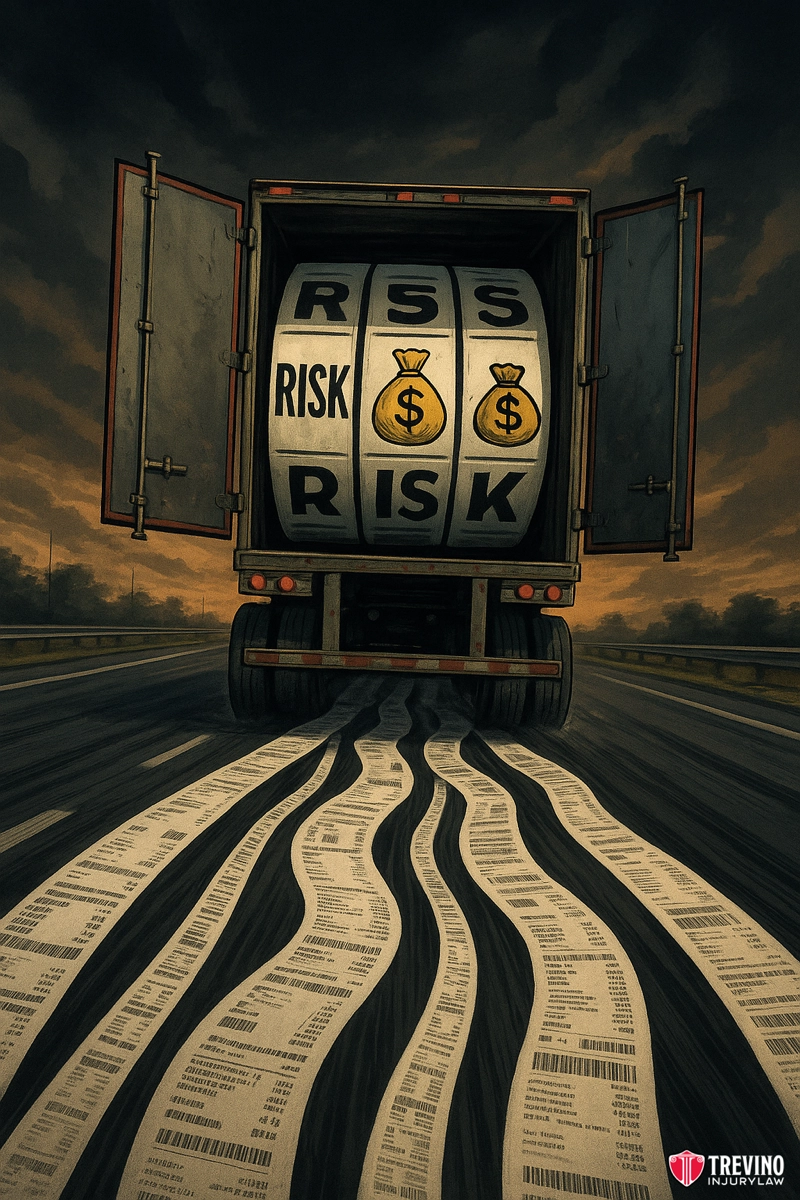
In 2024 alone, Bexar County recorded 2,460 commercial truck crashes, ranking it as the third most dangerous county for truck accidents in Texas (TxDOT/Carabin Shaw Analysis, 2025). We analyze logbook patterns to reveal how financial pressure contributed to these statistics and, specifically, led to your crash. Speeding is the visible action, but proving the company is responsible requires exposing the hidden paperwork that compelled it.
Can You Sue a Trucking Company for Dangerous Pay Structures?
Yes, you can sue a trucking company for “systemic negligence” if we can prove their pay structure created unreasonable pressure that compelled the driver to violate safety laws and cause your crash. This legal strategy moves beyond simple driver error to target the corporate entity—the “Villain” in our Scholar Warrior framework. If a company sets delivery schedules that are mathematically impossible to meet, legally given the traffic conditions and CPM rate, the company itself is liable for the wreck.

This is critical for securing maximum compensation, especially in catastrophic injury cases where the driver’s insurance policy may not be enough. By proving that the company’s business model prioritized speed over safety, we can argue for more serious damages. We put the company’s greed on trial. We show the jury that the accident wasn’t a “mistake,” but the inevitable result of a pay plan designed to exploit drivers and endanger the public.
How Attorneys Use Payroll Records to Prove “Systemic Negligence”
Attorneys use payroll records to prove systemic negligence by cross-referencing timestamps with GPS data. We look for verifiable proof of “ghost hours”, time worked but not logged. We start by subpoenaing the raw payroll logs and comparing them to the ELD data. This ‘theft of time’ is rampant: industry data shows that drivers reported being detained at 39.3% of all stops in 2023 (ATRI, 2024).
If we see a driver spend four hours at a loading dock in Laredo, part of that 39% of unpaid stops, and then immediately record speeds of 80 mph on I-35 North, the connection is clear. The company stole their time, and the driver stole speed from the highway to get it back.
We also look for discrepancies where a driver is paid for more miles than the ELD shows they drove, suggesting they are running “off the books” to boost their check. We immediately send spoliation letters to prevent the company from deleting these digital footprints, fully aware of the rigorous standards set by Brookshire Bros., Ltd. v. Aldridge, 438 S.W.3d 9 (Tex. 2014). Under Brookshire, we must prove the company intentionally concealed or destroyed evidence to secure a spoliation instruction; thus, our forensic accounting is designed not just to find the data, but to document exactly when and how the company tried to hide it. Forcing the insurance company to face the reality of its client’s dangerous business practices.
What is a Reasonable CPM That Ensures Safety vs. Profit?
A reasonable CPM that prioritizes safety typically tracks with national cost benchmarks. According to ATRI’s 2024 analysis, the average driver wage cost per mile is approximately $0.798. High-quality carriers pay at or above this level, often with additional “detention pay” to offset the financial penalty for safety-related delays. In the San Antonio logistics market, pay rates below $0.40 per mile are a major red flag for negligence. These “bottom-feeder” rates effectively force drivers to speed just to reach a minimum-wage-equivalent, making safety an unaffordable luxury.
When we present this evidence to a Bexar County jury, we contrast the defendant’s low rate with industry standards to show they knowingly underpaid to undercut competitors. High CPM carriers generally have significantly better safety scores because their drivers can afford to slow down during bad weather or heavy congestion on I-10 East without risking their paychecks. By paying less, the trucking company made a calculated decision to shift its financial risk onto public safety.
How to Correlate Pay Stubs with Electronic Logbooks (ELDs)
Attorneys correlate pay stubs with ELD data by identifying discrepancies between “paid miles” and “actual time worked,” revealing off-the-clock driving used to boost income. This forensic process involves overlaying the driver’s settlement sheet (paycheck) onto their federally mandated Electronic Logging Devices (ELDs). “Ghost logs” occur when a driver drives off the clock to save their limited drive time but bills the company for the miles to ensure they get paid.

If a driver’s pay stub shows they were compensated for 3,000 miles in a week, but their ELD only records 2,500 miles, we have immediate proof of federal falsification. This discrepancy often indicates the driver was speeding or driving while fatigued to bridge the gap. We request these specific records during discovery to prove the trucking company paid for, and therefore ratified, the illegal driving that caused your injury.
Is Unpaid Detention Time Legal in Texas?
Yes, unpaid detention time is generally legal under federal and Texas law unless a specific contract exists, which leaves drivers financially vulnerable to long wait times.
Does CPM Pay Cover Loading and Unloading Time?
No, standard CPM pay structures typically exclude loading and unloading time, meaning drivers work for free during these critical safety checks.
Do Higher CPM Rates Reduce Truck Accidents?
Yes, studies generally show that higher CPM rates reduce accidents by reducing financial stress and attracting more experienced, safety-conscious drivers.
CPM vs. Hourly Pay: Which is Safer for San Antonio Roads?
Hourly pay is universally considered safer for San Antonio roads because it compensates drivers for congestion on Culebra Road and construction on Loop 1604, removing the incentive to speed. When a driver is paid by the hour—typically averaging $25.47/hr in San Antonio based on May 2024 BLS figures—a traffic jam is merely a delay, not a reduction in their paycheck. Conversely, a CPM driver views heavy traffic on Bandera Road as a direct threat to their livelihood, leading to aggressive lane changes and tailgating.
This fundamental difference in compensation changes the driver’s psychology. An hourly driver can afford to be patient, yield the right of way, and drive cautiously through school zones in Leon Valley. A CPM driver, heavily stressed by the “ticking clock” of their unpaid time, is statistically more likely to take risks that lead to rear-end collisions and intersection crashes.
What Happens When Drivers Are Paid Hourly? (The Safety Alternative)
When drivers are paid hourly, the financial pressure to rush disappears, resulting in fewer HOS violations and a significant reduction in speed-related crashes. This “safety alternative” creates a control group that highlights the dangers of the CPM model. Private fleets that pay by the hour often operate with significantly lower accident rates because their drivers are rewarded for safety and compliance rather than raw speed.
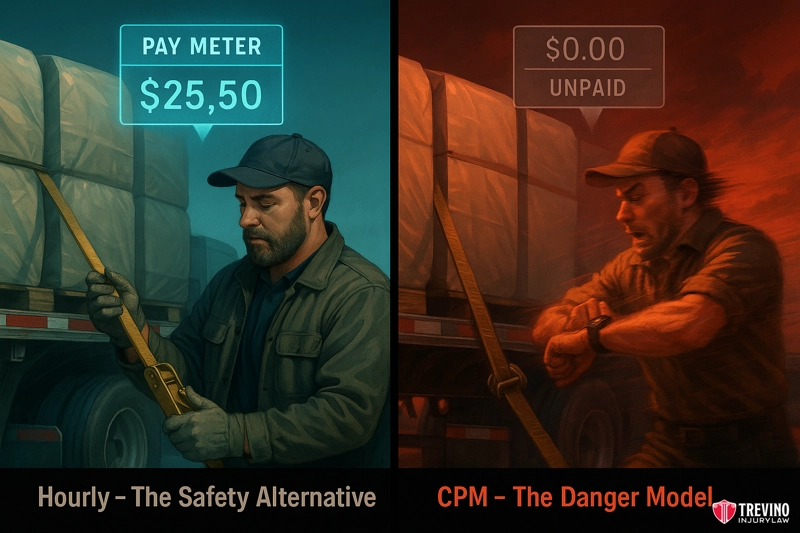
In these hourly environments, a driver who spends an extra 15 minutes securing a load or checking their brakes is paid for that diligence. In a CPM environment, that same safety check effectively costs the driver money. By demonstrating that the industry has a safer alternative available—yet your opponent chose the riskier CPM model to save money—we strengthen the argument that the negligence was a corporate choice, not just a driver error.
When CPM Does Not Apply: Percentage Pay for Owner-Operators and Flatbed Drivers
CPM structures may not apply to everyone. Drivers who specialize in oversized loads, hazmat, or reefer (refrigerated) transport often operate under different models. Owner-Operators are often paid a percentage of the load revenue. Unlike company drivers who are W-2 employees, owner-operators are independent contractors (1099) who own their rigs and often haul freight from the Eagle Ford Shale or Somerset oil fields. While they aren’t paid by the mile, they only eat if they deliver, creating a different but equally dangerous incentive to speed.
Understanding this distinction is critical for liability. While the pay mechanism differs, the root cause—financial desperation—remains the same. Whether it is a company driver racing for cents per mile or an owner-operator racing for a load fee, we investigate the economic pressure the carrier placed on them. If the dispatch schedule required illegal speeds to be profitable, the company is liable for the destruction caused on our highways.
Why Hire a San Antonio Truck Accident Lawyer?
When a driver on Loop 410 chooses speed over safety to beat a logbook deadline, that isn’t a mistake; it is a calculation. Negligent trucking companies and insurance adjusters count on you hiring a settlement mill that won’t audit their payroll records or fight them in court.
We are The Trial Authority. We don’t fold; we expose their systemic negligence and force them to pay full value.
We secured a $17 million settlement in a complex trucking wrongful-death case by proving exactly this kind of recklessness. We take the fight to Bexar County juries when insurers refuse to be fair.
You need a San Antonio 18-wheeler accident attorney who immediately sends spoliation letters to lock down black box data before it is destroyed.
Call 210-TREVINO for a free case review. Se Habla Español. No Win, No Fee.