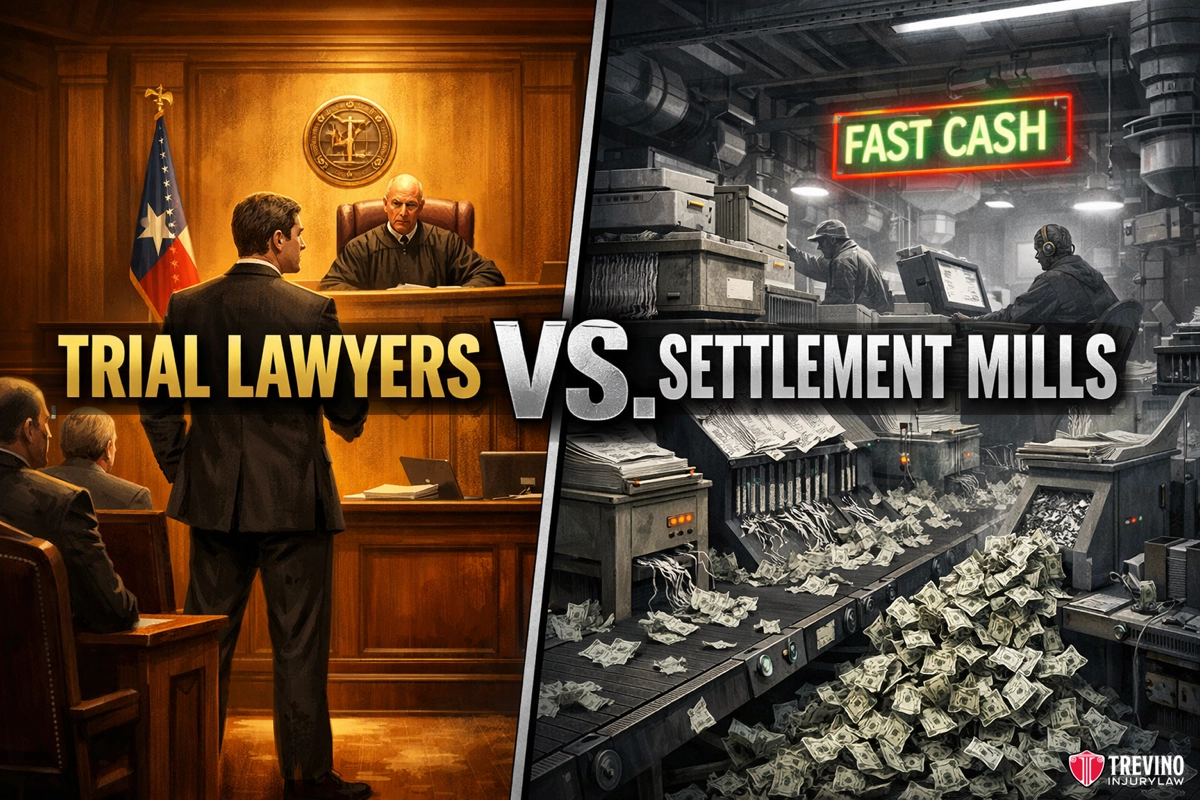
That lawyer with the billboard and the catchy jingle? They could be the worst choice for your case.
A settlement mill is a factory. They spend millions on advertising to sign hundreds of clients, settle cases fast for “quick cash,” and avoid the courtroom at all costs. That ad spend only works at volume. Your case is a file number in a system built for speed, not value.
What Could Your Accident Case Be Worth?
Answer a few quick questions about your accident. Takes about 60 seconds.
See What My Case Might Be WorthThe insurance company offered less than $20,000. I ended up with over $1 million. — Jackie Galindo
A San Antonio personal injury trial lawyer takes the opposite approach. Trial lawyers carry fewer cases, prepare each one as if it’s going to a jury, and use that preparation as leverage against insurance companies. The goal isn’t to drag every case into a courtroom. It’s to make sure the insurance company knows you’ll go there if they refuse to pay what your claim is actually worth.
Here’s why that matters. Insurance adjusters track which attorneys actually go to trial and which ones fold. Every settlement offer is priced against that risk. When they see a settlement mill on the file, they offer bottom dollar. When they see our name, they price the offer against a real jury verdict.
Trial experience is rare because trials are rare. Of 13,655 civil cases disposed of in Bexar County in 2023-2024, only 69 involved a jury. That’s 1 in 200. Many lawyers have never tried a case to verdict, and the insurance companies know it.
At Trevino Injury Law, we’ve taken over 80 cases to trial. The insurer offered $5,000 on a low back injury claim. The jury returned $536,007. That’s 107 times the offer.
In an 18-wheeler wrongful death case, the insurance company paid $17 million to settle before trial. They didn’t want to find out what a San Antonio jury would do. That’s not a slogan. That’s a track record.
Your case gets personal attention. You get the compensation you actually deserve. And if the insurance company still refuses to pay what your case is worth, you have a lawyer who is ready, willing, and proven in the courtroom.
Don’t let your case become just a number. Call 210-TREVINO now for a free case review. You pay nothing unless we win. Se Habla Español.
What is the Difference Between a Personal Injury Trial Lawyer and a High-Volume Law Firm?
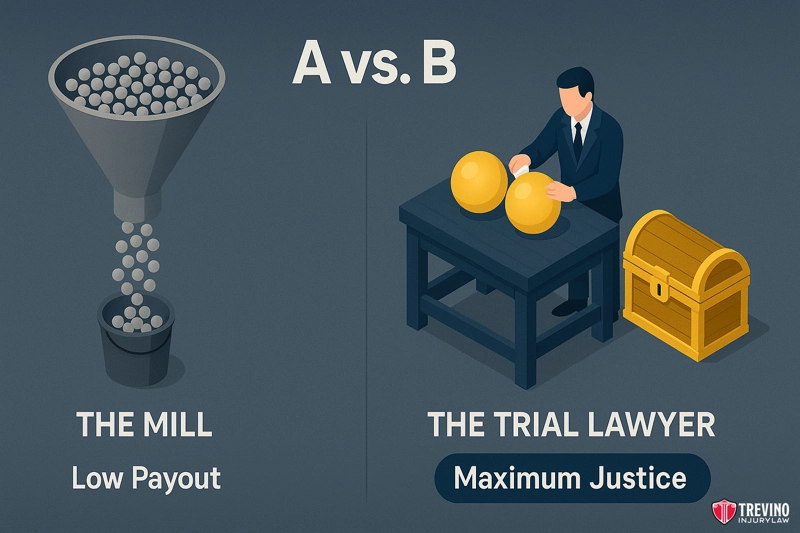
A dedicated personal injury attorney prepares every case for a potential jury verdict to maximize its financial value, while a high-volume firm aims for quantity, resolving injury claims as quickly as possible. The fundamental difference is intent: a trial lawyer uses the threat of litigation to pressure insurers, whereas a mill has no intention to take a case to trial.
This contrast is often described as “Volume vs. Value”. High-volume firms rely on massive marketing to handle hundreds of cases simultaneously. In this environment, you may work with a “pre-litigation attorney” who has no plans to take a case to a judge because they fear losing their streamlined revenue model.
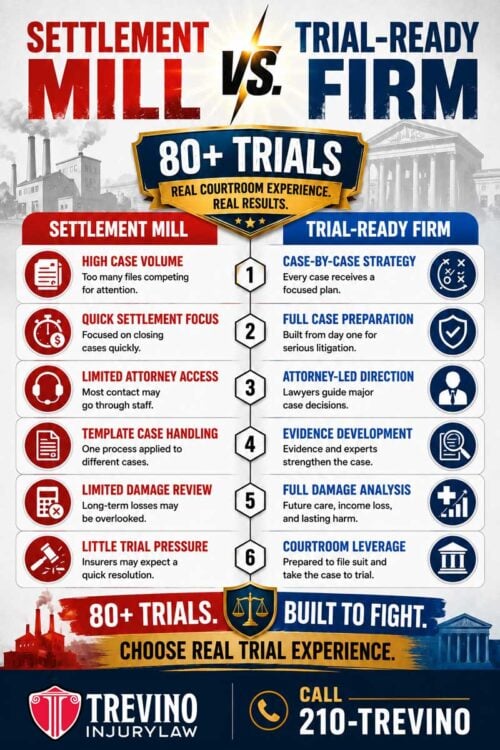
A trial-focused firm like Trevino Injury Law maintains manageable caseloads so we can actually prepare each case for the Bexar County Courthouse. That means time to depose witnesses, hire experts, and build a narrative that resonates with a jury. Settlement mills can’t do this.
When the insurance company refuses to pay fair value, they drop the client or refer the case out because they lack the infrastructure to litigate. Insurance companies know which lawyers go to court and which ones fold, and they price their settlement offers accordingly.
How Does High Case Volume Affect Personal Attention in a Personal Injury Case?
Attorneys at high-volume firms are often buried in paperwork, juggling 200–300 files at a time, making it statistically impossible to provide true personal attention. When a single lawyer is responsible for such a high volume, they cannot devote the hours needed to analyze medical records or build a compelling case for a serious injury.

In contrast, every personal injury case at a trial-focused practice receives deep scrutiny. This lower volume ensures that every piece of evidence is preserved, and legal strategies are developed to explore every avenue for compensation before any settlement is considered.
Why Do High-Volume Law Firms Prefer Settling Cases Instead of Going to Court?
For these firms, the preference to settle cases is purely financial: settling 100 cases at $10,000 yields significantly more fees with less work than trying a single complex case. The settlement mill’s objective is often to get paid quickly without the risk or expense of a jury trial.
For trial lawyers, we only settle your case if the offer represents the full and fair compensation you are owed. We are willing to negotiate, but if the insurance company tries to underpay, we are not afraid to take the case to a jury.
What Questions About Trial Experience Reveal if a Law Firm is a Settlement Mill?
Ask a potential attorney about their recent courtroom experience, including when they last picked a jury, and ask whether they will personally handle your file or pass it off to a generic case manager. These direct questions cut through the marketing noise and reveal whether the firm has the actual trial readiness required to force insurance companies to pay fair compensation for your injuries.
Think of this as a “Litmus Test” for your potential legal representation. When you schedule a free consultation, ask, “When was the last time you took a verdict in Bexar County or anywhere in Texas?” A true trial lawyer will have a specific answer, likely referencing a recent case. A settlement mill attorney may stumble, deflect, or admit it has been years since they stood before a judge.
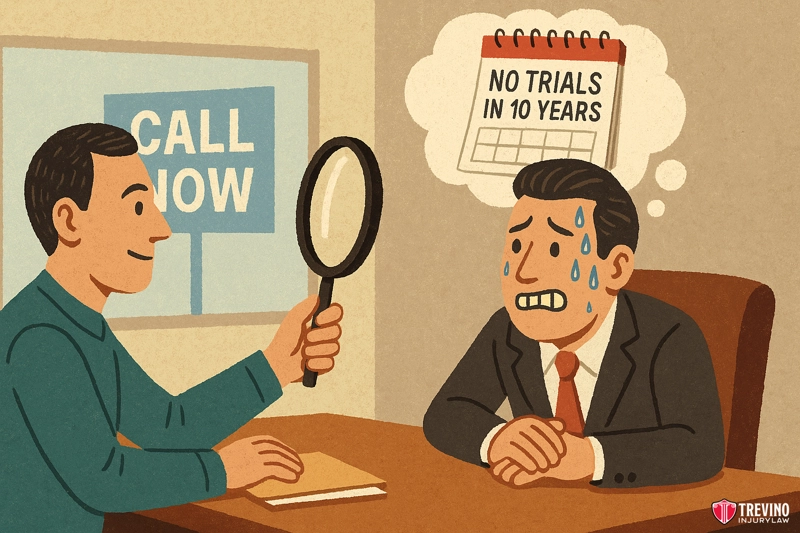
You must also ask, “Will you file a lawsuit if the insurance offer is too low?” Many settlement mills operate on a strict pre-litigation basis and will actually drop clients who demand to file suit because it disrupts their high-volume business model. Furthermore, ask the critical question: “Who will I communicate with?” In a settlement mill, the answer is often “your case manager.” If you cannot meet the attorney who is supposedly fighting for your future, or if you are told you will primarily deal with support staff, you are likely at a mill.
What Red Flags Mean a Firm Will Push for a Quick Personal Injury Settlement?
- Guarantees: Be wary of any lawyer who promises specific dollar amounts within minutes of meeting you, before reviewing your full medical records or police report.
- Pressure: High-pressure tactics urging you to accept early settlement offers immediately, claiming “the offer expires today,” are a hallmark of mills trying to close files quickly.
- Ghosting: A complete inability to speak to the actual attorney after signing the contract, with all communication routed through paralegals or call centers, indicates you are just a number.
- Generic Advertising: Reliance on catchy jingles and generic slogans, rather than specific mentions of a trial record or board-certified expertise, often signals a volume-based approach.
Once you have identified a potential mill, the next logical step is to understand exactly how their lack of trial readiness financially damages your specific claim.
Does a Trial-Focused Attorney Secure a Better Personal Injury Settlement?
Yes, insurance companies utilize sophisticated software to track which attorneys actually take cases to trial, automatically authorizing higher settlement offers for trial lawyers to avoid the risk of a large jury verdict. This data-driven approach means that the relationship between a specific firm and the insurance companies directly impacts the initial value assigned to your claim by the insurance adjuster.
This phenomenon is often called “The Trial Premium” for clients or “The Trial Tax” for insurers, and it has grown stronger as trials have become less common. Data from the Administrative Office of the U.S. Courts reveals that federal civil trials dropped from 11.5% in 1962 to just ~1% by 2016.
In this era of the “Vanishing Trial,” insurance giants know that 99% of firms will fold, so they cap offers at ‘nuisance value.’ However, pay full value to the rare attorneys who defy these statistics. In short, trial experience translates to better offers because of the financial risk created by the Stowers Doctrine. Established in the landmark case G.A. Stowers Furniture Co. v. American Indemnity Co., this Texas law holds insurance companies liable for the entire jury verdict—even if it exceeds the policy limits—if they negligently rejected a reasonable settlement offer within those limits. Settlement mills cannot trigger this pressure because insurers know they will never actually secure the verdict required to trigger the Stowers penalty.
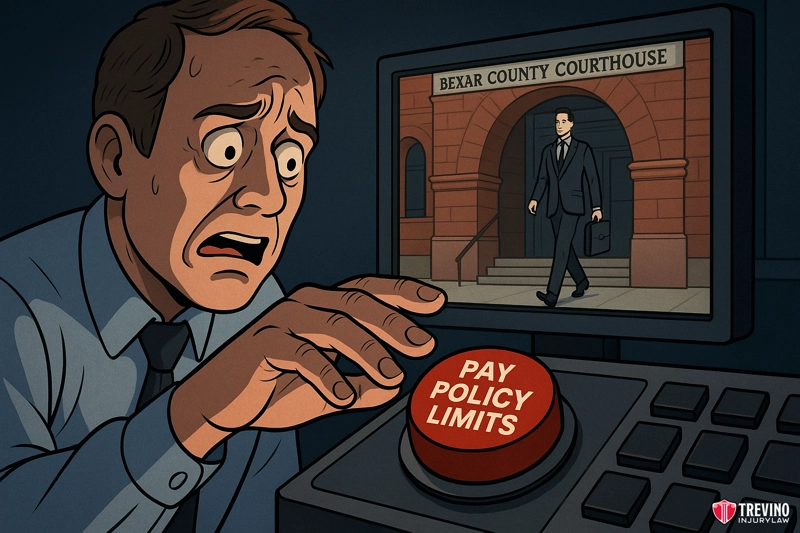
A prime example is the South Texas car accident claim, Arriaga v. Montemayor. The insurance company offered a mere $5,000. They insisted this was the limit of the claim’s value. However, the trial lawyers at our San Antonio car accident law firm refused to accept a lowball check. Because we litigate to verdict, the jury returned a $536,007 jury verdict. That is a massive increase over the initial offer. A settlement mill would have accepted the $5,000. This would leave the client with nothing but debt.
How Does Thorough Case Preparation Differ for a Personal Injury Trial?
Trial preparation starts on Day 1 with immediate evidence preservation, including dashcam footage, spoliation letters to trucking companies, and retaining medical experts. While settlement mills typically wait passively for the police report and medical bills to arrive, a trial lawyer actively builds the case as if it will go to court.
For a crash on a busy intersection like 1604 and I-10, this means sending investigators to the scene immediately to measure skid marks and interview witnesses before memories fade. We consult with accident reconstructionists and life care planners early in the process. This rigorous preparation signals to the insurance company that we are ready to fight, which, paradoxically, is the best way to secure a fair settlement without a trial.
This demonstrates the financial value of a trial lawyer, but it also helps you decide when to accept a deal and when to push forward.
Is It Better to Take a Settlement or Go to Trial?
It is usually better to settle only if the offer fully covers your past and future damages, but you must be prepared to go to trial to get that offer. A fair settlement allows you to avoid the uncertainty of a jury verdict and provides immediate financial relief, while a trial becomes necessary when the insurance company refuses to pay the true value of your claim.
Trial Attorney Candelario (J.R.) Trevino on settlement vs. trial — and what determines which path your case takes.
Moving from law firm business models to your personal decision requires understanding that while 95% of personal injury cases eventually settle, the quality of that settlement depends entirely on your attorney’s readiness for court. A “good” settlement is one that secures full compensation without the risk of a trial. A “bad” settlement leaves money on the table simply because the lawyer wanted to close the file quickly.
At Trevino Injury Law, we don’t push for a trial for its own sake; we prepare for it so the insurance company fears the courtroom more than writing the check. If they offer a fair amount that covers all medical bills and lost paychecks, we advise you to accept it. If they try to underpay, we are ready to fight.
While the decision to settle often centers on the final payout amount, many clients mistakenly believe that hiring a “cheaper” high-volume firm saves them money on legal costs, only to discover that the fee structure is identical.
How Do Settlement Mills Set Client Fees Differently?

Most settlement mills charge the same standard 35% to 45% contingency fee as experienced trial lawyers, meaning clients effectively pay top-tier rates for bottom-tier legal service.
There is a dangerous misconception that hiring a “billboard lawyer” is cheaper than hiring a courtroom litigator. In reality, the industry standard for personal injury fees in Texas is consistent across the board, but the value you receive for that percentage varies wildly.
When a settlement mill takes 40% of a quick $10,000 settlement, the client is left with very little after medical bills are paid. Conversely, when a trial lawyer like Trevino Injury Law takes the same percentage from a $100,000 policy-limit settlement or a $536,000 jury verdict, the client’s financial future is secured. You are paying the same rate regardless of the firm’s quality, so it makes financial sense to hire the attorney who maximizes the total recovery rather than the one who minimizes their own workload.
Do Attorneys Usually Get More Money Than Clients From a Settlement?
No, attorneys usually do not receive more money than the client. In standard Texas personal injury cases, the attorney’s contingency fee is typically capped at 33.33% to 40% of the gross settlement, leaving the remaining 60% to 67% for the client’s medical bills and personal compensation.
However, in cases with low insurance policy limits and high medical bills, a client’s “net” pocket money can shrink, which is why ethical firms often reduce their fees to ensure the client is the primary beneficiary.
Will I Pay Taxes on a Settlement?
No, personal injury settlements for physical injuries are generally tax-free under 26 U.S. Code § 104(a)(2). This section of the Internal Revenue Code specifically excludes from gross income ‘the amount of any damages (other than punitive damages) received on account of personal physical injuries or physical sickness.’ This ensures that the compensation you recover for medical bills, pain and suffering, and lost wages due to physical injury remains yours, not the IRS’s.
Can I Fire My Lawyer if They Are a Settlement Mill?
Yes, you have the right to change attorneys at any time, though the fired attorney may have a lien for reasonable work they already performed.
Which Injury Cases Require a Trial Lawyer Most?
Complex injury cases involving commercial vehicles, traumatic brain injuries (TBI), or spinal damage require a trial lawyer because the damages invariably exceed standard insurance software calculations and demand expert litigation to secure full value. Unlike settlement mills that handle minor fender benders, high-stakes scenarios require navigating complex federal regulations to establish negligence per se.
Case Types Demanding Expert Litigation:
- Commercial Vehicle Accidents: Crashes involving 18-wheelers on corridors like I-35 near Universal City require scrutiny of Federal Motor Carrier Safety Regulations (FMCSRs), specifically hours-of-service rules (49 C.F.R. § 395) and maintenance logs (49 C.F.R. § 396). When Trucking Companies attempt to blame the victim to avoid a massive payout, we force them to pay by mastering Texas comparative negligence laws and dismantling their defenses under the 51% rule.
- Catastrophic Injuries: Victims requiring surgery at facilities like Methodist Hospital for TBI or spinal damage need representation that calculates a lifetime of pain and lost earning capacity, rather than accepting a quick “software-generated” offer.
- Workplace Disasters: Incidents involving heavy machinery or wrongful death demand a lawyer who can prove regulatory violations, whereas volume firms often treat these as simple accidents.
What Happens If I Accept a Settlement Too Early?
If you sign a release for a quick settlement, you generally waive your right to seek further compensation forever. While Texas courts have occasionally set aside releases for ‘unknown injuries’ under the doctrine of mutual mistake (Williams v. Glash), this is an exceptionally difficult legal hurdle to clear. Insurance companies draft releases specifically to avoid the Williams exception, meaning that once you sign their document, your case is almost certainly closed, even if a traumatic brain injury (TBI) manifests months later.
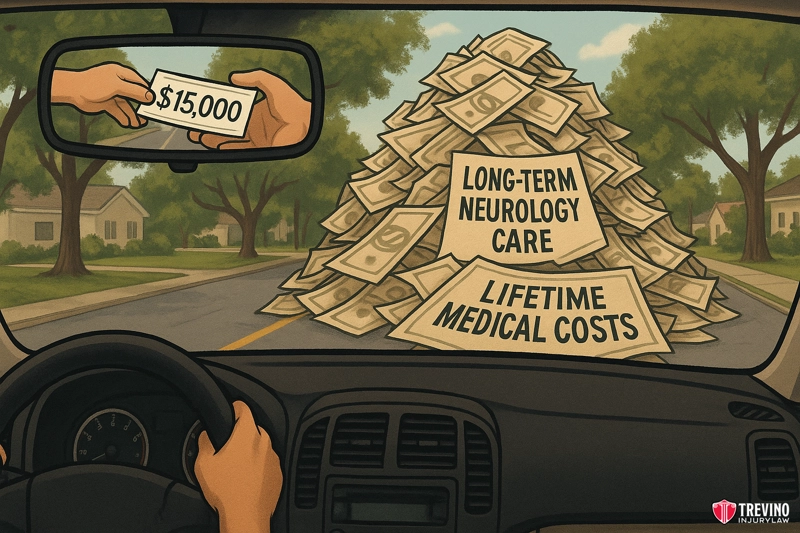
For example, a traumatic brain injury from a crash in Alamo Heights might manifest symptoms months after the accident. If you have already cashed a check for $15,000 based on an initial ER visit, you cannot go back to the insurance company when you later require long-term neurology care. Once the release is signed, the case is closed forever, leaving you personally responsible for all future medical costs.
When Does a Trial Attorney Make a Pre-Litigation Settlement Acceptable?
A pre-litigation settlement is acceptable only when the insurance company immediately offers the full policy limits or a fair value that completely covers all current and future financial needs. Not every case requires a courtroom war, and a skilled trial lawyer knows exactly when to advise a client to accept a deal.
The difference lies in why the settlement is happening. If an insurer pays the full policy limit for a crash in Helotes because they know Trevino Injury Law is ready to sue, that is a victory. It is entirely different from accepting a low offer because the attorney is afraid to file a lawsuit. The readiness to go to trial is often the very catalyst that produces a fair settlement offer without ever needing to pick a jury.
Demand the Best San Antonio Personal Injury Trial Lawyer: Call 210-TREVINO Now
Insurance giants treat Bexar County crash victims as file numbers, banking on settlement mills to fold for quick cash. Trevino Injury Law is built differently. As a trial-first law firm, every case is prepared as if a San Antonio jury will decide it. With 80+ cases taken to trial, the defense knows we go the distance, and settlement offers come in higher as a result.
Don’t Guess About Your Rights. Get a Definite Answer.
The insurance company is already evaluating your accident. Call 210-TREVINO Now to level the playing field, or choose your next step below. It’s confidential and you pay nothing unless we win.

Our trial-first aggression delivered a $536,007 jury verdict in Arriaga v. Montemayor, 107X the $5,000 offer. As your personal injury trial lawyers, we immediately file FOIA requests and send spoliation letters to lock down dash-cam and body-cam footage before evidence disappears. Ready to talk? Schedule a free case review. We fight on strict contingency: No Win, No Fee.
Call 210-TREVINO for a free case review. Se Habla Español.

FREE CASE REVIEW 24/7 | NO WIN. NO FEE. | MAXIMUM COMPENSATION