
Uncapped common-law damages for past and future losses. A non-subscriber lawsuit forces your employer to pay for the actual lifetime cost of your injury, bypassing fixed state-regulated insurance schedules.
The company is already trying to trap you into a voluntary benefits plan. They send adjusters with settlement waivers disguised as quick cash, dictating which doctors you see and prioritizing return-to-work metrics over your recovery. Trevino Injury Law secured a $7.9 million verdict for a client with a crushed foot by proving gross negligence beyond these standard benefit plans. That is the difference between accepting an arbitrary corporate cap and litigating damages before a Bexar County jury.
What Could Your Work Injury Accident Case Be Worth?
Answer a few quick questions about your accident. Takes about 60 seconds.
See What My Case Might Be WorthThe insurance company offered less than $20,000. I ended up with over $1 million. — Jackie Galindo
You must not sign any post-accident release of liability. Signing that document permanently forfeits your right to sue, leaving you with no legal recourse when your condition worsens. A Spoliation Letter, a legal demand that stops the company from destroying evidence, must be sent immediately to preserve proof of their negligence.
Trevino Injury Law’s work accident attorneys reject lowball plans and force the company to pay the true lifetime cost. Call 210-TREVINO now for a free case review. You pay nothing unless we win. Se Habla Español.
Texas Non-Subscriber Work Injury Claim: Key Takeaways
- As your San Antonio non-subscriber work injury lawyer, we secure uncapped damages for accidents on corridors like Bandera Road in Bexar County.
- The Texas Supreme Court ruling in Kroger v. Keng prevents non-subscriber employers from reducing your payout due to comparative negligence.
- Trevino Injury Law secured a $7.9 million verdict for a crushed foot by proving gross negligence beyond standard voluntary benefit plans.
- Our legal team uses forensic economists to project Loss of Earning Capacity for injured workers across the North Central corridor and San Antonio.
How an Injured Employee Can Recover Compensation from a Texas Non-Subscriber Employer
Recovering fair compensation from a Texas non-subscriber employer requires a different legal strategy than standard workers’ compensation claims. Because the Texas Labor Code allows many Texas employers to opt out of the state-regulated insurance system, an injured employee must pursue a negligence-based injury claim directly against the company to secure a full recovery.
Instead of accepting a capped “voluntary benefit plan,” filing a civil lawsuit allows you to seek uncapped common law damages for your losses. Successfully navigating a Texas non-subscriber work injury case often requires an experienced law firm that can prove employer negligence and maximize the value of your non-subscriber work injury claim.
How Does Non-Subscriber Compensation Differ from Standard Workers’ Comp?
Non-subscriber compensation differs primarily by allowing “uncapped” common-law damages for negligence. In contrast, standard workers’ compensation is strictly limited to fixed fee schedules and income caps regardless of how severe your injury is or who was at fault.
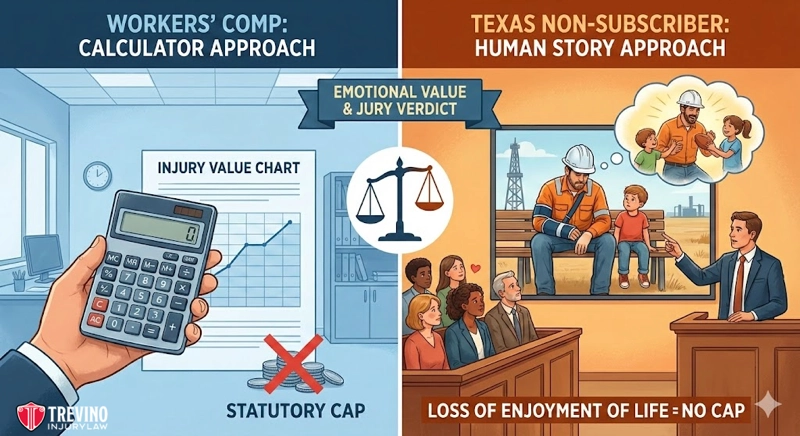
Unlike the state-regulated system, where a lost finger or crushed limb has a pre-determined “price tag,” non-subscriber cases in San Antonio allow juries to assess the full impact of the injury on your life. We often see employers in the North Central corridor and beyond offer “voluntary benefit plans” that mimic workers’ comp limits, usually capping wage replacement at $1,168 per week or limiting benefits to 104 weeks.
Accepting these plans without legal review can trap you in a system designed to save the company money rather than restore your life. This section explains why rejecting those limited plans in favor of a negligence claim is often the only way to secure a future for your family.
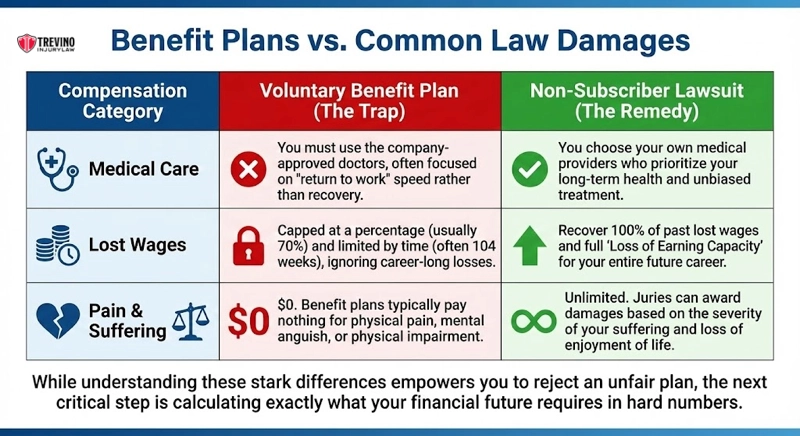
Benefit Plans vs. Common Law Damages
| Compensation Category | Voluntary Benefit Plan (The Trap) | Non-Subscriber Lawsuit (The Remedy) |
| Medical Care | You must use the company-approved doctors, often focused on “return to work” speed rather than recovery. | You choose your own medical providers who prioritize your long-term health and unbiased treatment. |
| Lost Wages | Capped at a percentage (usually 70%) and limited by time (often 104 weeks), ignoring career-long losses. | Recover 100% of past lost wages and full “Loss of Earning Capacity” for your entire future career. |
| Pain & Suffering | $0. Benefit plans typically pay nothing for physical pain, mental anguish, or physical impairment. | Unlimited. Juries can award damages based on the severity of your suffering and loss of enjoyment of life. |
While understanding these stark differences empowers you to reject an unfair plan, the next critical step is to calculate, in hard numbers, exactly what your financial future requires.
What Economic Damages Can You Recover in a Lawsuit?
Economic damages cover every verifiable financial loss caused by the accident, from the ambulance bill and surgery costs to the specific wages you will lose twenty years from now due to an early retirement forced by your injuries.
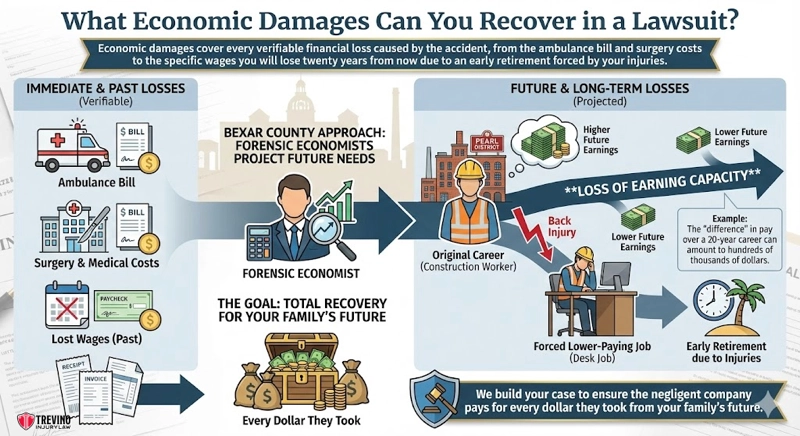
In Bexar County courts, we do not simply present a stack of past medical bills; we use forensic economists to project your financial needs decades into the future. For example, if a construction worker in the Pearl District suffers a back injury that forces them into a lower-paying desk job, the “difference” in pay over a 20-year career can amount to hundreds of thousands of dollars. This is called “Loss of Earning Capacity,” and it is often the most significant portion of an economic claim in high-stakes injury cases.
We build your case to ensure the negligent company pays for every dollar they took from your family’s future.
How Future Medical Costs Are Projected in a Work Accident
Securing your future requires a “Life Care Plan” that accounts for every medical intervention you will need for the rest of your life, not just the treatment you have received so far. It is not just about the surgery next week; it is about the replacement hardware you might need in 15 years, the physical therapy required at age 60, and the necessary home modifications.
We work with medical experts to determine when you have reached Maximum Medical Improvement (MMI)—the point where your condition has stabilized—to calculate these long-term costs accurately before any settlement is reached.
Who Pays Medical Bills While the Case Is Pending?
You generally do not have to pay medical bills out of pocket while your case is pending, as we use “Letters of Protection (LOPs)” to secure your treatment without upfront costs. An LOP is a legal agreement in which medical providers agree to treat you now and defer payment until your case is resolved.
This ensures you can receive top-tier care from specialists in the Medical Center area without ruining your credit score or draining your savings. At the same time, we fight the insurance company for fair compensation.
Establishing these hard financial costs lays the foundation for understanding the significant value of your non-economic damages, which often exceed the medical bills themselves.
How Much Is Pain and Suffering Worth in a Texas Non-Subscriber Case?
Pain and suffering damages are calculated based on the severity, duration, and specific impact of the injury on your daily life, with no statutory cap in Texas non-subscriber cases to limit what a jury can award you.
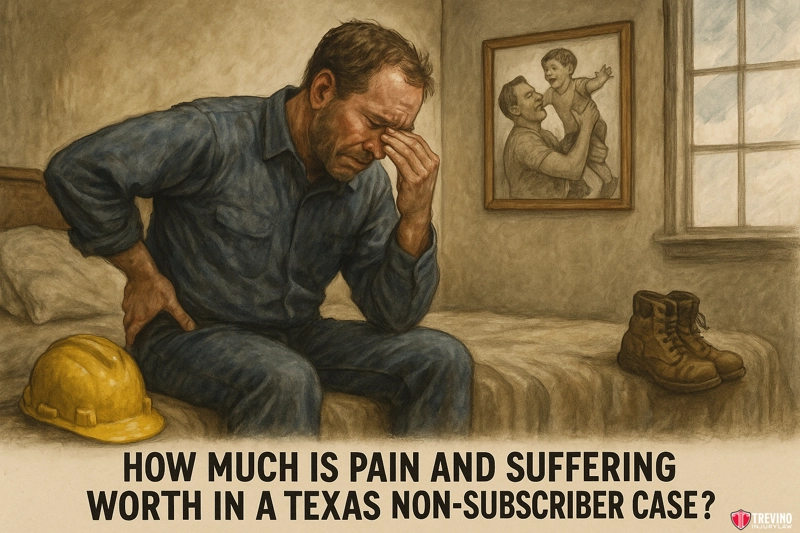
This is where the non-subscriber system differs most radically from workers’ comp. There is no calculator or chart that assigns a specific value to a back injury. Instead, we must paint a vivid picture for the San Antonio jury. If an oil field worker can no longer pick up their children or play sports due to a crush injury, that “Loss of Enjoyment of Life” has a distinct monetary value.
We answer the common question “How much can you get for pain and suffering?” by reviewing comparable verdicts in Bexar County and presenting the human story behind the injury.
Physical Impairment vs. Disfigurement
Texas law strictly distinguishes between ‘looking different’ (disfigurement) and ‘functioning differently’ (physical impairment), allowing you to recover separate damages for each. This “two-bar” distinction was clarified in Golden Eagle Archery, Inc. v. Jackson, 116 S.W.3d 757 (Tex. 2003), where the Texas Supreme Court held that physical impairment encompasses the loss of enjoyment of life and physical limitations distinct from pain and suffering.
This allows our firm to seek specific compensation for the activities you can no longer perform, separate from the compensation for your scars or physical pain.
In severe cases, like the $7.9 million verdict we secured for a client with a crushed foot, these damages acknowledge that the injury stole more than just wages; it stole a piece of the victim’s physical freedom.
When Can You Claim Punitive Damages?
You can claim punitive damages when the employer’s actions went beyond simple carelessness and rose to the level of “gross negligence,” meaning they were consciously indifferent to an extreme risk of harm. If a company knew a safety guard was missing on a machine but ordered you to work on it anyway to speed up production, they may be liable for these additional damages.
Punitive damages are designed solely to punish the company for its reckless behavior and serve as a warning to other employers in South Texas to prioritize safety over profits.
Gross negligence is frequently the cause behind preventable tragedies, such as the 92 fatal falls reported by the Texas Department of Insurance in their 2023 injury census. When a construction company, an industry that the 2023 Census confirms is the deadliest in the state, with 124 fatalities, knowingly fails to provide fall protection to speed up a job, that is grounds for punitive damages.
While proving gross negligence can significantly increase the potential value of your case, the final settlement offer you receive depends on how effectively we leverage these risks against the insurance company.
What Factors Determine a Reasonable Settlement Offer?
A reasonable settlement offer must comprehensively cover all past medical debts and projected future care costs while providing full compensation for your non-economic suffering, with the final value heavily influenced by the strength of the liability evidence against your non-subscriber employer.
Insurance adjusters at major companies in San Antonio do not determine settlements based on what is fair; they base them on “exposure,” the statistical risk of incurring greater losses in court. They view your injury as a math problem to be minimized.
The single biggest factor driving a settlement offer up is the threat of a trial. Because non-subscriber employers in Texas are stripped of their standard legal defenses, they often fear facing a jury in Bexar County without those shields.
Does Comparative Negligence Affect My Payout?
In a true non-subscriber case, standard comparative negligence does not apply, meaning your compensation cannot be reduced just because you were partially at fault.
This massive legal advantage was solidified by the Texas Supreme Court in Kroger Co. v. Keng, 23 S.W.3d 347 (Tex. 2000). In this landmark ruling, the Court confirmed that non-subscriber employers are statutorily barred from asserting contributory negligence as a defense, allowing injured employees to recover 100% of their damages even if they were partially responsible for the accident.In a standard personal injury case, the “51% rule” (Modified Comparative Negligence) bars you from recovering any money if you are found to be more than 50% responsible for the crash.
However, because non-subscriber employers surrender this defense, that rule generally does not apply here. Even if a jury finds you were 49% or even 90% at fault for a slip on an oil rig or a crash on Bandera Road, you can still recover the full amount of your damages, provided the employer was at least 1% negligent. This prevents companies from shifting the blame onto you to save money.
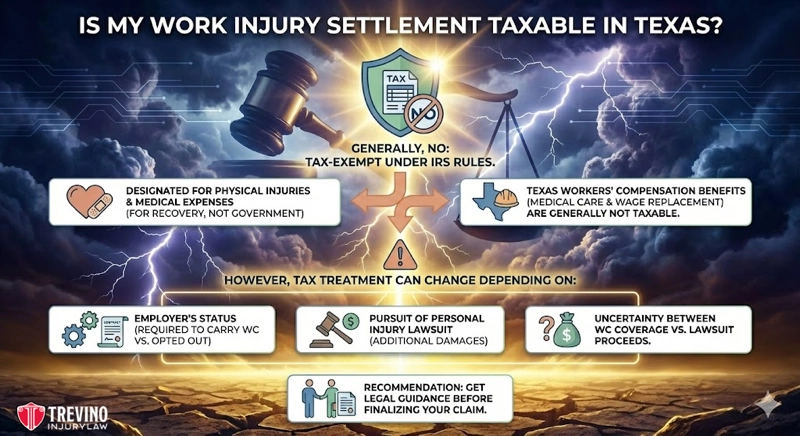
Is My Work Injury Settlement Taxable in Texas?
Generally, no; settlement proceeds designated for physical injuries and medical expenses are tax-exempt under IRS rules, ensuring the money you receive goes directly to your recovery rather than the government.
Under the Texas workers’ compensation system, most benefits paid under a workers’ compensation insurance policy are generally not taxable because they are intended to cover medical care and wage replacement for workers injured on the job.
However, tax treatment can change depending on whether your employer was required to carry workers’ compensation insurance under the Texas Workers’ Compensation Act, whether they chose to opt out of workers’ compensation, and whether you also pursued a personal injury lawsuit or other claim against your employer for additional damages.
If there’s any question about what parts of your Texas workers’ comp recovery are covered by workers’ compensation coverage versus lawsuit proceeds, it’s worth getting legal guidance before finalizing your workers’ comp claim.
Can I Receive Compensation If I Was Fired After the Accident?
Yes, you retain your right to compensation for the injury itself, and you may also have a separate claim for wrongful termination if the firing was retaliation for filing your legitimate injury claim.
In Texas, being fired after you were injured at work does not wipe out your ability to recover compensation benefits for the injury itself. Whether your employer was a subscriber that was required to carry workers’ comp insurance under the Texas Workers’ Compensation Act, or a non-subscriber workplace that chose to opt out of workers’ compensation, Texas allows injured workers to still pursue compensation for work injuries.
In a non-subscriber workplace injury case, non-subscriber employers lose many of the legal defenses available in Texas civil practice, so if the employer was negligent, your work injury attorney may be able to seek a wider range of damages through personal injury law, covering types of compensation you may not get in a workers’ comp claim.
What Happens If You Sign a Waiver?
If you sign a post-accident waiver or accept a “benefit plan” payment that includes release language, you may permanently forfeit your right to sue for full compensation, leaving you with no legal recourse when medical bills pile up later.
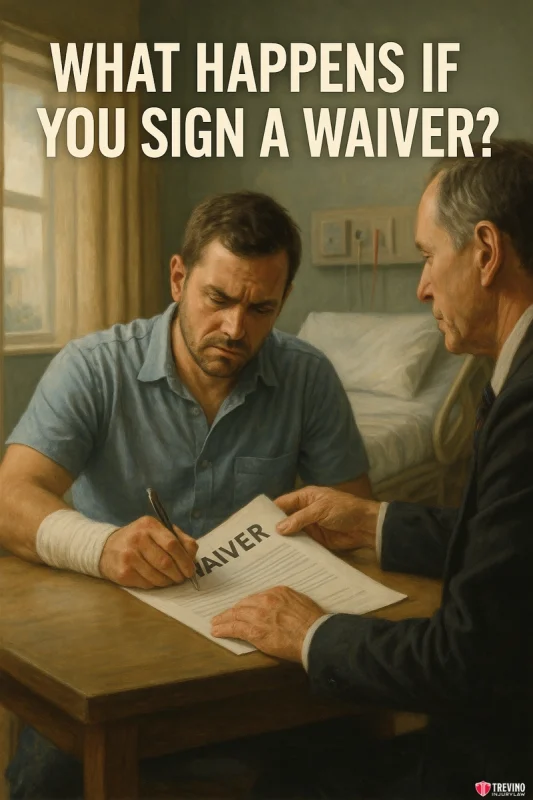
Employers often rush to the hospital or your home in the West Side immediately after an accident, offering quick cash, sometimes as little as $500 or $1,000, in exchange for a signature. This is a trap. That document often contains “release of liability” language that legally blocks you from ever asking for more money, even if you later require major surgery.
Never sign any document from your employer or their insurance representative without first having a qualified attorney review it, as rescinding a waiver is legally difficult and often impossible. Before signing paperwork or responding to post-accident pressure, review the immediate steps after a work accident in San Antonio for practical guidance on reporting, treatment, documentation, and evidence preservation.
When Is It Too Late to Demand More Compensation in Texas?
Once a settlement agreement is signed and notarized, it is almost always too late to reopen the case, even if your medical condition worsens unexpectedly or you discover new injuries that were not diagnosed at the time of signing.
This finality is why we never rush to settle until we are certain of your long-term prognosis. Most settlements are paid as a lump sum, which is a single, one-time payment intended to cover all past and future expenses.
Once you accept that check, the case is closed forever. If you accept $50,000 today but learn next year that you need a $100,000 spinal fusion, you cannot go back to your employer for the difference. We ensure your settlement includes a buffer for these future risks before you sign on the dotted line.
Why Hire a San Antonio Non-Subscriber Work Injury Lawyer?
Texas non-subscriber employers opt out of the state system to protect profits, viewing your life-altering injury as a mere financial liability. While insurance adjusters and high-volume settlement mills rush to close your case for pennies, we force negligent companies to face the reality of your suffering. We do not negotiate from fear; we prepare for war to ensure they pay the true lifetime cost of their negligence.
Want to Protect the Full Value of Your Claim?
You’ve seen how this affects your case — but this is only one piece of the puzzle. Our Work Injury Lawyer page breaks down what a trial-ready firm does differently.
Our aggressive trial strategy secured a $7.9 million verdict for a client with a crushed foot. We are ready to take your case to the Bexar County Courthouse. Contact a San Antonio non-subscriber personal injury claim lawyer immediately to send a spoliation letter and legally preserve evidence of gross negligence.
Call 210-TREVINO (210-873-8466) for a free case review. Se Habla Español. We fight on a strict No-Win, No-Fee basis.