Any injury caused by partial employer negligence qualifies for a non-subscriber lawsuit in Texas, unlocking uncapped damages for catastrophic harm. Traumatic brain injuries, amputations, spinal cord damage, and repetitive stress disorders all meet the threshold when your company fails to provide a safe environment.
The company doctor is already minimizing your trauma as a simple concussion, while defense lawyers prepare to argue that your own recklessness was the sole proximate cause of the accident.
They fight aggressively because the stakes are permanent. According to census data, workplace accidents claimed 564 lives across Texas industries in 2023. Most of those tragedies, along with debilitating occupational illnesses, result from employers ignoring known hazards and failing to provide personal protective equipment.
What Could Your Work Injury Accident Case Be Worth?
Answer a few quick questions about your accident. Takes about 60 seconds.
See What My Case Might Be WorthThe insurance company offered less than $20,000. I ended up with over $1 million. — Jackie Galindo
Evidence of that negligence disappears quickly as employers overwrite video footage from the crash site or job location. A Spoliation Letter, a legal demand that stops the company from destroying proof, must go out immediately before the strict two-year statute of limitations or the thirty-day reporting trap voids your claim entirely.
Trevino Injury Law’s work accident lawyer files these preservation demands on day one, stripping employers of their defenses. Call 210-TREVINO now for a free case review. You pay nothing unless we win. Se Habla Español.
The Core Legal Requirement: Proving Negligence to “Qualify”
Qualifying for a non-subscriber lawsuit in Texas requires proving that your employer was at least 1% responsible for the accident that caused your injury, as these employers lose the legal right to argue that you were partially at fault for your own injuries.
While standard workers’ compensation claims in Texas function on a “no-fault” basis, meaning you get paid even if you caused the accident, non-subscriber claims operate entirely on the concept of fault. This distinction is the single most crucial factor for injured workers in San Antonio.
To “qualify” for a lawsuit, you do not need to prove your employer was 100% to blame; you only need to establish that their negligence contributed to the incident in some capacity.
“Under the binding legal precedent set by Kroger Co. v. Keng, non-subscriber employers are stripped of their right to use common law defenses, specifically ‘contributory negligence.’
In this landmark ruling, the Texas Supreme Court confirmed that if an employer opts out of workers’ compensation, it cannot avoid liability by arguing the employee shared the blame. Consequently, even if you were 99% responsible for the accident and your employer was only 1% negligent, you are legally entitled to recover 100% of your damages.
This low threshold turns what might seem like a simple workplace accident into a viable path for significant compensation.
Examples of Qualifying Negligence
Negligence often manifests as a failure to provide necessary safety equipment, such as protective eyewear or harnesses, leading to preventable injuries on job sites.
In many San Antonio warehouses and construction zones, we see cases where a lack of proper training, such as failing to certify a forklift operator, constitutes actionable negligence when that operator causes a crash. Forklift collisions are among the most common workplace accidents in San Antonio, and most trace back to a preventable safety failure.
Additionally, Texas employers have a non-delegable duty to furnish reasonably safe instrumentalities and a safe place to work. As established in Farley v. M M Cattle Co., this duty is continuous and cannot be handed off to a third party.
Therefore, ignoring wet floors in a medical center or failing to repair broken railings at a manufacturing plant are not just oversights; they are direct violations of the specific duties defined by the Texas Supreme Court, providing clear grounds for a lawsuit.
Establishing this low threshold for negligence creates liability. Still, the financial value of your case ultimately depends on the severity and permanence of the specific injuries you sustained.
High-Value Injuries That Frequently Lead to Lawsuits
High-value injuries that frequently lead to non-subscriber lawsuits include catastrophic events like traumatic brain injuries, amputations, spinal cord damage, and wrongful death, as these cases involve damages that far exceed the caps of standard benefit plans.
While legally, any injury caused by negligence can support a lawsuit, the economic realities of litigation in Bexar County mean that most cases filed involve severe, life-altering harm.
Employers and their arbitration plans often try to settle these claims quickly for pennies on the dollar, offering to pay medical bills while ignoring the lifetime of lost wages and pain and suffering you face.
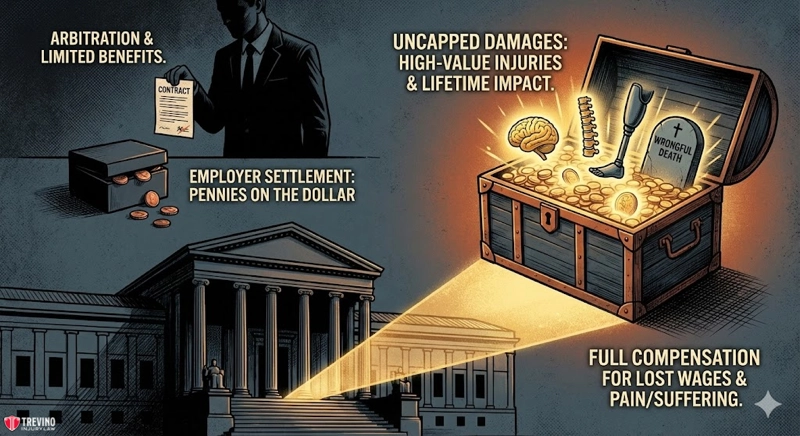
In a non-subscriber lawsuit, however, damages are uncapped. This allows us to pursue full compensation for the total impact of the injury on your life, from the immediate emergency surgery at University Hospital to the decades of lost earning potential you may face. Once a non-subscriber claim is viable, damages available from a Texas non-subscriber employer explains the economic and non-economic categories that may shape the value of the claim.
In the state of Texas, these high-value work-related injuries often become personal injury lawsuits because a non-subscriber system shifts the burden onto the worker.
When an employer is a non-subscriber, meaning they did not subscribe to Texas workers’ compensation or carry workers’ comp insurance, Texas workers are no longer limited to a standard compensation program. They can pursue full damages under the Texas Labor Code if negligence contributed to the injury or illness.
By contrast, when an employer has workers’ compensation insurance, benefits are capped and fault usually doesn’t matter.
That difference is why serious Texas work injuries tied to safety failures are frequently litigated with help from a Texas work injury lawyer, especially when medical costs and long-term losses far exceed what comp insurance would ever cover.
Traumatic Brain Injuries (TBI)
Traumatic Brain Injuries qualify for substantial litigation damages because they often result in cognitive deficits that permanently impair a worker’s ability to hold a job or maintain relationships.
Company doctors frequently minimize these injuries as simple “concussions,” but we utilize neuropsychological evidence to prove the true extent of the damage.
By demonstrating the long-term need for care and the loss of executive function, we establish grounds for a high-value claim that accounts for the injury’s invisible but devastating impact.
Amputations & Crush Injuries
Amputations and crush injuries, common in San Antonio’s construction and industrial sectors, which the U.S. Bureau of Labor Statistics identified as the deadliest industry in Texas with 124 fatalities in 2023, immediately qualify for “disfigurement” and “physical impairment” damages that are largely unavailable in standard workers’ comp plans.
We have successfully litigated these horrific cases to secure justice for workers left permanently disabled. For example, in Mario Trevino Mendoza v. Farmers Best International LLC, we secured a $7.9 million verdict for a worker who suffered a crushed foot, proving that the employer’s negligence justified a recovery six times the settlement offer.
Spinal Cord Injuries
Spinal cord injuries, ranging from herniated discs to paralysis, qualify for extensive damages due to the high cost of surgeries, rehabilitation, and lifetime mobility modifications.
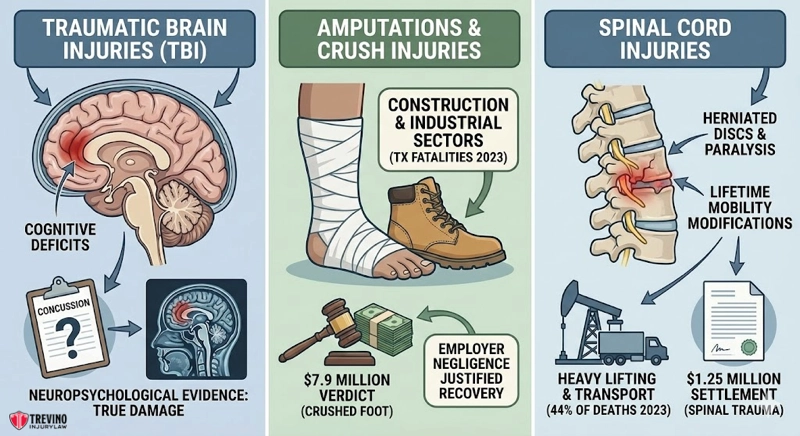
These injuries often occur in heavy lifting incidents or falls, common in the oil field and transport industries, where transportation incidents alone accounted for nearly 44% of all occupational deaths (246 fatalities) in 2023.
In the Jackie Galindo case, we secured a $1.25 million settlement for a client with spinal and shoulder injuries, demonstrating that even without a trial, the threat of a non-subscriber lawsuit forces companies to pay for the full scope of spinal trauma.
Fatalities (Wrongful Death)
When a workplace accident results in a fatality, a tragedy that claimed 564 lives across Texas industries in 2023, according to census data, the surviving family members automatically qualify to sue the non-subscriber employer for wrongful death damages, including loss of consortium and loss of inheritance.
These claims are distinct because they compensate the family for their emotional loss and financial future, not just the deceased worker’s medical bills.
If gross negligence is involved, such as an employer knowingly sending a worker into a lethal environment, we can also pursue punitive damages to punish the company and deter future recklessness.
While catastrophic physical trauma is immediately visible, many workers suffer equally debilitating conditions that develop slowly over time, raising the question of whether cumulative damage also qualifies for litigation.
Can I Sue for “Invisible” or Cumulative Injuries?
Yes, you can sue a non-subscriber employer for “invisible” or cumulative injuries like repetitive stress disorders or occupational illnesses, provided you can present expert medical testimony linking the condition directly to your specific job duties.
Proving these cases is more complex than a sudden accident because the defense will invariably argue that your condition resulted from aging, hobbies, or previous jobs.
However, the “eggshell skull” doctrine in Texas law protects you: even if you had a pre-existing vulnerability, an employer is liable if their negligence aggravated or accelerated your injury.
The challenge lies in distinct documentation. We must establish that the injury occurred within the “course and scope” of your employment in San Antonio, distinguishing it from a general health issue.
Is your employer a non-subscriber in Texas? If they opted out of workers’ compensation coverage, you may have the right to file a personal injury case.
Repetitive Stress Injuries (RSIs)
Repetitive stress injuries, such as carpal tunnel syndrome or chronic back strain from heavy lifting, qualify for lawsuits when we can prove they result from unsafe work ergonomics or a lack of mandated breaks.
These injuries are common among assembly line workers and administrative staff in Bexar County.
To succeed, we rely on ergonomic experts to demonstrate that the employer failed to implement safe lifting protocols or provide necessary support equipment, thereby directly causing cumulative trauma.
Occupational Illnesses
Occupational illnesses caused by chemical exposure, such as silica dust inhalation on construction sites, qualify for litigation if we can prove the employer knew of the hazard and failed to provide personal protective equipment (PPE).
These cases often hinge on demonstrating “gross negligence,” showing that the employer was aware of the extreme risk but chose to ignore safety regulations.
Unlike a broken bone, these injuries may take years to manifest, making the preservation of employment records and safety logs critical to establishing the timeline of exposure.
Understanding which injuries qualify is the first step, but even a valid injury claim can be derailed entirely if you fall into one of the specific legal traps that disqualify you from filing suit.
What “Disqualifies” You From Filing a Lawsuit in Texas?
You may be disqualified from filing a non-subscriber lawsuit if the court determines your own intoxication caused the accident, if your actions were the “sole proximate cause” of the injury due to reckless horseplay, or if you fail to report the incident to your employer within the strict 30-day legal deadline established by Texas labor laws.
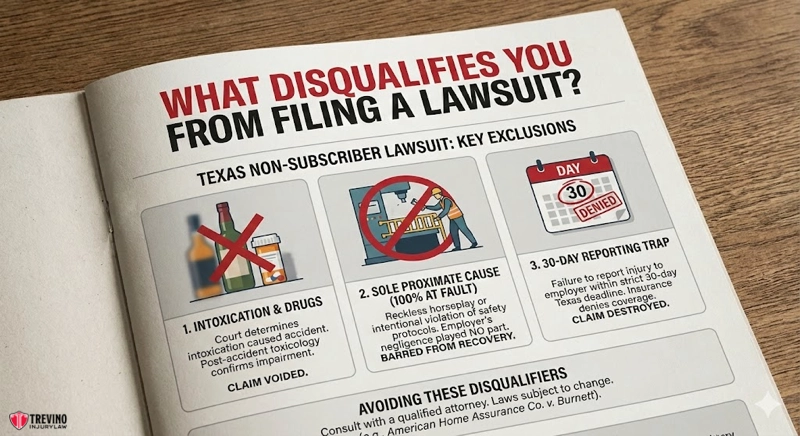
Even in a system designed to favor the injured worker, certain behaviors or procedural failures can completely bar recovery. The most common defense we encounter in South Side industrial hubs is the “Sole Proximate Cause” defense. While non-subscriber employers cannot argue you were partially at fault, they can say you were 100% at fault.
If you were injured while strictly violating safety protocols, such as removing a guard rail for a prank or punching a wall in anger, the court may find that the employer’s negligence played no part in the incident.
Similarly, if post-accident toxicology reports confirm you were under the influence of drugs or alcohol at the time of the crash on I-35 or the job site accident, your claim is automatically voided under Texas law.
The 30-Day Reporting Trap
The most heartbreaking disqualifier is a simple missed deadline. Texas law requires you to report your injury to your employer within 30 days of the accident.
Many workers try to “tough it out,” fearing retaliation or hoping the pain will pass, only to report it on day 31. Insurance companies use this administrative error to deny coverage immediately, citing cases like American Home Assurance Co. v. Burnett to enforce strict notice requirements. Even if your injury is severe and the employer was negligent, failing to create this official paper trail can destroy your ability to seek justice.
Avoiding these disqualifiers keeps your legal options open, but determining whether a lawsuit is the right path requires understanding exactly how a non-subscriber claim differs financially from standard workers’ compensation.
Non-Subscriber vs. Workers’ Comp: Why Qualification Matters
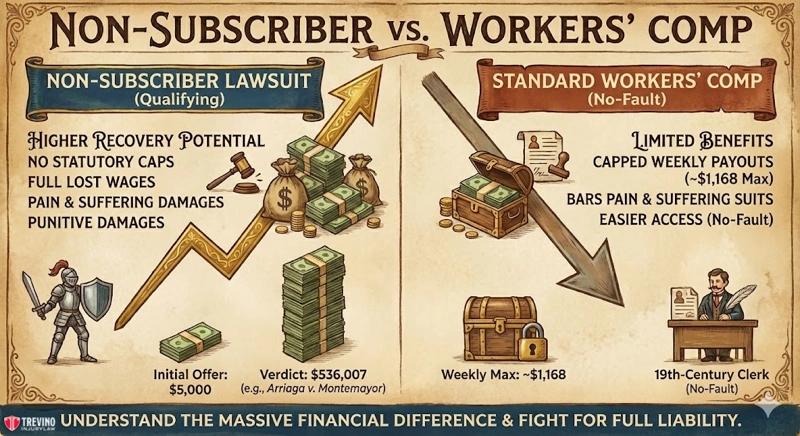
Qualifying for a non-subscriber lawsuit offers significantly higher recovery potential than standard workers’ compensation because it removes the statutory caps on damages, allowing you to sue for full lost wages, pain and suffering, and punitive damages rather than accepting a limited percentage of your paycheck.
While the standard Texas workers’ compensation system provides easier “no-fault” access to benefits, it strictly limits weekly payouts to roughly $1,168. It completely bars you from suing for the physical pain or mental anguish caused by a devastating workplace accident.
In stark contrast, a successful non-subscriber claim in San Antonio can yield results like the Arriaga v. Montemayor case, where we secured a $536,007 verdict over 100 times the initial settlement offer of $5,000, demonstrating the massive financial difference between accepting a quick payout and fighting for full liability.
Once you understand the immense value of these claims compared to standard benefits, you likely have specific questions about whether your personal situation fits the legal criteria for a lawsuit.
Can I Sue My Employer for a Back Injury?
Yes, back injuries are the number one qualifying claim in Texas non-subscriber lawsuits, provided we can prove the injury resulted from negligence, such as lack of training, improper lifting equipment, or forced violations of safety protocols on the job site.
What If I Had a Pre-Existing Condition?
Yes, you can still sue because Texas law applies the “eggshell skull” rule, meaning your employer is fully liable for the aggravation or acceleration of a pre-existing condition if their negligence caused a new injury that worsened your health.
What Counts as a Complicated Injury?
Yes, injuries involving multiple body systems, such as a Traumatic Brain Injury combined with PTSD, qualify as complicated cases that justify higher damage models due to the need for comprehensive life care plans and long-term specialized medical treatment.
Knowing that your injury qualifies is essential, but many victims hesitate to take the next step, wondering whether they can navigate the claims process on their own to save on legal fees.
What If I Don’t Hire a Lawyer for My Non-Subscriber Case?
If you attempt to handle a non-subscriber claim without a trial-ready attorney, you risk falling into the “company doctor” trap, where your injury is downplayed as pre-existing, and you will likely be pressured into signing a waiver that releases your employer from all future liability in exchange for a minimal nuisance settlement.
Non-subscriber employers in San Antonio, particularly in the retail and construction sectors, utilize sophisticated arbitration plans designed to strip you of your rights before you even realize the extent of your damages.
Without a legal advocate to preserve evidence and challenge their liability denials, you face the high probability of receiving zero compensation for long-term care, leaving your family financially vulnerable to the lifetime costs of your injury.
While failing to hire an attorney exposes you to lowball tactics, an even greater risk is failing to take action quickly enough, which can permanently erase your ability to file a claim at all.
What If I Miss the Statute of Limitations to Validate My Claim?
If you fail to validate your claim and file suit within the strict two-year statute of limitations in Texas, or if you wait too long so that critical video evidence at a crash site on Loop 410 is overwritten, your right to seek compensation will expire and cannot be reinstated.
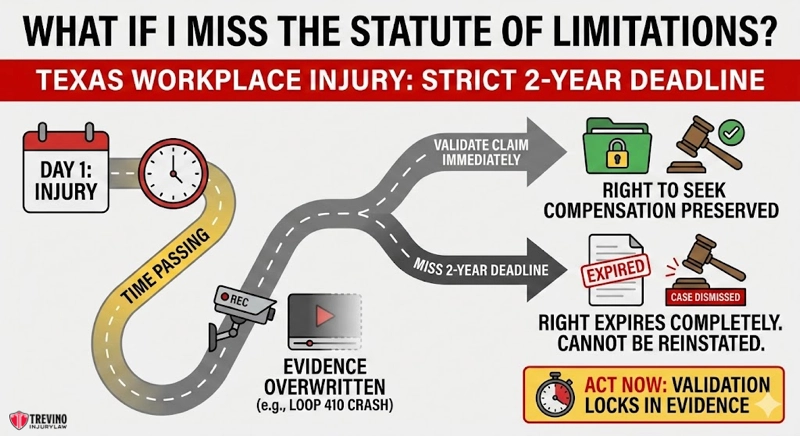
The “discovery rule” rarely saves late filings in workplace injury cases, meaning that once the clock runs out, the courts will dismiss your case regardless of how severe your amputation or spinal injury may be.
Immediate validation is the only way to lock in the evidence of negligence required to win; do not let a calendar date become the reason your family is denied justice.
Why Hire a San Antonio Work Injury Lawyer?
If you wait, critical video evidence from a Loop 410 crash site vanishes, handing a victory to the employer who caused your injury. Non-subscriber companies use liability waivers and complex arbitration to strip your rights, while settlement mills fold early to avoid the fight. We don’t back down; we fight for families and force them to pay.
Want to Protect the Full Value of Your Claim?
You’ve seen how this affects your case — but this is only one piece of the puzzle. Our Work Injury Lawyer page breaks down what a trial-ready firm does differently.
Proving our trial authority in Bexar County courts, we secured a $7.9 million verdict for a crushed foot. To stop employers from destroying facts, you need a San Antonio compensation lawyer who files immediate spoliation letters to lock in evidence.
Call 210-TREVINO for a free case review. Se Habla Español. You pay nothing unless we win—No Win, No Fee