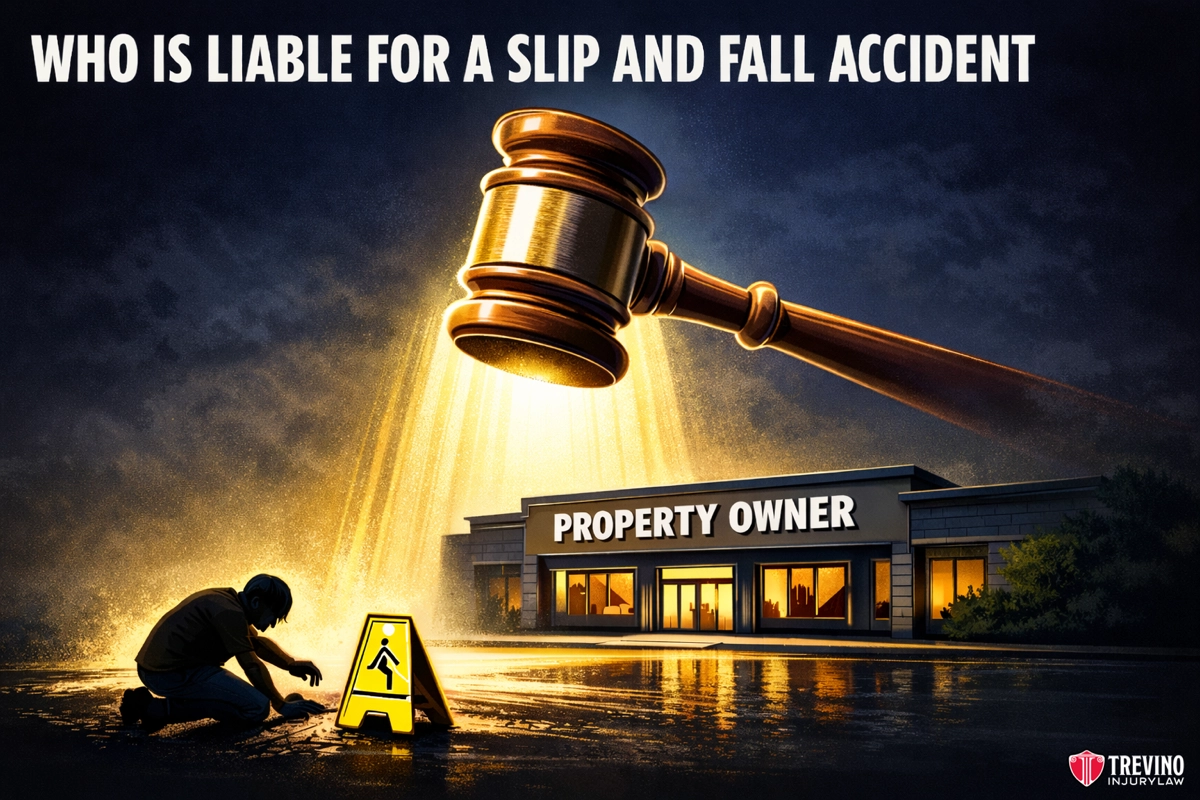
Liability rests with the property owner or commercial tenant holding exclusive control of the hazard that caused your injury. From holding companies at Alamo Ranch to local retailers, the entity that failed to fix the danger pays for the damage.
The corporate defense team is already analyzing surveillance footage frame by frame to downgrade your legal status from a protected invitee to a trespassing licensee. They isolate the exact second you glance away to shift the blame to your distraction, pushing your fault past the threshold where you recover nothing.
What Could Your Slip and Fall Accident Case Be Worth?
Answer a few quick questions about your accident. Takes about 60 seconds.
See What My Case Might Be WorthThe insurance company offered less than $20,000. I ended up with over $1 million. — Jackie Galindo
According to the U.S. Bureau of Labor Statistics’ 2023 Texas Census of Fatal Occupational Injuries, the trade, transportation, and utilities sector recorded 183 fatal injuries. Sweep logs and surveillance footage disappear in the first week. A Spoliation Letter, a legal demand that stops the property owner from destroying evidence, must go out immediately to preserve the truth before your filing window closes.
A Trevino Injury Law San Antonio slip and fall accident lawyer secures internal records on day one and forces negligent corporations to pay full value. Call 210-TREVINO now for a free case review. You pay nothing unless we win. Se Habla Español.
How Does Legal Status Impact Determining Liability for a Slip and Fall Accident?
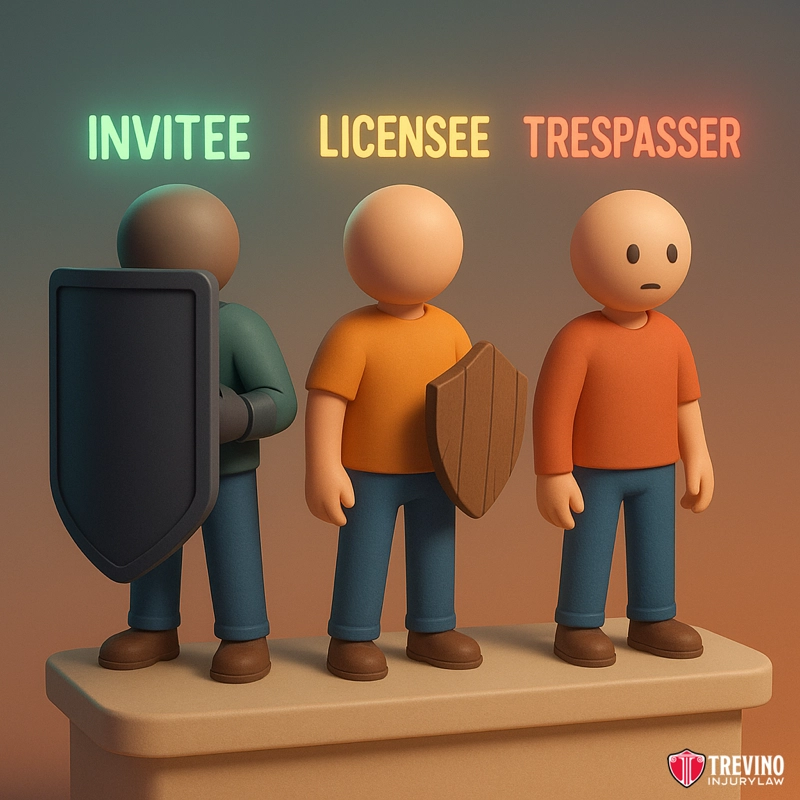
In Texas, the extent of a property owner’s liability is strictly defined by the legal classification of the invitee, Licensee, or Trespasser at the time of the accident. This legal hierarchy determines if they owe a duty of care and the specific “Duty of Care” property owners owe you.
It is not enough to say you were injured on someone else’s property; we must prove why you were there. A shopper at North Star Mall has significantly more legal protection than a person cutting across a vacant lot in Castle Hills.
Defense attorneys know this. Their first tactic is often to argue that you were not an “Invitee” at the time of the fall, thereby reducing their financial obligation. This distinction matters because property owners owe the highest level of responsibility to invitees. This is the highest duty of care, requiring them to actively inspect the premises for hidden hazards rather than ignoring them.
Table: Your Legal Status vs. Property Owner Responsibility
| Your Legal Status | Definition | Example Scenario | Duty of Care Owed |
| Invitee (Highest Protection) | High. The owner must proactively inspect for dangers and fix them (Constructive Notice). | Shopping at H-E-B, Dining at The Pearl, Watching a movie at Santikos. | Medium. The owner must warn of known dangers (Actual Knowledge). |
| Licensee (Medium Protection) | Entering for social purposes or own benefit. | Entering for social purposes or one’s own benefit. | Low. The owner is only liable for “gross negligence” or willful harm. |
| Trespasser (Lowest Protection) | Entering without permission. | Cutting through a closed construction site or private ranch. | A guest at a BBQ in Alamo Heights, a salesperson visiting a home. |
Why Is “Invitee” Status Critical for a San Antonio Slip and Fall Involving Potential Hazards?
“Invitee” is the most protected legal status in Texas. Retail giants often claim their premises are safe, but state data tells a different story. The U.S. Bureau of Labor Statistics’ 2023 Texas Census of Fatal Occupational Injuries (released January 2025) revealed that the ‘Trade, Transportation, and Utilities’ sector saw 183 fatal injuries—the highest of any sector in Texas. If these environments are hazardous enough to kill trained employees, they are certainly dangerous for unsuspecting shoppers.
You fall into this category if you are invited onto the property with the owner’s express or implied permission for a mutual commercial benefit. For invitees, the property owner cannot simply wait for a problem to be reported. They have a Duty to Inspect.
If you slip on a spill at a grocery store that has been there for 45 minutes, the store is liable under the doctrine of Constructive Notice. As established in Texas cases like Wal-Mart Stores, Inc. v. Reece, you must prove the hazard existed long enough that the owner should have discovered it during routine inspections.
This legal standard is why securing “sweep logs” immediately is critical to your case.
The Trap: How You Can Lose Compensation If Injured in a Slip
Insurance adjusters will carefully review surveillance footage to see if they can downgrade your status to “Licensee” or “Trespasser” to avoid paying the claim. This often happens if you exceed the “Scope of Invitation.”
Example: You are an invitee while shopping in a store’s aisles. Your protection as an invitee is limited to the areas of the store open to the public. Under Texas law, a customer can lose their invitee status and be downgraded to a licensee or trespasser if they enter a restricted area, such as an employee stockroom. In Goss, the court found the store owed a lower duty of care because the customer entered a deli cooler area to get a product. We fight this defense by proving the area was accessible, unlocked, or lacked proper ‘Employees Only’ signage.
We anticipate these arguments. By establishing that the area was accessible, unlocked, or lacked proper signage, we fight to maintain your status as an Invitee and hold the corporation to the highest standard of care.
Yes, liability changes significantly for licensees, defined as social guests entering a property for their own benefit or non-commercial purposes, such as attending a private party in Alamo Heights or a salesperson visiting a home.
In these cases, the property owner is only liable for known dangers (actual knowledge) that they failed to warn visitors about, effectively removing the “duty to inspect” from the equation.
If you slip on a loose rug at a friend’s house, you must prove they explicitly knew the rug was dangerous and failed to warn you, a much higher burden of proof than in a commercial setting.
Can You Lose Status If the Owner Claims You Were Negligent in Restricted Areas?
Yes, a customer can lose their protected “invitee” status and become a licensee or trespasser if they exceed the “scope of invitation” by entering areas clearly marked as “Employees Only,” such as stockrooms or commercial kitchens. If you wander into a restricted warehouse area at a store like Costco to find a product and are injured, the court may rule that the owner no longer owed you the duty to inspect that area for safety. Defense attorneys frequently use this argument to deny claims, alleging the victim was in an unauthorized zone where the public was not expected to be.
Determining your legal status establishes the ground rules for the case, but once that is settled, the next challenge is identifying exactly which corporate or individual entity controls the property.
Identifying Liable Parties in Your Slip and Fall Case: Property Owner, Landlord, or Employee?
Identifying the correct defendant often requires analyzing complex commercial lease agreements and employment contracts to determine which entity possessed “exclusive control” of the hazard that caused your injury. Determining if a business owner, property owner, manager, or employee is responsible is crucial.
In many San Antonio commercial districts, the business you see (like a retail store) may not own the building or the parking lot, creating a web of potential defendants that can include property management firms, holding companies, and third-party vendors. Filing suit against the wrong party can lead to a quick dismissal, wasting valuable time while the statute of limitations ticks away.
Beyond the complexity of finding the right company to sue, specific legal doctrines, such as Respondeat Superior, determine when a business is financially responsible for the careless actions of its individual workers.
Is the Store Liable for an Employee’s Negligence?
Yes, under a Texas legal rule called Respondeat Superior.
Simply put, this rule means “the boss answers for the worker.” If an H-E-B employee accidentally hits you with a stocking cart while doing their job, H-E-B is responsible for your serious injuries. You do not have to sue the individual worker; you sue the company that trained and supervised them.
However, corporate lawyers often try to dodge this by claiming the employee was “off the clock” or acting outside their job duties when they hurt you.
Who Is Liable for a Fall Accident in San Antonio Parking Lots and Sidewalks?
Parking lot accidents are complex because ownership is often split. That control analysis changes with the setting, so compare the common slip-and-fall locations in San Antonio where responsibility may involve retailers, landlords, property managers, or public entities.
In massive shopping centers like The Rim or The Forum, the store you visited (like Target or Best Buy) usually does not own the parking lot. The lot is owned by a property holding company or Real Estate Investment Trust (REIT).
- The Store’s Responsibility: Maintaining the entryway and inside aisles.
- The Landlord’s Responsibility: Fixing potholes, lighting, and cracks in the parking lot.
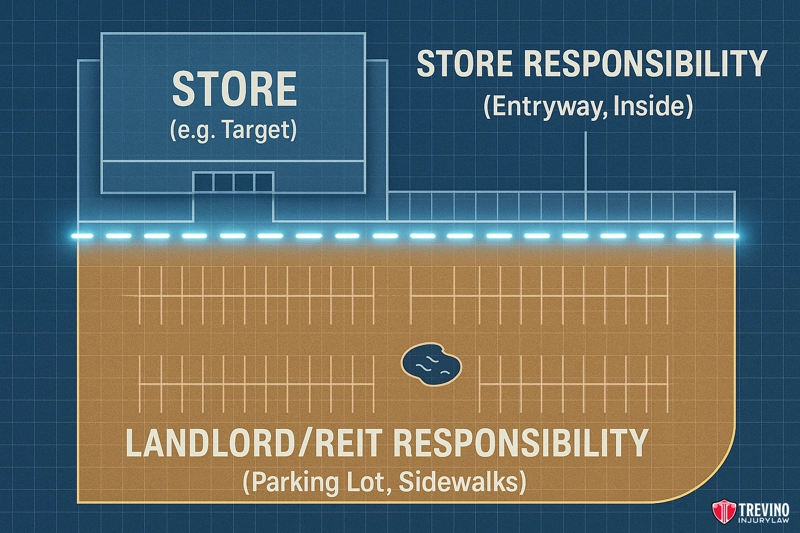
If you trip on a cracked sidewalk outside a store at Alamo Ranch, suing the store directly often leads to dismissal. You must identify and sue the property management company. We know how to pull county deed records to find the right defendant before the statute of limitations expires.
Can You Sue the Cleaning Contractor Who Caused Your Fall on a Wet Floor?
Yes, you can and often must sue an independent cleaning contractor if the store outsourced janitorial services and the contractor’s negligence, such as using excessive wax or failing to place wet floor signs, caused your fall.
Major chains often use third-party services for overnight cleaning to shield themselves from liability, utilizing indemnity clauses that force the contractor to pay for damages. In these complex cases, we often file suit against both the retailer and the cleaning company to ensure all responsible parties are held accountable for your injuries.
Identifying the correct defendant is step one, but even with a clear target, they will fight back by attempting to shift the blame onto you.
Can a Personal Injury Attorney Help You Recover Damages If You Were Partially at Fault?
Yes, but there is a strict limit. Texas follows the ‘Modified Comparative Negligence’ rule under Tex. Civ. Prac. & Rem. Code § 33.001. This is commonly known as the ‘51% Bar.’ You remain eligible for compensation as long as a jury finds you to be 50% or less responsible for the slip and fall.
However, if the insurance defense team can convince a jury that your own negligence (like looking at your phone) contributed 51% or more to the accident, you recover $0.
This legal reality turns your compensation case into a war for percentage points. Fall victims who have suffered damages must prove the at-fault party is primarily responsible. The difference between 50% fault (you get paid) and 51% fault (you get nothing) is the difference between a secure future and financial ruin.
How “Proportionate Responsibility” Affects Lost Income and the Compensation You Deserve
“Proportionate responsibility” is the mathematical formula courts use to reduce your final payout based on your percentage of fault. The jury determines the total value of your damages first, and then the judge applies the math.
Example Scenario: The “Grocery List” Defense
Imagine a jury awards you $100,000 for a back injury after slipping on a grape at a local grocery store. However, the defense argues you were distracted by reading a shopping list.
- Verdict: $100,000 Total Damages
- Jury Finding: Store was 80% at fault | You were 20% at fault.
- The Calculation: $100,000 – 20% ($20,000) = $80,000 Final Award.
The financial stakes of losing that 1% are staggering. Recent liability data indicates that the average hospital cost for a slip and fall injury often ranges between $30,000 and $40,000, with costs for severe fractures or traumatic brain injuries easily exceeding $100,000. If a jury finds you 51% at fault, you recover zero, and you are left to pay that entire bill out of pocket.
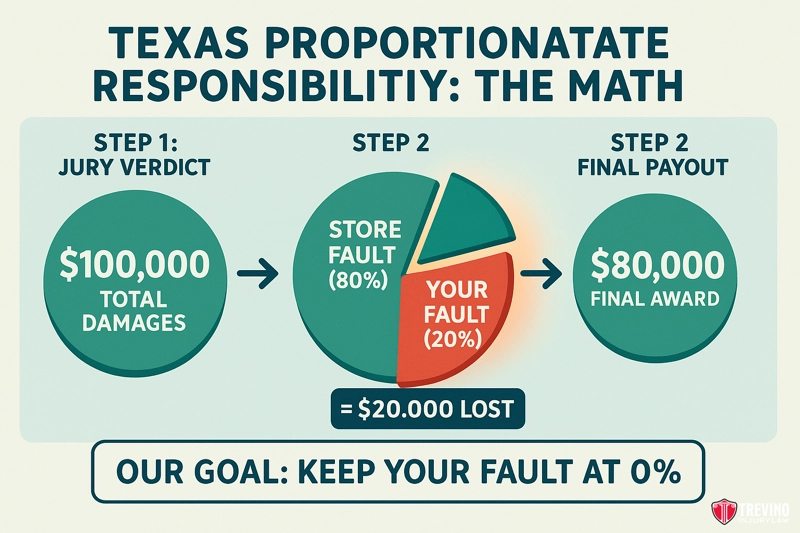
Our job as trial attorneys is to fight for every percentage point to ensure your “share” of the blame remains at 0%, maximizing your final recovery.
How Stores Defend Against Personal Injury Claims in Slip and Falls
Corporate defendants do not rely on guesswork; they use forensic evidence to manufacture a narrative that you were not keeping a “proper lookout.” They will scour every second of data to inflate your fault percentage above that fatal 51% threshold.
Common Defense Tactics Include:
- Surveillance Frame-by-Frame: Isolating a single second where you glanced down at your phone or turned your head to talk to a child right before the fall.
- “Inappropriate Footwear” Arguments: Blaming your flip-flops, high heels, or worn-out sneakers for the fall, rather than their wet floor.
- Social Media Mining: Searching your Facebook or Instagram for posts where you mention being “in a rush,” “clumsy,” or having previous injuries.
- Deposition Traps: Asking leading questions during sworn testimony to get you to admit you “could have seen the puddle if you were looking closer.”
Do not hand them this evidence. Preserving the truth is especially critical for older residents in Bexar County. A 2025 report from the CDC indicates that death rates from falls are rising, reaching 69.9 deaths per 100,000 for adults aged 65 and older. When an elderly family member falls in a business, it is rarely ‘just a bruise’; it is statistically a life-altering event.
To protect your rights, you must seek medical attention immediately, even if your injuries seem minor; symptoms of a concussion or spinal injury often appear days later. If you experience pain, report it.
While at the store, take photos of the scene as thoroughly as possible to preserve the truth. This is why we advise clients to stay off social media and never give a recorded statement to the insurance adjuster without an attorney present.
Can a Slip and Fall Accident Lawyer Help You Sue the City in This Unique Situation?
Suing the City of San Antonio or VIA Metropolitan Transit is vastly different from suing a private company. You are up against Sovereign Immunity, a legal doctrine that generally shields tax-funded entities from lawsuits.
Under the Texas Tort Claims Act (Tex. Civ. Prac. & Rem. Code Ch. 101), the government is immune unless we can prove your injury fits into two narrow exceptions:
- Use of Motor Vehicles: A VIA bus, city trash truck, or police vehicle hit you (legally defined as “Tangible Personal Property“).
- Premises Defects: A dangerous condition on government property—like a broken water meter box on a sidewalk or a collapsed ceiling at the Alamodome, that the City knew about but failed to fix.
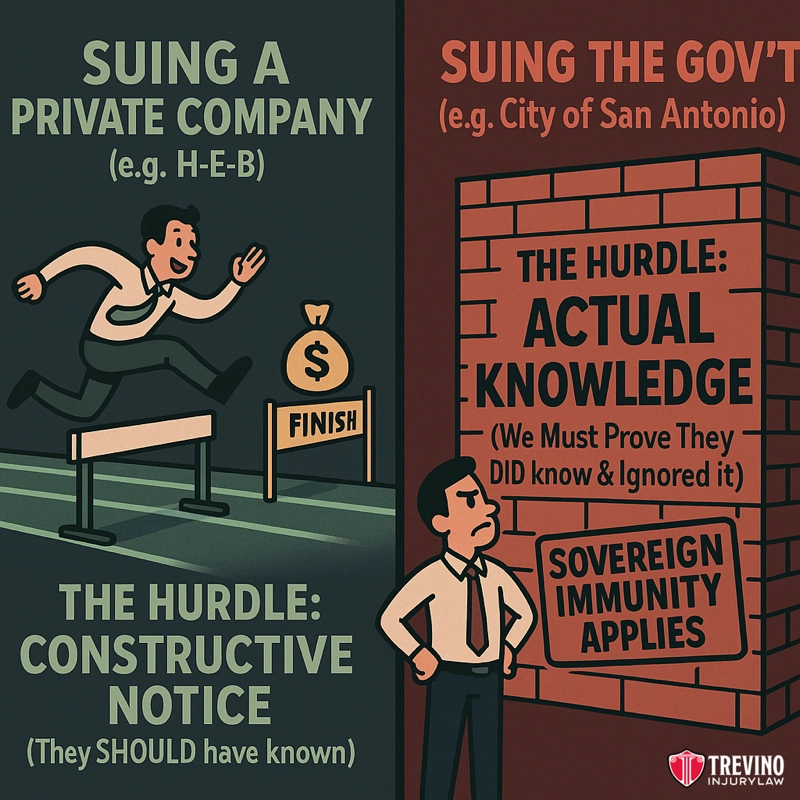
The “Actual Knowledge” Hurdle
In private cases, you only need to prove the owner should have known about a danger. In government cases involving premises defects, however, we must often prove the City had Actual Knowledge (e.g., previous work orders or complaints) and chose to ignore it.
The “Statutory Cap”: Limits on Damage Claims for Medical Bills and Broken Bones
Unlike a lawsuit against H-E-B or Walmart, where verdicts can reach millions, claims against the City of San Antonio are strictly capped by law. No matter how catastrophic your injury, the government’s liability is limited.
Maximum Recoverable Damages (Texas Tort Claims Act):
- $250,000 per person (Bodily Injury)
- $500,000 per single occurrence (Total for all victims involved)
- $100,000 for property damage
Warning: Consider that the lifetime cost of care for a severe spinal injury, common in falls on uneven city pavement, can exceed $1 million. Yet, the Texas Tort Claims Act strictly caps your recovery from the City at $250,000. This cap applies even if your medical bills exceed $1 million. Additionally, the law strictly prohibits punitive damages against the government.
The Statute of Limitations Trap: Why Your Slip and Fall Lawyer Says Act Now
This is where most unrepresented victims lose their case.
While the general Statute of Limitations gives you two years to sue a private defendant, government cases are different. The City of San Antonio Charter strictly mandates that a formal “Notice of Claim” be filed within just 90 days of the accident. If you miss this window, your claim is likely barred forever, regardless of the injury’s severity.
- The Consequence: If you miss this 90-day window, your case is permanently barred. It does not matter how severe your injury is or how negligent the City was.
- The Solution: Do not wait for the police report. Call us immediately so we can file this notice and preserve your right to sue.
Liability Case Basics: We Help You Understand the Difference Between Negligence and Premises Liability
While standard negligence claims focus on a person’s active conduct, premises liability claims focus on a dangerous condition that the owner failed to fix.
This legal distinction is not just a technicality—it determines the evidence we need to win.
- The “Active” Scenario (Easier): If an H-E-B employee accidentally strikes you with a restocking cart while turning a corner, this is Negligent Activity. We simply have to prove the employee was careless. The act itself is the proof.
- The “Premises Liability” Trap (Harder): In contrast, if that same employee leaves a pallet of water in an aisle and you trip over it ten minutes later, Texas law classifies this as a “passive condition.”
This is where the defense tries to trap you. Under Texas law, the mere existence of the hazard does not make the store liable. To win, we must prove the owner had Actual or Constructive Knowledge of the hazard before you fell. If you cannot prove they knew about it, they owe you nothing.
Because these “condition” cases hinge entirely on proof of knowledge, the specific evidence you collect immediately after the accident becomes the only way to establish liability.
Critical Evidence Your Attorney Needs to Pursue Compensation
Liability evidence in a premises liability case must establish a timeline of negligence, proving the property owner knew or should have known of the hazard but failed to remediate it. While medical records validate injuries, securing internal business documents is the only way to establish constructive notice and defeat defense tactics.
Essential Documentation for Proving Fault:
– Sweep Logs: Daily inspection checklists where a time gap of several hours -generally proves the store had constructive notice of the dangerous condition.
– Incident Reports: Internal documents created immediately post-accident that often contain admissions of fault by the manager that are later denied in court.
– Spoliation Letters: A formal legal demand sent immediately to prevent the store from deleting or overriding surveillance video of the fall.
– Footwear Preservation: Retaining the actual shoes worn during the incident is vital to scientifically disprove defense claims that worn treads caused the accident.
Common Scenarios Handled by a Slip and Fall Attorney
Liability varies drastically depending on the specific environment, as different laws govern private rentals, commercial hospitality, and the adequacy of warning signs.
Is a Hotel Liable for a Slip in the Shower?
No, unless the shower lacked mandatory safety features like grab bars required by code or had a known defect like a leaking fixture that the management ignored.
Can I Sue for a Slip and Fall at an Airbnb in San Antonio?
Yes, but these cases are complex. Whether you were staying in a rental in Southtown or a guest house in King William, liability typically falls on the homeowner’s specific short-term rental insurance, not Airbnb itself.
Many standard homeowners’ policies in Bexar County exclude business activity. If the owner didn’t carry the right rider, we may need to pursue assets directly. We know how to navigate these coverage gaps to find the compensation you need.
What If You Cannot identify the Owner Who Failed to Take Reasonable Care?
If the property owner cannot be immediately identified, your attorney must perform a title search and check county tax records before the statute of limitations expires to ensure the correct defendant is named.
In many parts of San Antonio, particularly with vacant lots or commercial strip centers, the recorded owner is often a “shell company” or holding firm designed to shield assets and obscure liability.
Failing to unmask the true owner before the two-year deadline will result in your case being dismissed, leaving you with no recourse.
When Does the “Recreational Use Statute” Block Liability?
The Texas Recreational Use Statute generally shields landowners from liability if they allow the public to use their land for recreation, such as hiking or fishing, without charging a fee.
This law is frequently applied in rural areas of Bexar County or on private land near government parks, effectively blocking most negligence claims unless “gross negligence” is proven.
However, this immunity typically evaporates if the landowner charged an entry fee or if the property was not being used for recreational purposes at the time of the injury.
Why Hire a San Antonio Slip and Fall Lawyer?
While statutes may shield rural landowners, commercial defendants in San Antonio hide behind the “51% Bar” and shell companies to deny your claim. Insurance adjusters and settlement mills want you to accept a lowball offer, hoping you never find the internal sweep logs that prove their negligence.
Want to Protect the Full Value of Your Claim?
You’ve seen how this affects your case — but this is only one piece of the puzzle. Our Slip and Fall Lawyer page breaks down what a trial-ready firm does differently.
We do not let them hide. Trevino Injury Law fights for families, exposing corporate tactics and forcing them to pay full value. You need the best personal injury accident lawyer to send immediate spoliation letters and preserve internal sweep logs before the defense destroys them.
Call 210-TREVINO for a free case review. Se Habla Español. You pay nothing unless we win, No Win, No Fee.