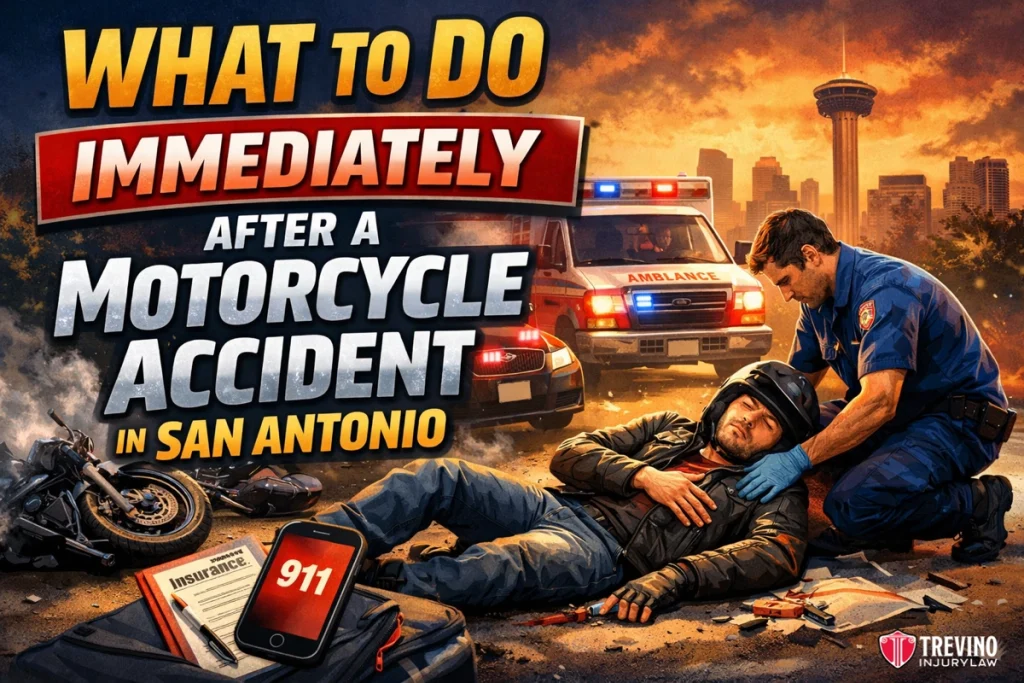
The impact throws you onto the asphalt of Culebra Road, and before the road rash even scabs over, the fight for your financial survival begins. The evidence you collect at the crash scene is the foundation of your winning case.
The insurance adjuster calling your phone sounds accommodating, but they are systematically using a recorded-statement trap designed to make you apologize, downplay your injuries, or admit you were speeding during a lane change. According to the Texas Department of Transportation, fifty-five-year-old riders alone reported 28 possible injuries in 2023. Behind most of these crashes was a distracted driver who failed to yield the right of way. That is not an unavoidable accident; that is negligence.
What Could Your Motorcycle Accident Case Be Worth?
Answer a few quick questions about your accident. Takes about 60 seconds.
See What My Case Might Be WorthThe insurance company offered less than $20,000. I ended up with over $1 million. — Jackie Galindo
Critical proof disappears rapidly. A Spoliation Letter, a legal demand that prevents the property owner from destroying evidence, must be issued immediately to preserve surveillance footage from the nearby intersection and dashcam recordings. Texas gives you two years to file a lawsuit, but your strategic leverage vanishes in weeks.
Trevino Injury Law, motorcycle accident lawyers, force the insurance company to face a trial-ready opponent from day one. Call 210-TREVINO for a free case review. You pay nothing unless we win. Se Habla Español.
What Are the First Steps to Take at a Motorcycle Accident Scene?
A motorcycle accident can be sudden and overwhelming, leaving you unsure of what to do in the critical moments following. Knowing the proper steps to take at the scene can help protect your safety and ensure emergency responders arrive quickly. Here’s what to do immediately after a motorcycle crash.
Ensure safety by moving yourself and your motorcycle out of traffic if possible. Your priority is to prevent further harm. Move to a safe location, such as the shoulder of the road, and turn on hazard lights to alert other drivers. Do not remove your helmet or protective gear until medical personnel arrive, as this could worsen hidden injuries. Take a moment to steady yourself and check on others involved while waiting for help.
Call 911 as soon as you’re in a safe position. Reporting the crash immediately ensures that police, EMS, and, if needed, fire personnel can respond promptly. Even if the accident appears minor, emergency responders are trained to assess injuries and secure the area to prevent secondary collisions. When speaking to the dispatcher, remain calm, give your exact location, and mention that a motorcycle is involved so they can send appropriate assistance.
Document the scene only if it’s safe and you are physically able. Take photos of vehicle positions, damage, and road conditions once you’ve contacted emergency services. On busy highways such as I-35 or Loop 410, prioritize getting to safety before doing anything else. When first responders arrive, cooperate fully and let them take over the scene. Always accept medical attention, even if you think you’re uninjured; shock can mask symptoms of serious harm. For more detail on the medical-care decision after leaving the scene, review whether to go to the hospital after a San Antonio motorcycle accident.
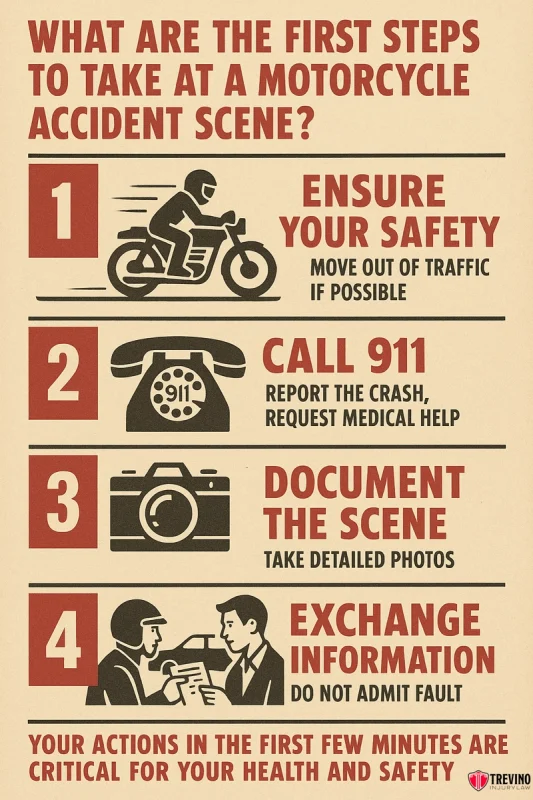
Seek medical evaluation immediately after leaving the scene. Some injuries, such as concussions, internal bleeding, or soft-tissue damage, might not show symptoms right away. Allow paramedics to examine you and, if recommended, go to a nearby hospital such as University Health System or Brooke Army Medical Center (BAMC) for a complete evaluation. This step protects your health and ensures your injuries are correctly identified and treated.
According to 2023 data from the Texas Department of Transportation (TxDOT), riders in their 50s and 60s are among the most frequently injured in motorcycle crashes. For instance, motorcyclists aged 55 reported 28 possible injuries, while those aged 52 and 59 each recorded over 18 incidents, regardless of helmet use. These figures underscore the importance of prompt medical evaluation and thorough documentation after any motorcycle accident.
Following these initial safety and documentation steps is crucial for establishing the official event record, which begins with the police report.
A Trial-Ready Checklist: 10 Steps to Preserve Evidence
We don’t just prepare settlement cases; we build them to win before a jury. The evidence you collect at the motorcycle crash scene is the foundation of that winning case.
Photos of skid marks on a notoriously dangerous road like Culebra Rd, the exact position of your bike, and the damage to the other vehicle can later be used by accident reconstruction experts to prove exactly how the collision happened. Securing this proof immediately is critical because the Texas Supreme Court established in the landmark case Brookshire Bros., Ltd. v. Aldridge, 438 S.W.3d 9 (Tex. 2014), that severe legal remedies for lost or destroyed evidence—known as spoliation—are only available if we can prove the property owner or at-fault driver had a duty to preserve the evidence and breached that duty. Our immediate investigation locks down this evidence before the defense can make it disappear.
Follow these steps to gather trial-ready evidence:
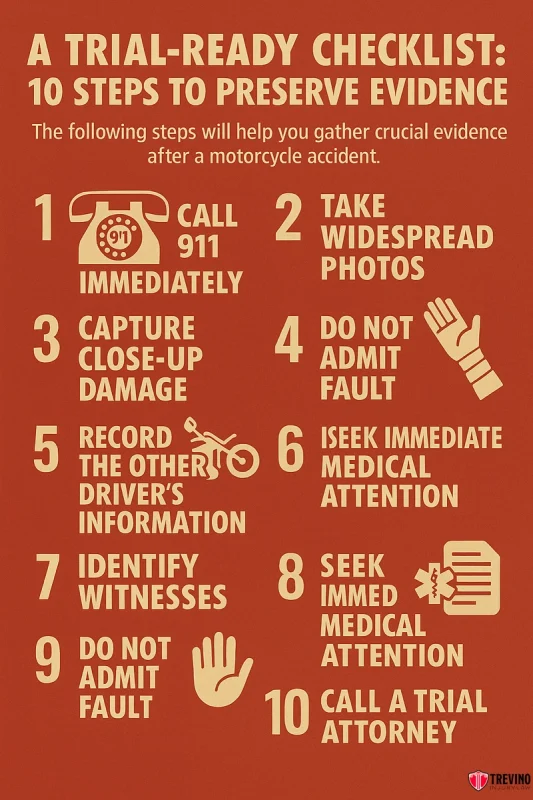
- Call 911 immediately. An official police report provides critical details, including the time, location, parties involved, and the officer’s initial observations about the crash.
- Take comprehensive photos: Before anything is moved, capture the entire scene from multiple angles, including traffic lights, skid marks, road conditions, and nearby landmarks.
- Capture close-up damage: Photograph the damage to your motorcycle, the other vehicle, and any of your protective gear, such as your helmet or jacket, to show the force of the collision.
- Document your injuries: Take photos of any visible injuries, such as bruises, cuts, or road rash, both at the scene and throughout your recovery, to illustrate the full extent of your harm.
- Record the other driver’s information: Get clear photos of the other driver’s license, insurance card, and license plate to ensure their information is accurate and complete.
- Seek immediate medical attention: If you feel well, visit an emergency room or urgent care. Some injuries, like internal bleeding or concussions, may not show symptoms immediately.
- Identify witnesses: Ask anyone who saw the accident for their name and contact information. Neutral witnesses can help confirm how the crash occurred.
- Note the details: Make a voice note or jot down what you remember about the crash, including weather conditions, road layout, and anything the other driver said, while the details remain fresh.
- Do not admit fault: Avoid saying anything that could be seen as admitting blame, such as “I’m sorry.” Stick to factual statements when speaking to others at the scene.
- Call a trial attorney: Contact an experienced motorcycle accident lawyer immediately. A trial-ready attorney can secure critical evidence and begin building your case immediately.
While gathering this evidence is vital, understanding the common mistakes that can undermine your efforts is just as important.
What are the Most Critical Mistakes to Avoid After a Crash?
After a San Antonio bike collision, insurance adjusters will look for any reason to deny your claim or pay you less than you deserve. They are trained professionals who know how to use your words and actions against you.
Companies like USAA and Progressive handle thousands of claims and have playbooks to minimize payouts. Avoiding these common but critical mistakes is essential to protecting your rights:

Apologizing or Admitting Fault: Never admit fault to the other driver, witnesses, or police. State the facts as you know them. An apology can be twisted into an admission of guilt.
Providing a Recorded Statement: The other driver’s insurance company will request one. You are not legally required to provide one; you should never do so without your attorney present. They will use it to find inconsistencies in your story.
Delaying Medical Treatment: Waiting days or weeks to see a doctor allows the insurance company to argue that your injuries were not caused by the wreck or are not as severe as you claim.
Posting on Social Media: Do not post anything about your accident, injuries, or recovery on social media. Insurance investigators will find it and use photos or even innocent comments to suggest you are not truly injured.
Accepting the First Offer: The first settlement offer is almost always a lowball amount, made quickly before you know the full extent of your injuries and future medical needs. It is a tactic to make the claim go away cheaply.
How Do You Prove Who Was at Fault for a Motorcycle Crash in San Antonio?
To prove fault in a San Antonio motorcycle accident, your attorney must use evidence such as the police report, witness statements, traffic camera footage, and expert testimony to establish that the other party’s negligence, like a driver making an unsafe left turn on Bandera Rd, directly caused your injuries and damages.
In Texas, personal injury law is based on the concept of negligence. This means we must show that the at-fault driver had a duty to operate their vehicle safely, that they breached that duty through careless or reckless conduct, and that breach was the direct cause of your wreck and resulting harm.
Our investigation into a serious motorcycle crash begins immediately. We dispatch investigators to the scene, file Freedom of Information Act (FOIA) requests for traffic camera footage from intersections such as the chaotic “Mixing Bowl,” and identify and interview every potential witness.
For crashes in Bexar County involving commercial vehicles, which are common along the busy I-35 trade corridor, we dig into the trucking company’s logs, driver records, and vehicle maintenance history to find evidence of violations of federal safety regulations. Proving fault is not about what you think happened; it’s about what we can prove with undeniable proof.
Proving a driver’s individual negligence is the most common path to compensation, but sometimes, their employer or even a vehicle manufacturer shares the blame.
Proving Negligence in Common “Left-Turn” and “Lane-Change” Accidents
Some of the most devastating motorcycle collisions in San Antonio happen when a car driver fails to see a rider and makes a sudden left turn or an unsafe lane change. These “failure to yield right-of-way” cases often result from driver inattention. The defense will almost always claim, “I never saw him,” or argue that the motorcyclist was speeding. Our job is to dismantle that defense with facts.
We use evidence such as the point of impact on the vehicles, the location of debris on the road, and witness testimony to reconstruct the moments leading up to the crash and prove that the driver had a clear opportunity to see our client and simply failed to look.
In many cases, we can show that the driver’s view was unobstructed and their actions clearly violated Texas traffic law.
How Much is a San Antonio Motorcycle Accident Claim Worth?
The value of a San Antonio motorcycle accident claim is calculated by combining all economic damages (like medical bills and lost wages) and non-economic damages (like pain and suffering), with the final amount heavily influenced by the severity of your injuries and the strength of the evidence proving the other party’s fault.
There is no “average” settlement, and you should be wary of any online calculator that claims to tell you your case’s worth. The actual value depends entirely on the unique facts of your wreck. A minor crash with treatable road rash will be worth far less than a collision resulting in a permanent spinal injury requiring lifelong care.
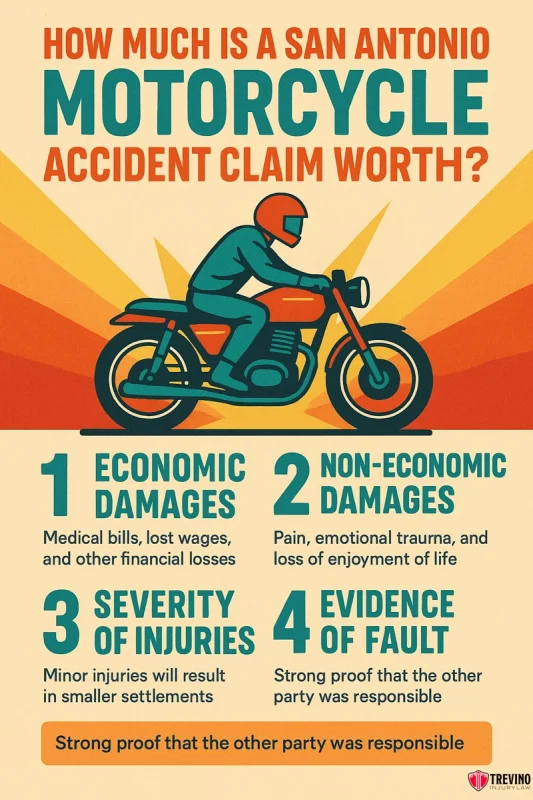
We work with you, your doctors, and financial experts to document every loss. This includes all future medical expenses, from the initial ambulance ride and ER visit at a facility such as Methodist Healthcare System to surgeries, rehabilitation, and in-home care.
We also calculate all lost income and any impact on your future earning capacity. Finally, we fight to place a full and fair value on your non-economic damages, the physical pain, emotional trauma, and diminished quality of life that a serious bike collision causes.
Calculating these damages is a critical step, and seeing how these calculations translate into real-world results for our clients provides the clearest picture of what is possible.
How Our Trial Approach Secured Maximum Compensation for the Accident Victims
This focus on preparing every case for trial produces real results for our clients. In one case, an insurance company offered our client, Jackie Galindo, less than $20,000 for her injuries from a motor vehicle wreck. We took them on and prepared for court, ultimately securing a $1.25 million settlement. Similarly, we refused to back down when Jose Arriaga was offered just $5,000 for his injuries. We went to trial and won a $536,007 jury verdict, over 100 times their offer. These results show that we fight for the full value you deserve, and our willingness to go to trial makes all the difference.
These successful outcomes are not accidents; they are the direct result of a legal strategy that insurance companies recognize and respect, an approach fundamentally different from that of high-volume settlement firms.
Why is a Trial-Ready Law Firm Your Best Advantage After a Motorcycle Wreck?
A trial-ready law firm is your best advantage because insurance companies like Allstate or State Farm are far more likely to offer a maximum settlement to avoid the risk and expense of facing a proven litigator in a Bexar County courtroom who has a history of winning substantial jury verdicts.
Many personal injury firms you see on billboards operate on a “settlement mill” business model. They aim to sign up a high volume of cases and settle them as quickly as possible for whatever the insurance company is willing to pay. This approach leaves money on the table.
Our philosophy is the opposite. We prepare every single motorcycle crash case as if it were going to trial. From day one, we gather the evidence a jury needs to see. This includes immediately filing FOIA requests for police body cam and dashcam footage and preserving all evidence in a format that is admissible in court, steps many high-volume firms skip because they take time.
This meticulous, trial-first preparation is our greatest leverage in negotiations. The insurance companies know we are not bluffing and that we win.
This fundamental difference in strategy directly affects how insurance companies handle your claim from the first phone call.
How Insurance Companies Treat Claims from Trial-Proven Attorneys
Insurance adjusters are risk managers. When evaluating a claim, they consider the law firm representing the injured victim. If they see a firm that rarely, if ever, goes to court, they know they can make a lowball offer with little risk. They know the firm will likely pressure their client into accepting it to avoid a fight.
When they see Trevino Injury Law, their calculation changes; they see a firm that has taken more than 80 personal injury cases to trial and has a public record of winning significant verdicts for our clients. They know a lowball offer will be rejected and that we are fully prepared to take them to court and win. This proven willingness to go to trial forces them to negotiate fairly and often results in maximum settlement offers to avoid facing us at trial.
Knowing the right steps after a motorcycle accident can make all the difference. From seeking medical attention to dealing with insurance and legal representation, our skilled San Antonio motorcycle accident attorneys are here to help you navigate the process and secure your recovery.
What Are the Most Common Causes of Motorcycle Accidents on San Antonio Roads?
The most common causes of motorcycle accidents on San Antonio roads are distracted driving, drivers failing to yield the right-of-way at intersections, unsafe lane changes on highways such as I-10 and Loop 410, and following too closely, all of which constitute negligence under the Texas Transportation Code.
While motorcyclists are often unfairly stereotyped as reckless, the vast majority of collisions are caused by other drivers who fail to see motorcycles or respect their right to be on the road.
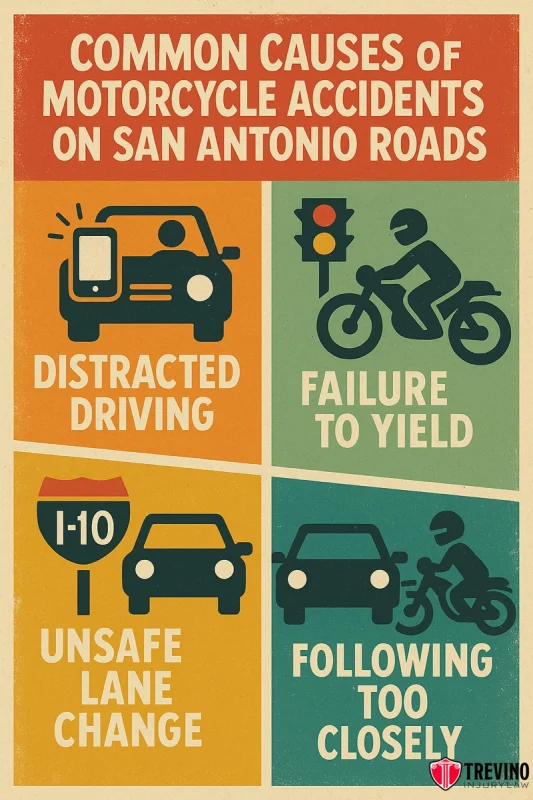
Our experience litigating cases in Bexar County shows that certain areas are particularly dangerous. We see many crashes on congested corridors such as Culebra Rd, San Antonio’s deadliest non-freeway road, and Bandera Rd, where heavy traffic poses constant risks.
The high speeds and frequent lane changes on major highways such as Loop 1604 and I-10 also result in a disproportionate number of severe motorcycle collisions. Understanding these patterns of negligence helps us build stronger cases by showing that the at-fault driver’s actions were not merely a mistake but a failure to exercise reasonable care in a known high-risk area.
Understanding these common causes helps you recognize negligence, which brings us to the single most pressing question many injured riders have.
What is the Average Settlement for a Motorcycle Accident in Texas?
While there is no official “average” settlement for a motorcycle accident in Texas, the value is determined by your specific medical costs, lost income, property damage, and the severity of your pain and suffering. Serious injury cases often result in six or seven-figure recoveries when handled by an experienced trial attorney.
Many factors influence the final value, making each case unique. The goal is never to hit an “average” number but to secure the maximum compensation your specific case warrants.
Our legal team focuses on building a comprehensive case that accounts for every dollar you have lost and will lose in the future as a result of the wreck. We have a proven record of securing substantial outcomes for our clients precisely because we don’t aim for an average result; we prepare to prove the full, catastrophic impact of the crash to a jury.
This detailed approach ensures that when we negotiate with the insurance company, we are arguing from a position of undeniable strength, backed by evidence.
Calculating this potential value is complex and depends on following the correct legal procedures from the very beginning.
How Do You File a Motorcycle Accident Claim in Texas?
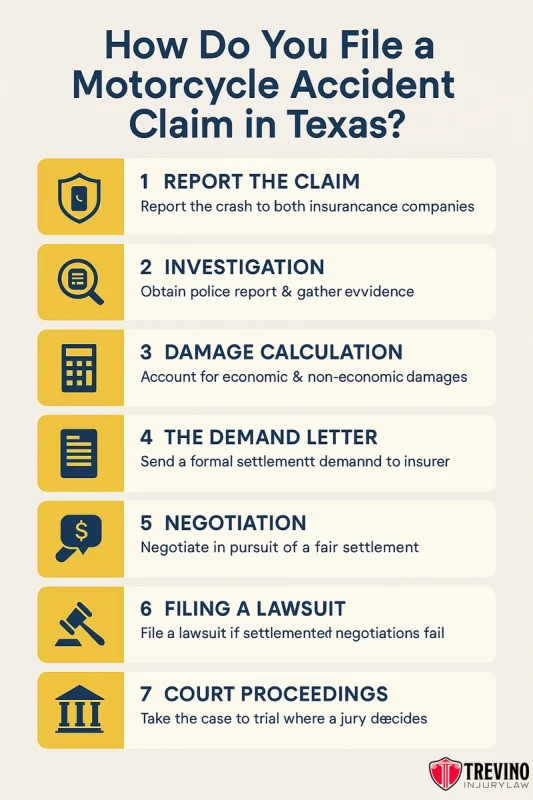
Filing a motorcycle accident claim in Texas involves notifying all relevant insurance companies of the loss, gathering all necessary evidence like the police report and medical records, submitting a formal demand letter detailing your damages, and negotiating a full and fair settlement.
This process can be complex and is fraught with pitfalls, where an unrepresented person may make critical errors that harm their case. Having an experienced attorney manage this process ensures every step is handled correctly and strategically from the start.
Here is a general overview of the claims process:
Report the Claim: The first step is to report the motorcycle wreck to the at-fault driver’s insurance company and your own. Provide the basic facts of the accident, but do not give a recorded statement or admit any fault.
Investigation and Evidence Gathering: Your legal team will launch a comprehensive investigation. This includes obtaining the official police report, interviewing witnesses, securing any available video footage, and gathering all your medical records and bills to document the extent of your injuries.
Damage Calculation: Once you have completed your initial medical treatment, your attorney will calculate the full value of your claim. This includes all economic damages (medical bills and lost wages) and a carefully calculated figure for non-economic damages (pain and suffering).
The Demand Letter: Your San Antonio attorney will draft and send a formal demand letter to the insurance company. This legal document outlines the facts of the case, establishes the other driver’s liability, details your injuries and damages, and demands a specific settlement amount.
Negotiation: The insurance adjuster will respond to the demand, usually with a much lower counteroffer. This begins a period of negotiation in which your attorney will argue your case, using the evidence to press the insurer toward a fair settlement.
Filing a Lawsuit: If the insurance company refuses to offer a fair settlement, your attorney will file a personal injury lawsuit. This does not mean your case will go to trial; most cases still settle before trial, but it shows the insurance company you are serious about recovering the full amount you are owed.
Court Proceedings: If settlement negotiations fail, your case may move to court, where a judge or jury will determine liability and damages. During trial, your attorney will present evidence, expert testimony, and witness statements to prove the other party’s negligence and the full extent of your losses.
While trials can take longer than settlements, they can also provide more substantial compensation if your case is well-prepared and supported by strong evidence.This formal process involves many critical decision points, raising several key questions along the way.
Do I Need a Lawyer in San Antonio for a Minor Motorcycle Accident?
Yes, you should always consult a lawyer even for a minor motorcycle accident because seemingly small injuries can develop into serious conditions later, and insurance companies often try to undervalue or deny claims that seem minor at first. Adrenaline can mask symptoms of significant injuries like concussions or soft tissue damage.
By the time you realize the injury is serious, the insurer may have already closed your claim for a pittance. A free consultation with an attorney costs you nothing and protects your right to future compensation.
Should I Give a Recorded Statement to the Adjuster?
No, you should never give a recorded statement to the at-fault driver’s insurance adjuster without your attorney present, as they are trained to ask questions designed to get you to admit partial fault or downplay your injuries, which can be used against you later.
Adjusters are not on your side; their job is to save their company money. They can take an innocent comment out of context to argue you were responsible for the crash. Let your lawyer handle all communications with the other driver’s insurer.
Can I Be Blamed for the Accident if I Wasn’t Wearing a Helmet?
No. In Texas, you generally cannot be held liable for causing an accident solely for not wearing a helmet, although the defense may argue it worsened your injuries. However, an experienced attorney can argue that the driver’s negligence was the true cause.
Texas law only requires helmets for riders under 21 (with some exceptions). The other driver’s failure to yield or to see you caused the crash. We work to keep the focus on the at-fault driver’s actions, not on your choice of safety gear.
How the Two-Year Deadline Impacts Your Actions Today
In Texas, the law gives you 2 years from the date of a motorcycle accident to file a lawsuit, a deadline known as the statute of limitations. But thinking of this as a long timeline is a mistake insurance companies count on. This isn’t just a legal deadline; it’s a tactical weapon they use against you from the moment the crash happens.
Every day you wait, they actively work to run out the clock. Their goal is to delay, to request endless paperwork, and to make settlement offers so low and so late that you feel pressured to accept whatever you can get before your rights expire completely. If you miss this two-year window, the courthouse doors close forever, no matter how clear the other driver’s fault was.
We see this deadline differently: as the starting pistol for building a trial-ready case. The clock is ticking for both sides. While they use time to weaken your claim, we use it to gather the crucial evidence that disappears within days or weeks. Your decision to act immediately is the first and most critical step in controlling the timeline.
The First 72 Hours: The Cost of Facing the Insurance Adjuster Alone
If you don’t hire a lawyer immediately, you will face the other driver’s insurance adjuster alone, usually within the first 72 hours of the crash. These adjusters are highly trained professionals whose only job is to protect their company’s profits by paying you as little as possible. They are not on your side.
Here is what happens in those first few days without representation:
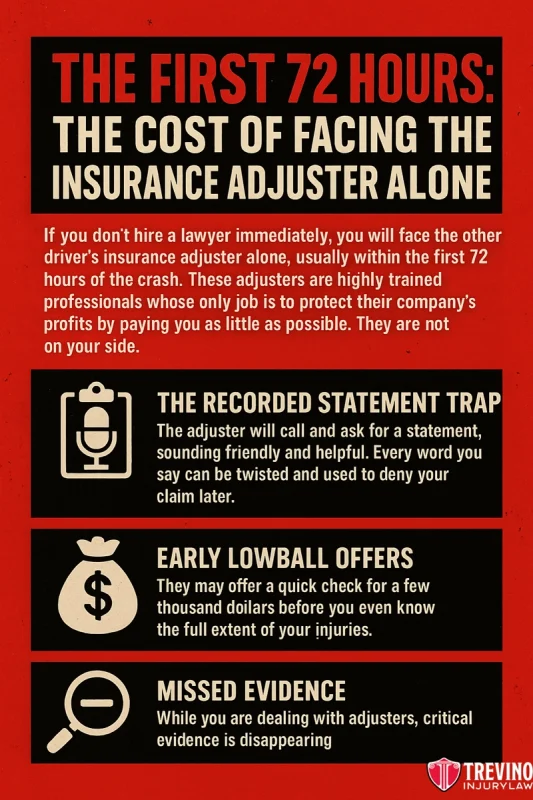
- The Recorded Statement Trap: The adjuster will call, ask for a recorded statement, and sound friendly and helpful. They are trained to ask leading questions designed to get you to downplay your injuries (“So you were able to walk around at the scene?”) or admit partial fault (“Were you going a little fast?”). Every word you say can be twisted and used to deny your claim later.
- Early Lowball Offers: They may offer a quick check for a few thousand dollars before you even know the full extent of your injuries. This offer is a tactic to pressure you into signing away your rights for a fraction of your claim’s true value.
- Missed Evidence: While you are dealing with adjusters, critical evidence is disappearing. We immediately send formal requests to preserve surveillance footage from businesses near the crash scene, obtain police body-cam video, and secure witness statements, steps that are often impossible to take weeks later.
Hiring an experienced trial attorney instantly levels the playing field. We take over all communication, stop the adjuster’s tactics, and begin our own investigation to build your case for trial. This sends a clear message: your claim will be taken seriously.
Your Case Is Disappearing: Why Waiting Weeks Can Be as Damaging as Waiting Years
While the legal deadline to file a claim is two years, the evidence needed to win your case has a much shorter lifespan. The proof you need begins to vanish when your accident scene is cleared on a San Antonio road like Culebra Rd or Loop 1604. Waiting is not a neutral act; it actively harms your ability to recover maximum compensation.
Think of it as a timeline of disappearing evidence:

- Within hours, the crash scene is cleared. The exact position of your bike, the skid marks, and the debris field, all critical for accident reconstruction, are gone forever. Witness memories, which are sharpest right after the event, begin to fade.
- Within Days: Nearby businesses and traffic cameras overwrite their surveillance footage, often within 24-72 hours. This footage could have been the undisputed proof of the other driver’s negligence.
- Within Weeks: Gaps in your medical treatment can give the insurance company an excuse to argue your injuries aren’t as severe as you claim or weren’t caused by the crash. The other driver has had weeks to straighten out their story with their insurer.
It is officially too late to get help after two years. But in practical terms, it is too late to build the strongest possible case once critical, time-sensitive evidence is lost forever. The most important call you can make is the one you make immediately, so we can deploy our investigators and preserve the evidence needed to win your case in court.
Why Hire a San Antonio Motorcycle Accident Lawyer?
Following that step-by-step process after a San Antonio motorcycle accident is critical because insurance adjusters immediately build cases against you. Corporate giants and high-volume settlement mills want you to fold for pennies. We do not fold. Trevino Injury Law takes a trial-first approach. We fight for families, and we force them to pay.
Want to Protect the Full Value of Your Claim?
You’ve seen how this affects your case — but this is only one piece of the puzzle. Our Motorcycle Accident Lawyer page breaks down what a trial-ready firm does differently.
When adjusters issue lowball offers, we take them to the Bexar County Courthouse, where we recently secured a 107x verdict over an initial offer. To secure evidence, your San Antonio motorcycle accident lawyer will immediately issue spoliation letters to preserve dashcam footage.
Call 210-TREVINO for a free case review. Se Habla Español. We promise a No-Win, No-Fee guarantee.